
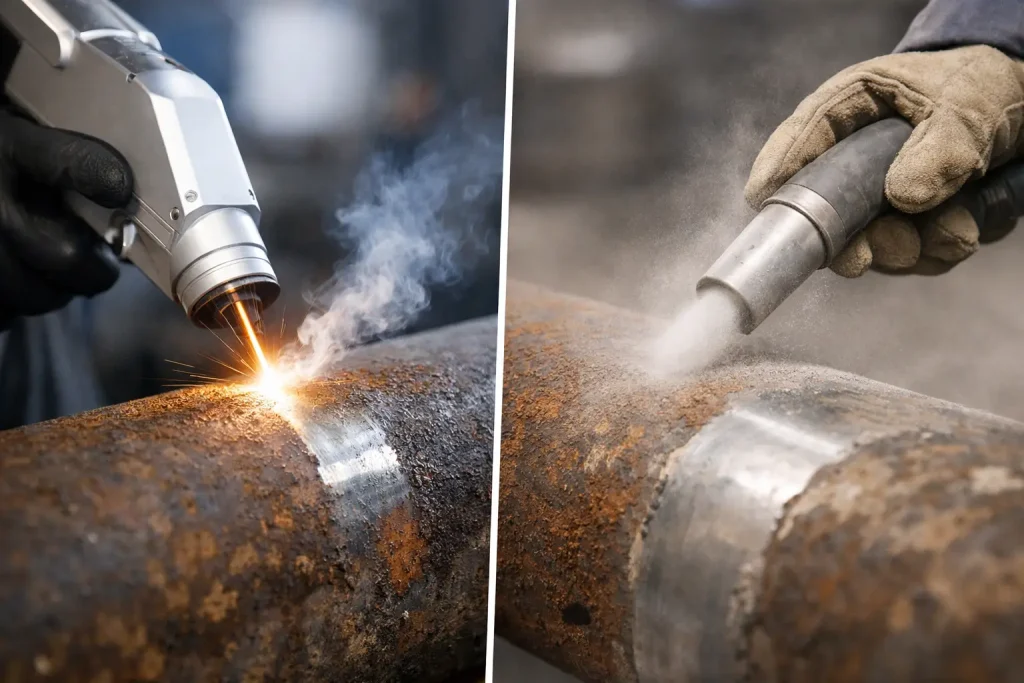
When a shutdown window is tight and the surface condition matters, the choice between laser cleaning vs sandblasting is not a minor specification. It affects substrate integrity, waste handling, setup time, safety controls, and how quickly a team can move into inspection, coating, welding, or return to service. For asset owners and maintenance teams, the right method is the one that solves the cleaning problem without creating a bigger one around it.
Both processes remove contamination, coatings, corrosion, and surface residues. But they do it in very different ways, and those differences matter in the field. Sandblasting relies on abrasive media propelled at high speed to strip the surface. Laser cleaning uses controlled laser energy to ablate contaminants with much greater selectivity. One is broad and aggressive by design. The other is precise and controlled.
Laser cleaning vs sandblasting: the core difference
Sandblasting is a mechanical process. Abrasive particles strike the surface, break away rust, paint, mill scale, or buildup, and create a new surface profile at the same time. That can be useful when a coating system requires anchor profile, but it also means the base material is part of the process. You are not only removing contamination. You are also impacting the substrate.
Laser cleaning works differently. The laser targets the contaminant layer through controlled ablation, removing rust, oxides, coatings, oil, grease, or other residues while minimizing effect on the underlying material. That selectivity is what makes laser cleaning attractive for applications where dimensional accuracy, surface preservation, or controlled preparation matters.
For a plant manager or engineer, the practical question is simple: do you need aggressive bulk removal, or do you need precise cleaning with less collateral impact?
Where sandblasting still makes sense
Sandblasting remains common because it is effective for large areas and heavy contamination, especially when the surface profile is part of the specification. Structural steel before recoating is a clear example. If the job requires broad-area production work and the substrate can tolerate abrasion, blasting may be the right fit.
It is also familiar. Many contractors, inspectors, and project teams understand blast standards, media choices, and containment requirements. On open sites with enough space for enclosure, media recovery, and dust control, that familiarity can support fast mobilization.
That said, familiar does not always mean lower total cost. Blast media, containment, cleanup, disposal, and downtime all add up. In sensitive operating environments, those secondary impacts often become the deciding factor.
Where laser cleaning has a clear advantage
Laser cleaning is strongest where precision, control, and cleanliness matter more than brute force. It is well suited for weld seam cleaning, localized rust removal, selective coating removal, mold cleaning, heritage restoration, maintenance around sensitive equipment, and inspection preparation where the base material must remain intact.
This matters in oil and gas, fabrication, infrastructure maintenance, and property restoration. On these jobs, damaging the substrate can create rework, reduce component life, or compromise quality. A more selective method is not just a technical preference. It can directly protect asset value.
Laser cleaning also reduces the operational burden around the cleaning task. There is no abrasive media to bring in, recover, and dispose of. Dust generation is far lower. In many cases, extensive blasting enclosures are not required. That can shorten setup and teardown time and simplify work in active facilities where space, access, and safety controls are tightly managed.
Surface impact and quality outcomes
This is where the comparison often becomes decisive. Sandblasting is inherently abrasive. It can remove contamination quickly, but it can also roughen, erode, or alter the underlying surface. On thick structural members, that may be acceptable or even beneficial. On machined parts, delicate metal surfaces, historic materials, thin sections, or localized repair areas, it can be a problem.
Laser cleaning offers much tighter control. It can remove a coating layer or corrosion product without the same degree of mechanical impact. That is especially useful when preparing a surface for inspection or restoring a component where preserving markings, edges, tolerances, or surface features matters.
The visual result is also different. Blasting creates a broadly textured finish. Laser cleaning can leave a cleaner, more defined surface with less unintended disturbance around the target area. For teams that need to inspect welds, identify defects, or prepare specific zones without affecting adjacent material, that precision is a real advantage.
Downtime, containment, and site logistics
In operating plants and live commercial environments, cleaning is rarely just about cleaning. Access restrictions, production schedules, nearby equipment, ventilation, housekeeping, and permit controls all shape what is practical.
Sandblasting often requires more support infrastructure. Depending on the job, that can include containment, isolation, media handling, dust collection, and post-job cleanup. Those are manageable requirements, but they add time, labor, and coordination. In shutdown work, every added layer can affect the schedule.
Laser cleaning is often easier to deploy in constrained or sensitive areas because the process is more controlled and creates less secondary waste. That can reduce disruption to adjacent work fronts and shorten the path from cleaning to the next activity. When the cost of downtime is high, that operational efficiency matters as much as the cleaning rate itself.
Safety and environmental considerations
Both methods require proper safety controls, but the risk profile is different. Sandblasting can generate substantial dust and spent media, and depending on the coating or contamination being removed, waste handling may become a serious project consideration. If hazardous materials are involved, disposal requirements can quickly increase cost and complexity.
Laser cleaning eliminates abrasive media from the process and significantly reduces waste volume. That supports cleaner work areas and can simplify environmental management. For organizations with strong sustainability goals or strict site controls, this is more than a compliance issue. It is a practical way to reduce housekeeping, waste streams, and exposure concerns.
For many decision-makers, the environmental case is compelling because it aligns with operations. Less waste to handle, fewer consumables to manage, and less cleanup after the job often translate into measurable project benefits.
Cost is not just the hourly rate
A common mistake in laser cleaning vs sandblasting comparisons is looking only at direct process cost. Sandblasting may appear less expensive on a simple per-hour basis, especially for broad-area work. But project cost should include setup, containment, consumables, cleanup, disposal, downtime, and the risk of substrate damage or rework.
Laser cleaning can be the better-value option when those full-cycle costs are considered. If it shortens isolation requirements, avoids blast enclosure construction, reduces waste disposal, and preserves the base material, the business case can shift quickly. This is especially true on high-value assets or in operating environments where every extra hour of disruption carries a real cost.
The right question is not which method is cheaper in theory. It is which method delivers the required cleaning outcome with the lowest total operational impact.
How to choose between laser cleaning and sandblasting
The decision should start with the surface, the contaminant, and the end requirement. If you need anchor profile on a durable substrate across a wide open area, blasting may be appropriate. If you need selective removal, minimal substrate impact, low waste generation, or work in a sensitive live environment, laser cleaning is often the better fit.
It also depends on what happens next. Inspection, NDT preparation, weld quality, coating performance, and restoration outcomes can all be affected by the cleaning method. That is why experienced project teams evaluate cleaning as part of the full work scope, not as an isolated line item.
At BKR Engineering, this is the practical lens we bring to surface preparation work. The goal is not to force one method into every application. The goal is to select the process that protects the asset, supports the schedule, and delivers a cleaner result with less disruption.
If you are deciding between the two, focus on the surface you need to preserve, the environment you need to work in, and the downstream task that depends on a properly prepared substrate. That is usually where the right answer becomes clear.