
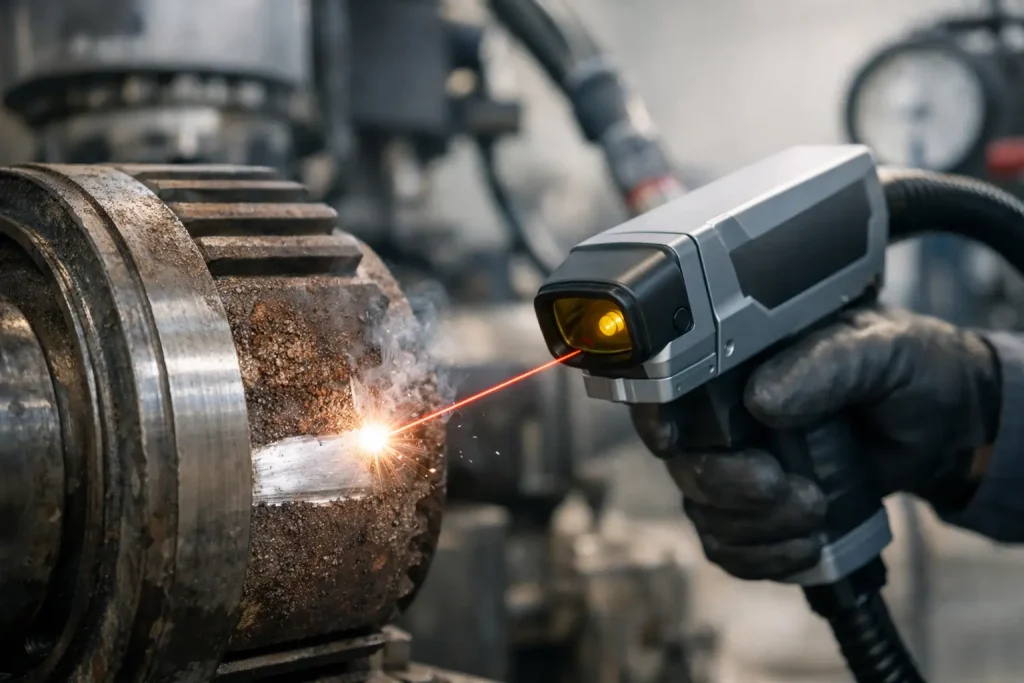
A shutdown rarely runs long because of one major failure alone. More often, the delay comes from the work around the work – isolating an area for blasting, building containment, managing waste, waiting for surfaces to cool or dry, and correcting damage caused by aggressive cleaning methods. That is exactly where how laser cleaning reduces downtime becomes a practical business question, not just a technical one.
For plant managers, maintenance teams, and asset owners, cleaning is usually a prerequisite task. You need it before inspection, before coating, before welding, and before returning equipment to service. If that cleaning step is slow, messy, or difficult to control, it extends the whole maintenance window. Laser cleaning changes that equation by removing contamination with precision and far less operational disruption.
Why downtime is often a surface preparation problem
In many maintenance programs, surface preparation is treated as a routine line item. In practice, it can become a critical path activity. Rust removal, coating removal, oxide cleaning, and degreasing often sit between inspection and repair, or between repair and restart. When those steps rely on abrasive blasting or chemical cleaning, the surrounding controls can consume more time than the actual contaminant removal.
Abrasive methods may require enclosure setup, media handling, post-cleanup, and additional safety coordination. Chemical processes can involve masking, dwell time, rinsing, ventilation, and hazardous waste disposal. Even when these methods are effective, they can slow access to the asset and create bottlenecks for adjacent trades.
Laser cleaning reduces those delays because it is a controlled, dry process. The laser energy targets the contamination layer with high precision, often leaving the base material intact. That means less collateral work before, during, and after cleaning.
How laser cleaning reduces downtime in real operations
The most immediate time saving comes from setup. With conventional blasting, teams often need to protect nearby equipment, contain debris, and plan around dust and rebound. In live industrial environments, those precautions can be substantial. Laser cleaning typically requires a smaller work footprint and creates minimal secondary waste, so mobilization is faster and site disruption is lower.
The second gain is process control. Because laser cleaning is selective, operators can remove rust, paint, oxides, oil residue, or other contaminants without the broad material loss associated with harsher methods. That matters when you are working on machined surfaces, weld zones, molds, heritage materials, or assets where dimensional tolerance matters. Less damage means less corrective work, and less corrective work means shorter maintenance windows.
There is also a scheduling benefit. Dry cleaning processes support faster handoff to inspection or the next repair step. You are not waiting for media recovery, water evaporation, or chemical neutralization. On many jobs, once the surface is cleaned, the inspection team or coating crew can proceed almost immediately.
Faster setup and breakdown on site
In outage planning, every support activity matters. If cleaning a valve bank, steel structure, or production component requires extensive barricading and containment, the labor hours add up quickly. Laser cleaning equipment can often be deployed with less site preparation, especially when the goal is localized cleaning rather than full-area stripping.
That does not mean no planning is required. Safety controls, access, power supply, and fume management still need to be addressed properly. But compared with methods that generate large volumes of blast media or chemical runoff, the overall logistics are often much lighter.
Less cleanup after the cleaning
A common reason jobs overrun is that the cleaning process creates another cleanup job. Abrasive media must be collected. Slurry or chemical residues must be handled and disposed of. Dust can migrate into nearby systems and trigger added housekeeping or inspection concerns.
Laser cleaning removes contaminants at the source with very limited residue. In many applications, what remains is far easier to capture and manage. That directly shortens the time between task completion and return to service.
Reduced risk of substrate damage and rework
Rework is one of the most expensive forms of downtime. If a cleaning method etches, profiles, erodes, or distorts the underlying surface, the asset may need additional repair before it can move to the next stage. This is especially relevant for stainless steel, precision parts, molds, thin metals, weld seams, and restoration projects.
Laser cleaning is valuable here because the process can be tuned for selective material removal. When handled by an experienced service provider, it can strip contamination while preserving the substrate below. That lowers the chance of overcleaning and helps keep the job moving forward instead of backward.
Where the downtime savings are most visible
The strongest results usually appear in jobs where conventional cleaning creates heavy operational overhead. In oil and gas environments, for example, teams often need corrosion removal for inspection access, coating removal around repair zones, or weld preparation in tight areas. Using a method that minimizes waste and reduces impact on surrounding equipment can materially shorten the outage window.
In fabrication and manufacturing, laser cleaning can support mold cleaning, weld cleaning, and localized surface preparation without disassembling more than necessary. That is a different kind of downtime reduction – less interruption to production flow rather than a major shutdown event.
For infrastructure and property maintenance, including heritage restoration, the value is often in precision. Removing paint, staining, oxidation, or contaminants without damaging the original material helps avoid repair cycles that would extend project duration and cost.
It depends on the job, and that matters
A practical discussion of how laser cleaning reduces downtime should also acknowledge limits. Laser cleaning is not automatically the fastest choice for every square foot of every project. For very large areas of heavy coating removal, another method may still be considered depending on access, thickness, finish requirements, and project economics.
The real question is not whether laser cleaning replaces every traditional process. It is whether it reduces total downtime for the specific task. In many cases, the answer is yes because total downtime includes setup, containment, waste handling, adjacent trade delays, rework risk, and restart readiness – not just cleaning speed on paper.
That distinction is important for procurement teams and maintenance planners. A method that appears cheaper or faster in isolation can become more expensive once site controls and recovery time are included. Laser cleaning often performs well because it reduces the hidden labor and delay built into the full job cycle.
Why service experience affects the result
Technology alone does not shorten downtime. Execution does. The operator needs to understand substrate behavior, contamination type, required cleanliness standard, and the constraints of the operating environment. Poor parameter selection can slow production or produce inconsistent results, even with advanced equipment.
This is why many asset owners prefer a specialist service partner rather than treating laser cleaning as just another rented tool. The value comes from applying the process correctly, coordinating it with the broader work scope, and keeping the cleaning step aligned with inspection, repair, or coating requirements. For companies managing critical assets, that level of control is often the difference between a clean schedule and a slipped one.
BKR Engineering has built its laser cleaning services around that operating reality, with a focus on controlled ablation, substrate protection, and practical field delivery in demanding industrial environments.
Looking beyond labor hours to total operational impact
Downtime is not only measured by the number of technicians on a task. It also includes lost production, delayed inspection findings, idle contractors, permit extensions, and restart uncertainty. When cleaning methods generate dust, waste, or substrate damage, they can affect all of those factors.
Laser cleaning supports a more controlled maintenance workflow. It can help teams access surfaces sooner, clean only what needs to be cleaned, avoid unnecessary material removal, and move to the next activity with fewer delays. For operations where maintenance windows are tight and asset availability matters, those gains are often more valuable than the cleaning method itself.
If you are evaluating cleaning options for an upcoming shutdown, turnaround, or targeted repair, the best place to start is not with the machine. It is with the downtime map. Look at where time is really being lost – setup, containment, waste, rework, or handoff delays – and the right cleaning method usually becomes clear.