
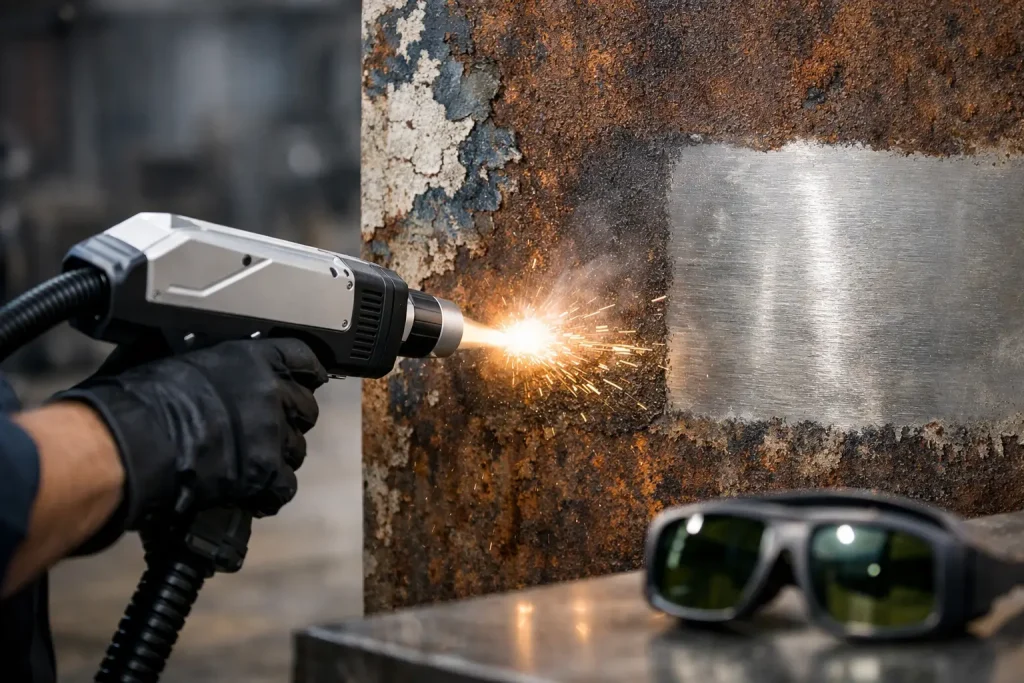
A coated steel panel can look simple on the surface, but anyone responsible for maintenance or refurbishment knows the real question is underneath: can laser cleaning remove coatings without creating a second problem? In many cases, yes. Laser cleaning can remove a wide range of coatings with high control, but the result depends on the coating type, thickness, adhesion, substrate, and the finish you need afterward.
That is the practical answer asset owners and maintenance teams need. Laser cleaning is not a universal replacement for every stripping method, but it is often the better option when substrate protection, waste reduction, and downtime matter just as much as removal itself.
Can laser cleaning remove coatings on all surfaces?
Laser cleaning removes coatings by directing concentrated light energy onto the surface. The coating absorbs that energy, breaks down, detaches, or vaporizes, while the underlying substrate is left largely unaffected when the process is set correctly. That selective removal is what makes the method attractive in industrial maintenance, restoration, fabrication, and inspection preparation.
The key phrase is when the process is set correctly. Laser cleaning is highly controllable, but it is not automatic. A painted carbon steel plate, an oxidized stainless component, and a heritage metal feature with aged coatings will not respond in the same way. The laser settings, scan pattern, focal distance, and pass count all need to match the job.
For operators and project teams, this is where experience matters. The technology is precise, but practical results come from understanding how a specific coating behaves under laser exposure.
Which coatings can laser cleaning remove?
Laser cleaning is effective on many common industrial and commercial coatings. These include paint layers, powder coatings, primers, oxides, varnishes, sealants, bituminous residues, and certain protective films. It is also widely used to remove contamination such as oil, grease, carbon deposits, and corrosion products that sit on top of or beneath coating systems.
On metal substrates, the process is especially effective because the difference in absorption between the coating and the base material can be used to advantage. That makes laser cleaning a strong option for coating removal on steel, stainless steel, aluminum, and other metallic surfaces where preserving the substrate is critical.
Not every coating responds at the same speed. Thin paint films and light oxidation can often be removed efficiently. Thick, multi-layer coating systems with strong adhesion usually take longer and may require multiple passes. Some elastomeric or heat-sensitive coatings can char or leave residues if the wrong parameters are used, which is why pre-job testing is often the right move.
Where laser cleaning works best for coating removal
Laser cleaning is most valuable when the surface under the coating still matters. That includes equipment that must stay within tight dimensional tolerances, weld zones that need careful preparation, and surfaces where abrasive blasting would be too aggressive or too messy.
For plant maintenance teams, a common use case is localized coating removal for inspection. If you need to expose a section of pipe, tank, or structural steel without blasting a whole area or introducing secondary media into a live environment, laser cleaning offers a controlled approach. The same applies to spot repairs, edge preparation, and selective removal near sensitive components.
In restoration work, the benefit is different but equally important. Decorative or historic metal surfaces often need coatings removed without erasing fine details or changing the profile of the base material. Laser cleaning gives a level of selectivity that conventional mechanical methods struggle to match.
It is also useful in fabrication and production support. Removing coatings, oxides, or residues before welding, bonding, or recoating can improve process consistency while reducing cleanup and containment requirements.
What affects whether laser cleaning can remove coatings effectively?
The short answer is that coating removal performance depends on five variables: coating chemistry, coating thickness, bond strength, substrate sensitivity, and productivity requirements.
Coating chemistry matters because different materials absorb laser energy differently. Some paints and oxide layers respond quickly. Others reflect more energy or degrade unevenly, which slows removal. Thickness is straightforward – the more material there is, the more passes or higher energy input may be needed.
Adhesion is just as important as thickness. A thin but tightly bonded coating can be harder to remove than a thicker, degraded one. Substrate sensitivity also changes the operating window. If the surface is soft, polished, heat-sensitive, or dimensionally critical, the process has to prioritize protection over raw speed.
Then there is productivity. If the goal is to strip large surface areas as fast as possible, another method may sometimes be faster. If the goal is targeted removal with minimal masking, less cleanup, and better substrate preservation, laser cleaning often comes out ahead overall.
This is why coating removal should be evaluated as a project outcome, not just a stripping rate. Setup time, containment needs, waste disposal, rework risk, and asset downtime all affect the real cost.
Can laser cleaning remove coatings better than blasting or chemicals?
Better is not the right word for every situation. More controlled is usually the more accurate term.
Abrasive blasting is still effective for large-area cleaning and profile creation, but it introduces media, dust, rebound, and containment demands. Chemical stripping can work well on certain coatings, but it creates handling, disposal, ventilation, and worker exposure issues that many facilities would rather reduce. Mechanical methods can be simple, but they often remove more than the coating.
Laser cleaning changes that trade-off. It is a dry process, it generates far less secondary waste, and it can remove coatings selectively without impacting adjacent areas the same way blasting or grinding can. For facilities trying to reduce shutdown time and environmental burden, those advantages are operational, not just technical.
That said, laser cleaning is not always the fastest answer for every square foot. Very thick coatings over very large areas may need a hybrid strategy or a different primary method, especially when substrate sensitivity is low and production speed is the only priority.
Can laser cleaning remove coatings without damaging the substrate?
This is often the deciding question, and it is where laser cleaning has the strongest case. Yes, laser cleaning can remove coatings without damaging the substrate, provided the process is correctly selected and controlled.
The reason is selective ablation. The laser energy is tuned to interact with the coating more strongly than with the base material. Instead of physically impacting the surface with grit or cutting into it with abrasive tools, the process targets the unwanted layer.
But this does not mean zero risk in every scenario. Poor parameter selection can discolor, heat-tint, or mark the substrate, especially on reflective metals or delicate surfaces. The right approach is to treat coating removal as an engineered process, not a generic cleaning task.
In field conditions, that means sample testing, visual inspection, and adjustment based on actual coating response. A dependable laser cleaning partner will not oversimplify this. They will define the finish requirement, assess the base material, and recommend the right removal level for the next step, whether that is inspection, repair, welding, or recoating.
When laser coating removal makes the most business sense
Laser cleaning makes the strongest business case when the project has constraints that conventional methods handle poorly. That includes confined or sensitive environments, shutdown-critical assets, selective cleaning requirements, and jobs where waste control is a serious cost driver.
Oil and gas facilities, infrastructure maintenance programs, fabrication shops, and property restoration projects often fit that profile. In these settings, the value is not limited to removing a coating. The value is removing it with less collateral impact on the schedule, surrounding equipment, and waste stream.
For buyers and project managers, that is the bigger decision. The question is not only can laser cleaning remove coatings. It is whether it can do so in a way that protects the asset, supports the next operation, and reduces the hidden costs that come with blasting, chemicals, or aggressive mechanical removal.
That is where an experienced service provider makes the difference. BKR Engineering approaches laser cleaning as a precision surface preparation solution, not a one-size-fits-all cleaning service. The right method starts with the surface, the coating system, and the outcome the client actually needs.
If you are evaluating coating removal options, the best starting point is a practical one: define what must be removed, what must be preserved, and what delays or waste your operation cannot afford. That usually makes the right cleaning method much clearer.