
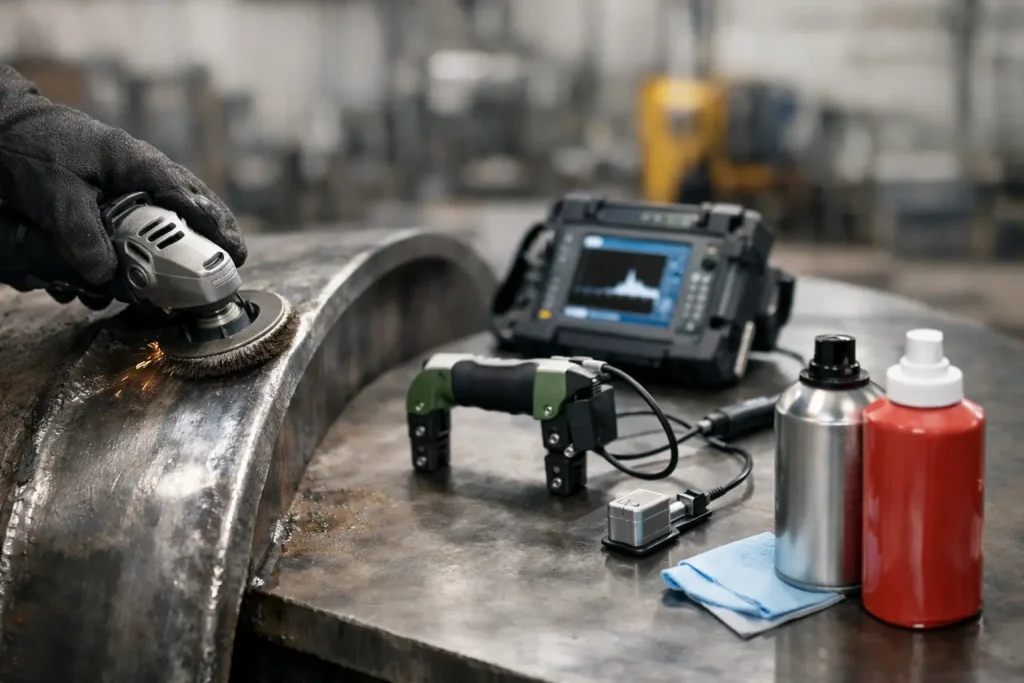
A failed inspection is not always an inspection problem. In many cases, it starts with the surface. If the area is still carrying rust, scale, old coating, oil, or carbonized residue, surface preparation for NDT becomes the factor that decides whether an indication is visible, distorted, or missed altogether.
For plant managers, asset integrity teams, and contractors, this is more than a housekeeping step. It affects inspection quality, outage duration, rework, and confidence in the final decision. The right preparation method clears the surface enough for accurate testing without changing the base material or creating fresh variables that the inspector then has to interpret.
Why surface preparation for NDT matters
Non-destructive testing depends on signal clarity. Whether the method is visual inspection, magnetic particle testing, liquid penetrant testing, ultrasonic testing, or eddy current, the surface condition influences what the technician can see or measure. Contaminants can mask defects. Coatings can block access. Surface roughness can create noise. Over-cleaning can be just as problematic if it smears metal, rounds edges, or removes evidence that matters.
That is why preparation should be driven by the inspection method and the condition of the asset, not by habit. A corroded pipe spool before ultrasonic thickness checks does not need the same treatment as a weld toe prepared for dye penetrant testing. A painted structural member under corrosion mapping raises different concerns than a heritage metal feature that must be cleaned with minimal material loss.
In practice, the best results come from defining three things early: what needs to be removed, what must remain untouched, and what inspection method comes next. That sounds simple, but it prevents a lot of avoidable delays in the field.
What inspectors need from the surface
Most NDT methods do not require a perfectly bare or polished surface. They require a surface condition that supports reliable readings. That distinction matters because excessive preparation adds cost and time, and in some situations increases risk.
For visual inspection, the main goal is clear line of sight. Loose rust, dirt, oil, and heavy coating breakdown can hide pitting, cracks, undercut, and mechanical damage. For magnetic particle and liquid penetrant testing, the requirement is stricter. Surface contaminants, trapped residues, and unsuitable coatings can interfere with flaw detection or create false indications. For ultrasonic testing, thick scale, corrosion products, and rough contamination can prevent proper couplant contact and reduce signal quality. Eddy current testing is also sensitive to lift-off and coating thickness variation.
This is why surface preparation should be specified by fitness for inspection, not by a blanket cleaning standard copied from a coating job. The target is not cosmetic improvement. The target is dependable data.
Common contaminants that interfere with NDT
The most frequent obstacles are predictable: rust, mill scale, paint systems, grease, oil, oxides, weld spatter, salts, and process residues. Each one affects NDT differently.
Rust and scale can conceal cracking and corrosion morphology. Paint may prevent direct access for penetrant or magnetic particle testing and can reduce confidence in visual examination of critical areas. Oil and grease are especially problematic for penetrant testing because they block the penetrant from entering fine discontinuities. Heavy oxides and rough corrosion products can scatter ultrasonic signals or reduce probe stability.
The challenge is that these contaminants often appear together. A corroded insulated line may have coating remnants, adhesive residue, oxidation, and chloride-bearing deposits in the same inspection zone. That is why a one-method-fits-all approach often falls short.
Choosing the right preparation method
Surface preparation for NDT should be precise, controlled, and appropriate to the substrate. Mechanical tools, abrasive blasting, chemical cleaning, and laser cleaning all have a place, but they do not deliver the same result.
Hand and power tools can be practical for small areas and quick access points, though they may leave inconsistent profiles and are operator dependent. Abrasive blasting is effective for large-scale coating and corrosion removal, but it can create containment demands, media waste, and surface profile changes that are not always desirable before inspection. Chemical cleaning can remove specific contaminants well, yet disposal, safety controls, and residue management must be considered. On sensitive assets or in live industrial environments, those trade-offs can become significant.
Laser cleaning offers a more selective option when the goal is to remove contamination without damaging the underlying substrate. Because the process can target rust, oxides, paint, oil, and other surface contaminants with high control, it is well suited to inspection preparation where substrate preservation matters. It also reduces secondary waste and avoids the extensive enclosure requirements associated with blasting in many environments.
That does not mean laser is automatically the answer in every case. Surface area, access, contamination type, schedule, and inspection standard still matter. But where precision, reduced downtime, and clean preparation are priorities, it is often the more efficient path.
Surface preparation for NDT by inspection method
Visual inspection
Visual testing benefits from clean, stable surfaces and good contrast. The priority is removing anything that obscures geometry or damage. Thick corrosion, peeling coatings, soot, and process buildup should be cleared, but there is rarely a need to overwork the area to a bright metal finish unless a specification calls for it.
Liquid penetrant testing
Penetrant testing is unforgiving when contamination remains in the defect opening. Oils, paint traces, oxidation, and cleaning residues can all reduce sensitivity. The surface must be dry and free of substances that block penetrant entry. At the same time, aggressive preparation that smears soft metals or closes fine cracks can undermine the test.
Magnetic particle testing
Magnetic particle testing requires a clean enough surface for magnetic particles to move and collect at discontinuities. Thin coatings may sometimes be acceptable, depending on standards and expected defect type, but heavy corrosion and non-conductive contamination should be removed. Surface profile also matters because roughness can create background indications.
Ultrasonic testing
UT usually does not require full coating removal across a broad area, but the contact point must support stable coupling and repeatable probe movement. Scale, rust nodules, and debris can interfere with readings. For corrosion mapping or thickness checks, selective cleaning of grid points may be enough. For angle beam weld inspection, smoother and more consistent preparation is often needed.
The case for controlled cleaning over aggressive removal
In inspection preparation, more force is not always more effective. Aggressive blasting or grinding may speed up contaminant removal, but it can also alter the condition that inspectors are trying to evaluate. If pitting edges are softened, crack openings are smeared, or the surface profile becomes excessively rough, interpretation gets harder.
Controlled cleaning is often the better strategy, especially on high-value equipment, precision fabrications, stainless components, machined surfaces, and restoration work. It helps preserve dimensional integrity while still exposing the surface clearly enough for testing.
This is where service experience matters. A contractor preparing steel for recoating and a specialist preparing an area for NDT are not solving the same problem. The second task requires tighter judgment about removal limits, inspection zones, and substrate sensitivity.
Operational benefits beyond the inspection itself
Good preparation improves more than flaw detection. It also improves planning. When the surface is ready the first time, inspection crews spend less time waiting, repeating scans, or questioning marginal indications caused by contamination. That can shorten shutdown windows and reduce coordination problems between maintenance, inspection, and operations.
There are safety and environmental gains as well. Preparation methods that avoid abrasive rebound, chemical handling, and large waste streams are easier to manage in active facilities and confined job sites. For owners balancing inspection quality with site controls, that matters.
BKR Engineering has seen this especially clearly in oil and gas, fabrication, and restoration settings, where clients need accurate access to the substrate without adding unnecessary disruption around the work area.
How to specify preparation clearly
If you are planning NDT work, the cleanest path is to define the preparation scope before mobilization. Identify the inspection method, the target areas, the contaminants present, and any constraints on substrate damage, waste generation, or access. If coating removal is required, specify whether it is full removal or localized exposure. If the base metal must remain unchanged, say so directly.
That level of clarity helps everyone. Inspectors get the surface they need. Service teams avoid over-preparing or under-preparing the work. Project managers reduce the chance of rework and schedule drift.
The best inspection results rarely come from doing the most. They come from doing exactly what the surface requires, no more and no less. When preparation is treated as part of the inspection strategy instead of a rushed preliminary task, the testing becomes faster, cleaner, and more trustworthy. That is the kind of discipline that protects both assets and decisions.