
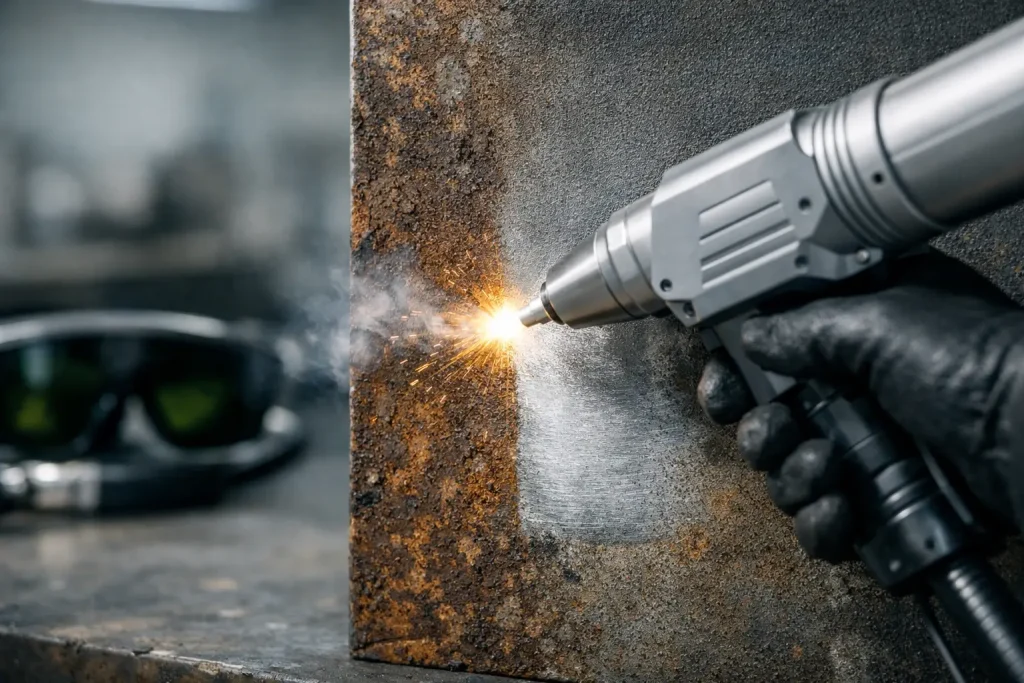
A corroded flange, a painted steel beam, or an oil-contaminated mold can all present the same problem: you need the surface clean, but you cannot afford to damage the material underneath. That is where the question what is laser cleaning becomes practical, not theoretical. For maintenance teams, fabricators, and asset owners, laser cleaning is a precise surface preparation method that removes unwanted layers without the mess, waste, and substrate risk associated with many traditional methods.
What is laser cleaning?
Laser cleaning is a controlled surface treatment process that uses a focused laser beam to remove contaminants or coatings from a material. Depending on the application, that can include rust, oxides, paint, oil, grease, carbon deposits, or other residues. The goal is selective removal – taking away the unwanted layer while leaving the base material intact.
The process is commonly described as laser ablation. In simple terms, the laser energy interacts with the contamination on the surface. That unwanted layer absorbs the energy and breaks apart, vaporizes, or detaches from the substrate. Because the beam can be precisely controlled, laser cleaning can target surface contamination with a level of accuracy that is difficult to achieve with abrasive blasting or chemical stripping.
For industrial users, that precision matters. If you are preparing a weld zone, restoring a heritage surface, cleaning a production tool, or removing corrosion from equipment, the difference between cleaning the surface and eroding the base metal is not a minor detail. It directly affects quality, asset life, and project cost.
How laser cleaning works in practice
A laser cleaning system emits short, high-energy pulses onto a surface. Those pulses are calibrated based on the material, the type of contamination, and the required finish. Rust on carbon steel, for example, behaves differently from paint on aluminum or grease on a mold surface, so the settings must match the job.
The key principle is absorption. Contaminants and coatings often absorb laser energy differently than the substrate beneath them. When the settings are correct, the unwanted layer reacts to the laser while the underlying material remains largely unaffected. This is what makes laser cleaning especially useful in applications where surface integrity is critical.
In field conditions, the process is also cleaner and more contained than many alternatives. There is no blasting media to collect and dispose of, and there are no aggressive chemical agents soaking into the work area. Fume extraction and proper safety controls are still necessary, but the overall footprint is often much smaller than conventional cleaning setups.
Why industries are moving toward laser cleaning
Traditional cleaning methods still have their place, but they come with trade-offs that can be costly in operating environments. Abrasive blasting can be effective, but it creates secondary waste, often requires containment, and may alter surface profiles more than desired. Chemical cleaning can remove coatings and contamination, but it introduces hazardous waste handling, worker exposure concerns, and extra disposal requirements.
Laser cleaning addresses many of those operational issues. It offers a dry, non-contact method with controlled material removal. For facilities trying to reduce downtime, simplify setup, and improve environmental performance, that combination is compelling.
This is especially relevant in sectors where access, cleanliness, and precision matter. Oil and gas facilities, fabrication yards, infrastructure maintenance teams, and property restoration specialists often need to clean specific areas without creating unnecessary disruption around them. A targeted laser process can often do that more efficiently than broad, aggressive methods.
What laser cleaning is used for
The range of applications is broader than many people expect. In heavy industry, laser cleaning is often used for rust and oxide removal, weld seam preparation, coating removal, and maintenance cleaning on machinery or structural components. It can prepare surfaces before inspection, coating, or repair without grinding away sound material.
In manufacturing, it can be used to remove residues from molds, tools, and production equipment. Because the process is non-abrasive and highly selective, it can support repeat cleaning cycles on valuable assets where dimensional stability matters.
It is also useful in more delicate environments. Stone, brick, historical metalwork, and selected architectural surfaces may benefit from laser cleaning when conventional methods are too harsh. That does not mean every heritage surface is automatically a fit – testing is essential – but it does mean laser cleaning can open options where preservation is a priority.
The main benefits and the real trade-offs
The biggest advantage of laser cleaning is control. You are not throwing abrasive media at a surface and hoping for the right result. You are applying measurable energy to remove a specific layer. That helps protect the substrate, improve repeatability, and reduce rework.
Another major benefit is waste reduction. Since there is no blasting media or chemical runoff, cleanup and disposal are often much simpler. For many operators, that improves both site safety and total project efficiency.
Downtime can also be reduced. In some cases, laser cleaning can be performed with less setup and containment than blasting, which matters when equipment availability is tightly scheduled. The visual result is another practical advantage. Laser cleaning often produces a clearly defined before-and-after effect, which helps with quality control and inspection readiness.
That said, laser cleaning is not the automatic answer for every job. The cleaning rate depends on the contaminant type, thickness, bond strength, and required finish. Large-scale bulk removal over wide areas may still favor other methods in some situations, especially where precision is less important than raw throughput. Capital equipment costs are also higher, which is why many companies prefer a specialized service partner rather than bringing the technology in-house.
Material response matters too. Different metals, coatings, and substrates require different laser parameters. A qualified operator does not treat stainless steel, aluminum, carbon steel, stone, and painted surfaces as if they are interchangeable. Successful results depend on testing, process control, and application experience.
What is laser cleaning compared with blasting or chemicals?
If you are comparing methods, the decision usually comes down to substrate sensitivity, environmental constraints, access conditions, and the value of precision.
Abrasive blasting is often suited to high-volume surface preparation where a defined anchor profile is needed and the work area can be fully managed. Chemical cleaning may still be used where coatings or residues respond well to solvents and disposal controls are in place. Laser cleaning becomes particularly attractive when damage risk, waste handling, site disruption, or selective removal are the main concerns.
For example, removing corrosion from a localized section of steel near sensitive equipment is a different task from blasting an entire tank exterior. Cleaning oil and oxide from a weld zone before fabrication is different from stripping thick coating systems across a broad structural surface. The right choice depends on the objective, not just the tool.
Where laser cleaning delivers the most value
Laser cleaning tends to deliver the strongest return where the cost of over-cleaning, collateral damage, or shutdown is high. That includes asset integrity work, inspection preparation, precision fabrication, and restoration projects where preserving the base material is critical.
It is also valuable in environments with strict safety and sustainability expectations. Reducing airborne abrasive, minimizing hazardous waste, and avoiding chemical handling can materially improve project planning and compliance. For owners and contractors, those are not soft benefits. They influence labor, permits, cleanup, and overall execution risk.
In Singapore and similar high-density operating environments, the reduced footprint of laser cleaning can be especially useful. BKR Engineering has built its reputation around exactly that need: delivering controlled laser ablation services that support maintenance, restoration, and production work without unnecessary disruption.
What to ask before choosing laser cleaning
Before selecting laser cleaning for a project, the right questions are straightforward. What is being removed? What is the substrate? How clean does the surface need to be? Is the priority speed, precision, environmental control, or all three? And can the work be tested first?
A credible service provider should be able to explain expected results, likely cleaning rates, safety controls, and any limitations. That conversation matters because the best outcomes come from matching the process to the application, not forcing the application to fit the process.
Laser cleaning is not a trend item or a cosmetic upgrade to old methods. It is a practical engineering solution for situations where precision, substrate protection, and cleaner execution have real operational value. If your assets are too important for aggressive cleaning and your schedule is too tight for messy alternatives, it is worth looking at laser cleaning as a serious part of your maintenance and surface preparation strategy.