
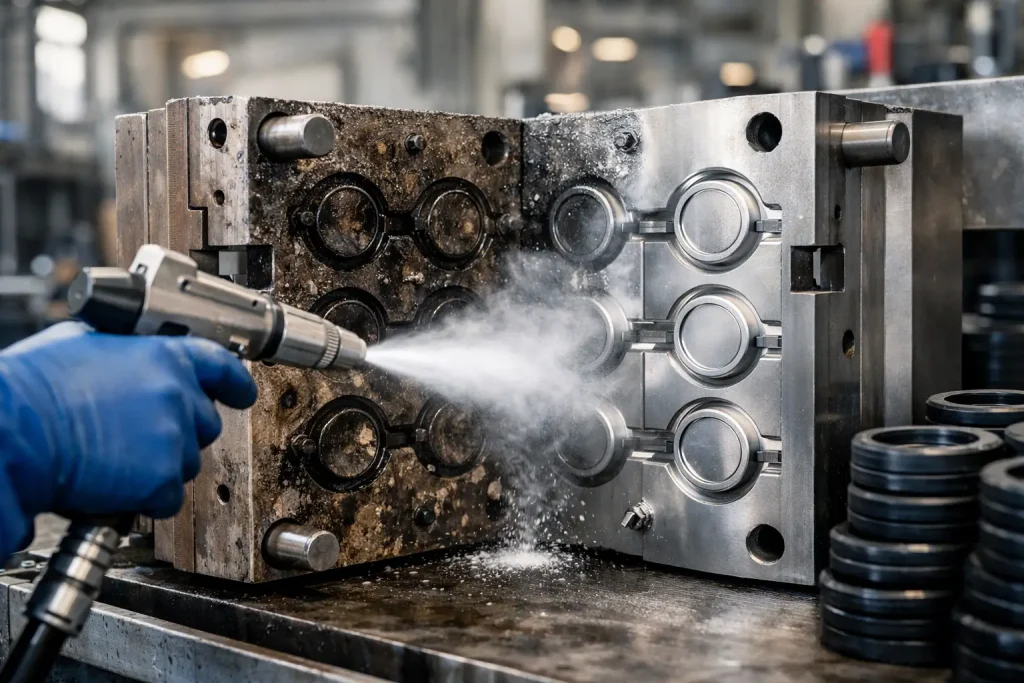
A rubber mold rarely fails all at once. More often, performance slips in small, expensive ways – sticking parts, vent blockage, surface defects, longer cycle times, and more frequent operator intervention. That is why mould cleaning for rubber industry production is not just a maintenance task. It is a process control issue tied directly to quality, uptime, and mold life.
In rubber manufacturing, contamination builds faster than many teams expect. Carbonized residue, release agents, cured rubber deposits, additives, and process oils can accumulate in cavities, vents, parting lines, and fine surface features. Once that layer forms, it starts affecting heat transfer, venting efficiency, demolding, and final part appearance. Cleaning strategy matters because the wrong method can solve one problem while creating another.
Why mould cleaning for rubber industry plants is so critical
Rubber molding tools operate under high temperature, pressure, and repeated cycling. Over time, residues become harder to remove and more likely to interfere with part consistency. A mold that looks serviceable at a glance may still be producing reject-causing defects because contamination is trapped in vents or detailed geometry.
This matters most in plants producing tight-tolerance components, cosmetic parts, seals, gaskets, automotive items, and technical rubber products where flash control and surface finish are closely monitored. Even small deposits can change how material flows or releases. That can show up as incomplete filling, burn marks, surface blemishes, or sticking that increases the risk of damage during demolding.
There is also a maintenance planning issue. If cleaning requires long disassembly, transport, soaking, media containment, or post-cleaning drying, downtime rises quickly. In high-throughput production, the cleaning method needs to restore the mold effectively without creating a second bottleneck in the maintenance workflow.
What builds up on rubber molds
The contamination profile depends on the compound, molding temperature, cycle count, and tool design. Natural rubber, EPDM, silicone, nitrile, fluoroelastomers, and other compounds do not foul molds in exactly the same way. Fillers, pigments, curing systems, and release chemistry also affect the residue left behind.
In practice, the most common forms of buildup include carbon deposits, cured rubber residue, trapped mold release, oil and grease contamination, and oxidation on the mold surface. Vents and micro-features are especially vulnerable because they are harder to reach and easier to damage with aggressive cleaning.
This is where many plants run into a trade-off. If cleaning is too mild, residue remains in critical areas and performance drops again after a short run. If cleaning is too aggressive, the process can alter surface finish, round off edges, widen vents, or leave abrasive wear that changes part quality over time.
Common cleaning methods and where they fall short
Traditional rubber mold cleaning usually relies on chemical soaking, manual scraping, abrasive blasting, dry ice, ultrasonic systems, or pyrolysis-based off-site processing. Each method has a place, but none is universally ideal.
Chemical cleaning can dissolve certain residues effectively, but chemical handling, disposal requirements, and drying time add complexity. Some solutions also raise compatibility concerns depending on tool material and coating condition. Manual cleaning gives technicians control, though it is labor-intensive and highly dependent on skill. It can also be inconsistent when fine vents and detailed cavities are involved.
Abrasive blasting is often chosen for speed, but it carries a clear risk in precision molds. Media impact can erode sharp features and alter the surface texture that the molding process depends on. Dry ice cleaning is cleaner than many legacy methods and avoids secondary media waste, but it may struggle with tightly bonded deposits in very fine features.
Off-site thermal or pyrolysis cleaning can remove heavy organic buildup, yet turnaround time and repeated heat exposure may not fit every maintenance program. For plants focused on quick recovery and tight dimensional control, those limitations matter.
Where laser cleaning fits in rubber mold maintenance
Laser cleaning offers a different approach. Instead of relying on abrasive contact or bulk chemical action, it uses controlled laser ablation to remove surface contamination selectively. For rubber molds, that precision is the main advantage. Residue can be targeted while the underlying tool steel or substrate is preserved.
For maintenance leaders, the practical value is straightforward. A properly controlled laser process can clean carbonized deposits, release residues, and contamination in intricate areas without introducing blasting media, chemical waste, or unnecessary wear on the mold surface. That makes it especially relevant for high-value tooling and molds with detailed venting, texturing, or tight-tolerance features.
This is not to say laser cleaning is the answer in every case. Heavily damaged molds, severe corrosion, or tools with existing mechanical wear may need repair work in addition to cleaning. The right result depends on the deposit type, the mold material, and the level of precision required. But where residue removal must be accurate and repeatable, laser cleaning compares well against more aggressive methods.
Operational advantages of laser-based mould cleaning for rubber industry use
The strongest case for laser cleaning is usually operational, not theoretical. Plants benefit when cleaning can be done with less teardown, less waste handling, and lower risk of tool damage. That affects more than maintenance cost. It supports production scheduling, quality stability, and tool longevity.
Because laser cleaning is a dry process, it avoids the cleanup and disposal burden associated with chemical baths or blasting media. It also reduces the risk of trapped residue from cleaning materials remaining in vents or cavities. For teams managing strict housekeeping, environmental compliance, or confined maintenance areas, that is a meaningful advantage.
There is also the issue of substrate protection. Rubber molds often contain precision-machined details that directly influence venting, release, and final part finish. Preserving those details is critical. Controlled laser ablation is well suited to selective removal because it can strip contamination while minimizing impact on the base surface.
For organizations focused on downtime reduction, service delivery matters as much as the technology itself. A specialist provider with field experience can assess the mold condition, match the cleaning parameters to the contamination, and execute the work with less disruption to the maintenance cycle. That is where a service-led partner such as BKR Engineering brings value beyond equipment alone.
When to clean and how to avoid over-cleaning
One common mistake is waiting until defects become obvious. By that point, residue has usually progressed beyond a light maintenance condition and may require longer intervention. A better approach is to tie mold cleaning intervals to actual production behavior – cycle stability, reject trends, vent performance, release consistency, and visual inspection results.
Not every mold needs the same schedule. High-cavity tools, compounds with heavy filler loading, and molds used for cosmetic parts often need closer attention than simpler tools running more forgiving materials. Maintenance teams should also watch for repeated use of release agents as a warning sign. If operators are compensating more often, the mold condition may already be affecting the process.
At the same time, cleaning too frequently with the wrong method adds unnecessary handling and wear. The goal is not the most cleaning. The goal is the right cleaning interval with the least impact on the tool.
What decision-makers should look for in a cleaning partner
For plant managers, engineers, and procurement teams, the evaluation should go beyond whether a vendor can remove residue. The better question is whether the service supports production reliability. That means understanding mold geometry, contamination type, turnaround expectations, substrate sensitivity, and safety requirements.
A capable partner should be able to explain what can be removed, what cannot, and where the limits are. They should also be clear about trade-offs. For example, if a mold has baked-on deposits in extremely fine features, cleaning may restore performance significantly, but not fully offset wear or design-related venting problems that have developed over time.
Experience in controlled surface treatment is particularly valuable because the margin for error is small. In mold maintenance, preserving the surface is often as important as cleaning it.
Better mould cleaning for rubber industry operations starts with that mindset. The right process does more than make a tool look clean. It protects quality, shortens maintenance disruption, and helps production teams run with fewer surprises on the next shift.