
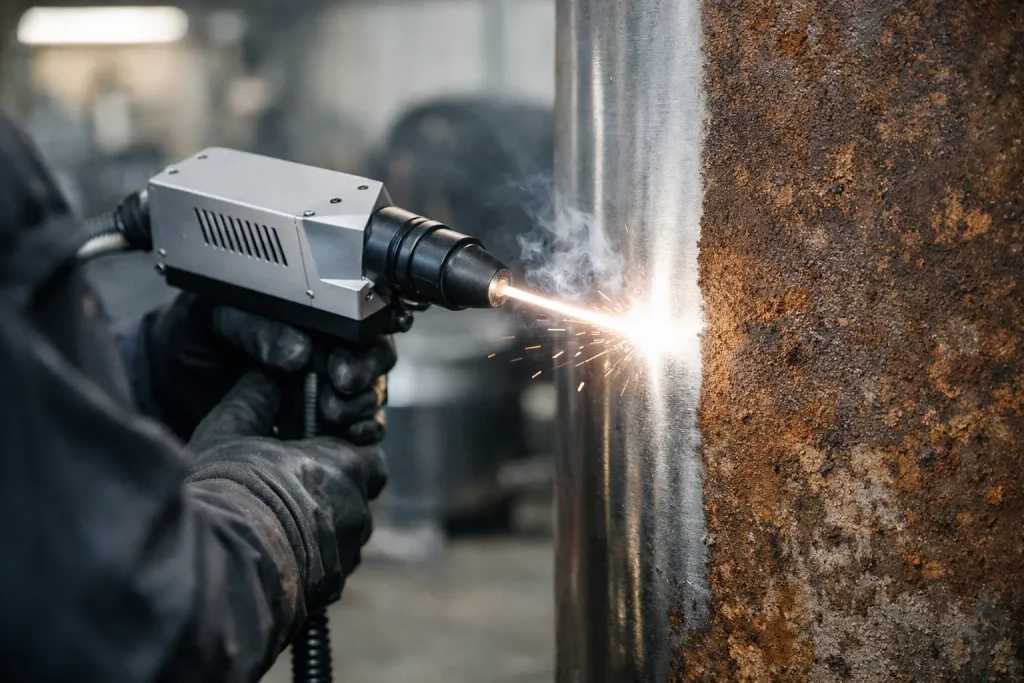
A corroded flange, a painted weld zone, or oil baked onto a critical surface can turn a simple maintenance task into a delay that affects an entire schedule. That is where laser ablation cleaning services stand out. Instead of blasting media across a surface or introducing chemical agents that create disposal and safety issues, laser cleaning targets contamination with control, leaving the base material intact.
For plant managers, contractors, and asset integrity teams, that difference is not just technical. It affects downtime, access planning, waste handling, inspection quality, and the long-term condition of the asset. In environments where surface preparation has to be precise and disruption has to stay low, laser ablation is often the more practical option.
What laser ablation cleaning services actually do
Laser ablation cleaning services use focused laser energy to remove unwanted material from a surface. That can include rust, oxides, coatings, paint, carbon deposits, oil residue, grease, and other contaminants. The energy interacts with the contamination layer so it breaks down and separates from the substrate underneath.
The key advantage is selective removal. A properly controlled process can strip away surface contamination without cutting into the underlying steel, aluminum, stone, or other base material. That matters when tolerances are tight, surface integrity is critical, or the item being cleaned has value beyond its function, as with heritage restoration or delicate fabricated components.
This is why laser cleaning is used across maintenance, inspection preparation, weld cleaning, coating removal, and restoration work. It is not simply a different way to clean. It is a different level of control.
Why industries are shifting to laser ablation cleaning services
Traditional cleaning methods still have their place, but they often come with trade-offs that become expensive once the full job scope is considered. Abrasive blasting can be effective, but it usually requires containment, media management, cleanup, and a higher risk of affecting the substrate. Chemical cleaning may handle certain contaminants well, but it introduces worker exposure concerns and waste disposal requirements that complicate execution.
Laser ablation cleaning services reduce many of those constraints. There is no blasting grit to recover, no secondary media embedded into the surface, and no chemical runoff to manage. For operating facilities, that can simplify site preparation and make it easier to perform cleaning in sensitive or space-constrained areas.
The operational benefit is often most visible in shutdown planning. Less setup, less containment, and less post-cleaning cleanup can shorten the overall work package. When cleaning is part of a larger maintenance sequence, that time savings can matter as much as the cleaning result itself.
Where laser cleaning makes the strongest impact
Not every job requires the same level of precision, but several applications consistently benefit from laser-based removal.
Rust and oxide removal
Corrosion is one of the clearest use cases. Rust and oxide layers can be removed in a controlled way without aggressive abrasion against the base metal. This is especially useful when the cleaned surface will be inspected, recoated, welded, or returned to service under demanding conditions.
Coating and paint removal
Removing paint or coatings from selected zones is often harder than it sounds. Mechanical methods can spread debris and damage adjacent areas. Chemical stripping can be messy and slow. Laser cleaning allows targeted removal, which is valuable for localized repair work, surface preparation, and rework on high-value components.
Weld preparation and post-weld cleaning
Surface condition affects weld quality. Laser cleaning can remove oxides, contamination, and residues from weld areas before joining, and it can also support post-weld cleanup where a clean, consistent finish is required. For fabrication and repair teams, that level of control helps improve repeatability.
Oil, grease, and industrial residue removal
Contamination is not always visible as thick rust or coating. In many industrial settings, surfaces accumulate oil films, grease, carbonized residue, or process contamination that interferes with inspection, bonding, coating adhesion, or general maintenance. Laser ablation can remove those layers without introducing additional contaminants.
Restoration and sensitive surface work
Laser cleaning is also useful where preservation matters. Stone, metal features, heritage assets, and architectural elements often require careful cleaning rather than aggressive stripping. In these cases, selectivity is the difference between restoration and damage.
The real value is substrate protection
A clean surface is the immediate goal, but substrate protection is often the bigger reason buyers choose laser ablation cleaning services. If the cleaning method alters dimensions, roughens the surface excessively, embeds media, or removes sound material along with the contamination, the job is already creating the next problem.
This is where laser cleaning changes the conversation. Because the process can be tuned to the material and the contaminant layer, it supports a more measured approach. That is important for machined parts, thin sections, weld zones, stainless surfaces, and components that need to meet inspection or coating standards without unnecessary material loss.
It also matters for appearance. On visible metal features, restoration work, and selected commercial or residential applications, the difference between cleaned and damaged is obvious. Precision is not a premium feature in those jobs. It is the requirement.
Safety, waste, and site logistics
Procurement teams and operations leaders are often looking at more than cleaning performance. They are also evaluating safety exposure, waste streams, access constraints, and how much disruption a method creates around live operations.
Laser ablation cleaning services are attractive because they reduce many of the side effects that come with conventional methods. There is no blast media spreading through the work area. There are no chemicals requiring storage, handling, and disposal as hazardous waste. The work zone can often be more contained and easier to manage.
That does not mean every project is simple. Laser cleaning still requires trained operators, proper safety controls, and a clear understanding of the surface and contaminant involved. But from a project delivery standpoint, it often removes layers of complexity that owners would prefer not to pay for.
It depends on the job
The strongest technical solutions are rarely universal, and laser cleaning is no exception. Surface geometry, contaminant thickness, access, material type, and production deadlines all influence whether laser ablation is the best fit.
For example, heavily scaled surfaces over very large open areas may call for a comparison between laser cleaning and other preparation methods based on speed, specification, and cost. On the other hand, if the priority is selective removal, minimal waste, or substrate preservation, laser cleaning usually gains a clear advantage.
This is why service selection should start with the application, not with the equipment. A qualified provider will assess the base material, the contaminant layer, the required finish, and the site conditions before defining the approach. That upfront evaluation is what turns a promising technology into a reliable service outcome.
What to look for in a laser cleaning partner
When evaluating laser ablation cleaning services, experience in real operating environments matters. Industrial cleaning is rarely performed under ideal workshop conditions. Access may be restricted, shutdown windows may be narrow, and the cleaning scope may sit inside a larger maintenance or construction sequence.
A capable service partner should understand those constraints and plan around them. That includes confirming the cleaning objective, selecting the right process settings, controlling the work area, and coordinating with the broader project team. Technical capability is essential, but service execution is what determines whether the method delivers actual value on site.
It also helps to work with a provider that can translate the process into practical outcomes. Decision-makers do not need a lecture on laser physics. They need to know whether the method will protect the substrate, reduce downtime, improve inspection readiness, and support safer, cleaner project delivery.
As the first and possibly still the only laser cleaning service company in Singapore, BKR Engineering has seen how quickly buyers move from curiosity to adoption once they see the cleaning result and the reduction in downstream complications.
Why the method is gaining ground
The rise of laser cleaning is not driven by novelty. It is driven by pressure on maintenance and capital projects to do more with less disruption. Asset owners want reliable cleaning that does not create another waste stream. Contractors want methods that reduce setup and cleanup. Engineers want surface preparation that supports quality without sacrificing material integrity.
Laser ablation cleaning services meet that demand because they align technical performance with operational reality. They remove contamination precisely, support safer work environments, and help teams avoid the hidden costs that often come with blasting and chemical cleaning.
If you are evaluating options for corrosion removal, coating removal, inspection preparation, or sensitive restoration work, the right question is not whether laser cleaning is newer. It is whether your current method is costing more time, more risk, and more material than the job should require.