
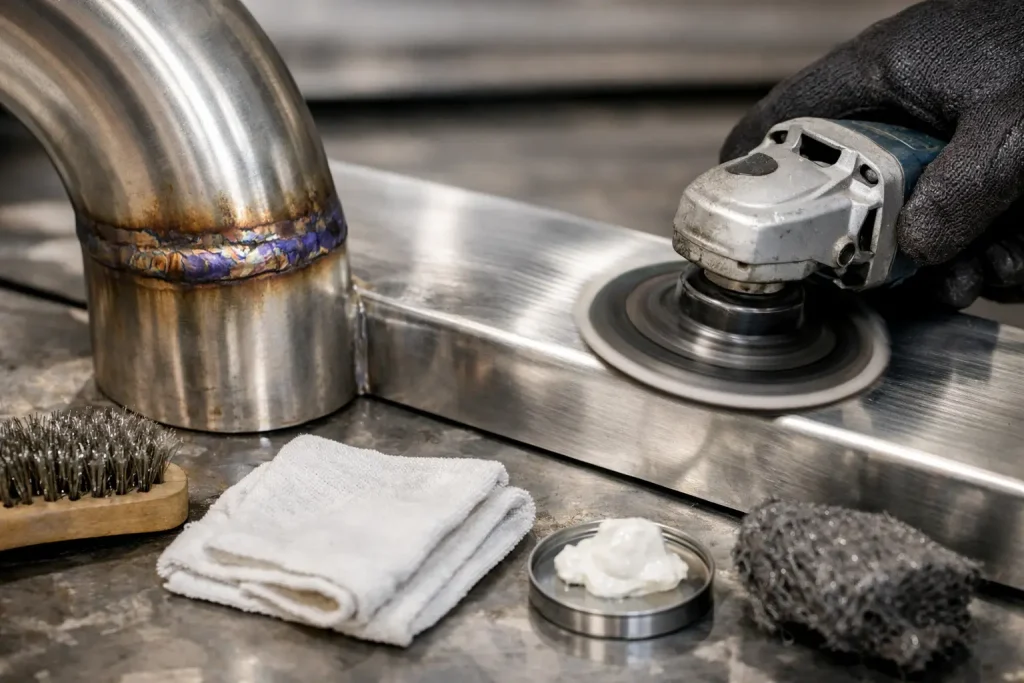
That blue, straw, or dark brown band around a weld is not just a cosmetic issue. If you need to remove heat tint stainless, the real goal is restoring the surface condition that gives stainless steel its corrosion resistance in the first place. In fabrication, plant maintenance, and inspection prep, that matters far more than appearance alone.
Why heat tint on stainless steel matters
Heat tint forms when stainless steel is exposed to elevated temperatures in the presence of oxygen, usually during welding or thermal processing. The visible discoloration is a sign that the protective chromium-rich oxide layer has been altered. In practical terms, the affected zone can have lower corrosion resistance than the surrounding base metal.
That is why heat tint removal is commonly specified in sanitary systems, pharmaceutical piping, food-grade fabrication, architectural stainless, and corrosive industrial environments. On a handrail, the issue may be aesthetic and durability-related. On process piping or tanks, it can become an asset integrity concern.
The severity depends on the color and the heat input. Light straw tint may indicate a milder oxidation condition than dark blue or black scale, but color alone is not enough to make the call. Service environment, finish requirements, and code or client specifications all influence the right cleaning method.
How to remove heat tint stainless without damaging the surface
There is no single best method for every job. The right approach depends on alloy grade, weld geometry, surface finish, access, contamination risk, and whether the component is already installed. What works in a fabrication shop may be a poor fit for an operating plant.
Mechanical removal
Mechanical methods include abrasive pads, flap wheels, grinding discs, and blasting media. These can remove the visible tint quickly, but they also come with trade-offs. If the abrasive is too aggressive, it can roughen the surface, smear contamination into the metal, or remove more base material than intended.
That matters on precision fabrications, thin sections, decorative finishes, and components where surface profile affects cleanability or coating performance. Mechanical cleaning can be effective for heavy oxide or when finish restoration is already part of the scope, but it is not automatically the safest option for stainless.
Another concern is cross-contamination. If tools have been used on carbon steel, embedded iron can trigger future rust staining. In controlled environments, dedicated stainless-only consumables are essential.
Chemical pickling and passivation
Chemical pickling pastes and gels are widely used to remove heat tint and restore the stainless surface. These products typically contain strong acids designed to dissolve the oxide layer and leave a chemically cleaned surface. Passivation may follow, depending on the process and specification.
This method is proven, but it is not simple from a safety or environmental standpoint. Acid handling, fume control, PPE, rinse water management, and waste disposal all need attention. On-site use can also be slow, especially when access is difficult or adjacent equipment must be protected.
For small shop-based weld cleanup, chemicals may still be practical. For live industrial environments, confined areas, or projects with strict environmental controls, the burden can be much higher than the cleaning step itself.
Electrochemical weld cleaning
Electrochemical systems use conductive solutions and current to clean weld discoloration. These systems are popular in stainless fabrication because they can be fast and produce a bright finish on localized weld zones.
They are useful, particularly for TIG weld cleanup on smaller assemblies. Still, the method has limits. Coverage rate can be slow on large areas, consistency depends on operator technique, and chemical handling has not disappeared entirely. It is often a good workshop tool, but not always the best answer for larger field jobs.
Laser cleaning for heat tint removal
Laser cleaning offers a different approach. Instead of grinding the surface or applying aggressive chemicals, a controlled laser beam ablates the oxide and discoloration layer with high precision. The aim is selective removal of the contaminant or altered layer while preserving the underlying stainless substrate.
For organizations that need to remove heat tint stainless components in sensitive or high-value applications, that precision is the main advantage. Laser cleaning can target localized weld zones, complex geometries, and installed equipment with minimal secondary waste. There is no blasting media to contain and no chemical slurry to neutralize and dispose of.
This becomes especially valuable where downtime, housekeeping, and substrate protection drive the decision. In many industrial settings, the cleanup around the cleaning process is where costs begin to expand. A method that reduces overspray, consumables, and post-job waste handling can simplify the whole project.
When laser cleaning makes the most sense
Laser cleaning is not a universal replacement for every traditional method. If a surface already requires heavy grinding or complete refinishing, another process may still be part of the scope. But in many stainless applications, it fits exceptionally well.
Weld discoloration on tanks, piping, frames, cladding, food-grade components, and architectural finishes often calls for controlled treatment rather than aggressive material removal. The same is true when nearby assets cannot be exposed to chemicals or abrasive dust. In operating facilities, reducing setup and containment can be as important as the cleaning result itself.
This is where service execution matters. The equipment is only part of the equation. Surface response varies by alloy, tint severity, finish, and access conditions. An experienced operator adjusts the process to remove the oxide effectively without creating unnecessary heat input or visual inconsistency.
BKR Engineering applies laser cleaning with exactly that mindset – controlled removal, substrate protection, and practical delivery in real operating environments.
What facility and fabrication teams should evaluate first
Before choosing a removal method, it helps to define the job beyond the words heat tint removal. A few project variables tend to decide the best path.
First is the service environment. Stainless used in coastal, chemical, sanitary, or high-humidity conditions has a different risk profile than decorative stainless in a dry interior setting. The corrosion consequences of incomplete treatment are not the same.
Second is the required finish. Some projects only need the affected area cleaned to restore corrosion performance. Others require a uniform visual finish across an exposed surface. If appearance is critical, the cleaning method needs to match the final acceptance standard.
Third is site logistics. Is the component in a shop, on a skid, inside an active plant, or installed overhead? Chemical methods that work well on a bench can become difficult on vertical surfaces, confined spaces, or areas with drainage restrictions.
Fourth is waste and safety control. Abrasives and chemicals often create handling requirements beyond the cleaning task itself. For facilities trying to reduce hazardous waste streams and simplify permits or housekeeping, that issue is not secondary.
Common mistakes when removing heat tint from stainless
One common mistake is treating discoloration as a stain instead of a metallurgical surface condition. If the process only lightens the color without properly addressing the affected oxide layer, the stainless may still be left vulnerable.
Another is overcleaning. Excessive grinding can gouge the surface, change the finish, and reduce material thickness where you least want it – near a weld. On thin-gauge stainless or polished finishes, that damage can be harder to correct than the original tint.
Cross-contamination is another frequent problem. Shared tools, dirty work areas, or improper handling can introduce carbon steel particles that later show up as rust spots. Teams sometimes blame the stainless grade when the real issue is contamination during cleanup.
The last mistake is selecting a method based only on upfront labor. Fast removal is not always low total cost if it creates disposal, rework, containment, or finish restoration requirements afterward.
Choosing the right process for long-term results
If your priority is simple discoloration cleanup on a small bench-top fabrication, several methods can work. If your priority is protecting corrosion resistance, minimizing substrate impact, reducing waste, and keeping field operations efficient, the decision becomes narrower.
That is why more asset owners, fabricators, and maintenance teams are reassessing how they remove heat tint stainless steel. The better question is not just what removes the color. It is what restores the surface condition with the least operational downside.
For stainless work, the cleanest-looking result is not always the best result. The right method is the one that respects the metal, the environment around it, and the realities of the job site. That is usually where long-term performance starts.