
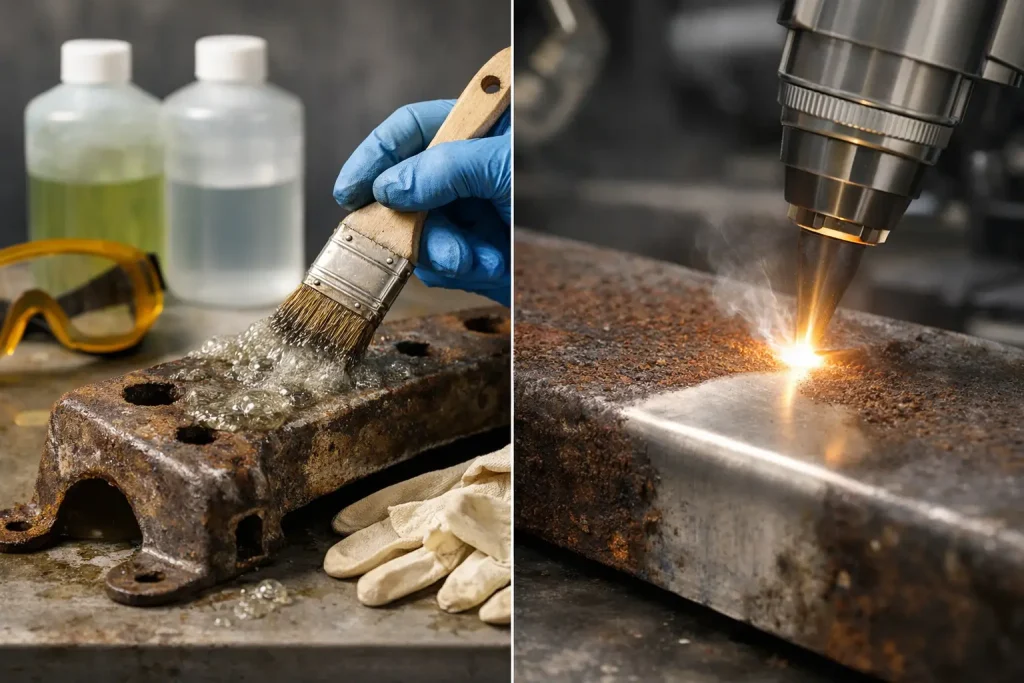
A coating failure on a critical asset rarely starts as a cleaning problem. It starts as a production risk, an inspection delay, or a repair scope that keeps expanding. That is why chemical stripping vs laser is not just a process comparison. It is a decision about substrate protection, shutdown time, waste handling, and how much control you need over the outcome.
For plant managers, contractors, and asset integrity teams, the better option depends on the coating, the base material, the work environment, and the tolerance for mess, containment, and rework. Both methods can remove unwanted layers. The real difference is how they do it, and what they leave behind.
Chemical stripping vs laser: the basic difference
Chemical stripping removes coatings or contamination by applying a solvent, caustic, or other reactive formulation that breaks down the target layer. The material is then scraped, rinsed, or washed away. In the right conditions, it can be effective on thick or complex coating systems, especially where full removal is required across irregular shapes.
Laser cleaning uses controlled laser ablation to remove rust, oxides, paint, oil, grease, and similar contaminants from a surface. Instead of soaking the workpiece in chemistry, the laser targets the unwanted layer with precision. The process is dry, highly controllable, and does not rely on abrasive contact with the substrate.
That distinction matters in the field. One method depends on chemical reaction and post-cleanup. The other depends on energy control and selective removal.
Where chemical stripping still makes sense
Chemical stripping is not obsolete. In some jobs, it remains a practical option.
If a project involves heavy coating buildup over large, non-sensitive surfaces, chemical methods may offer acceptable removal at a familiar cost structure. Some operations also already have chemical handling procedures, wash areas, and waste systems in place, which can make adoption straightforward from a procurement standpoint.
It can also be useful when the geometry makes line-of-sight access difficult for other methods. Deep recesses, enclosed profiles, or components that can be immersed off-site may be candidates for chemical treatment.
But those advantages come with conditions. Dwell time, neutralization, rinsing, worker exposure, residue management, and disposal all need to be controlled properly. On paper, the stripping step may look simple. In practice, the surrounding handling requirements often drive the real cost.
Where laser cleaning changes the equation
Laser cleaning is especially effective when the job demands precision, minimal substrate impact, and less disruption around the work area. That makes it well suited for corrosion removal, weld preparation, selective coating removal, and inspection prep on high-value assets.
For maintenance teams, one of the biggest operational advantages is control. The laser can be adjusted to remove the target layer while preserving the underlying material. That is important on machined surfaces, fabricated assemblies, stainless steel, heritage elements, and components where dimensional integrity matters.
The process also reduces secondary waste. There is no slurry, no spent chemical bath, and no large-volume hazardous liquid disposal stream. In many industrial environments, that changes the planning burden immediately. Less containment, less cleanup, and less interruption around adjacent operations can translate into shorter outage windows.
Surface protection is often the deciding factor
If your asset has little tolerance for base-metal loss or unintended damage, laser cleaning has a clear advantage.
Chemical stripping can attack more than the coating if the chemistry is not matched correctly or if dwell times drift. Certain substrates, seals, adjacent finishes, and bonded materials may be vulnerable. Even when the chemical itself is appropriate, the follow-up scraping or rinsing can introduce inconsistency.
Laser cleaning offers a more selective approach. That does not mean every laser setting is safe for every surface. It means the process can be tuned with a higher degree of precision. For projects involving localized removal, corrosion around welds, or cleaning before NDT or recoating, that level of control is often worth more than raw stripping speed.
This is one reason specialized service providers are increasingly used in industries where rework is expensive. When the cost of damaging the substrate is higher than the cost of cleaning, precision becomes a financial issue, not just a technical one.
Safety and environmental impact are not side issues
In chemical stripping vs laser, safety is not limited to operator PPE. It includes ventilation requirements, confined-space implications, fire considerations, runoff control, and what happens to the waste after the job is done.
Chemical stripping can involve corrosive or hazardous substances, vapors, skin contact risk, and contaminated rinse water. That does not make it unworkable, but it does increase the number of controls required to execute the job responsibly. In regulated environments, disposal and documentation can also become significant parts of the project scope.
Laser cleaning has its own safety requirements, including eye protection, fume extraction, and trained operation. But from an environmental and housekeeping perspective, it is often cleaner to manage. There is no chemical runoff and no need to transport or store large quantities of stripping agents. For companies under pressure to reduce hazardous waste generation, that matters.
What about speed and cost?
This is where buyers need a realistic view. The cheapest method on a quote sheet is not always the lowest-cost method on the job.
Chemical stripping may appear less expensive upfront, especially for broad-area coating removal. But total cost includes masking, application time, dwell time, rinsing, cleanup, waste handling, drying, and the impact on surrounding operations. If the work area requires significant containment or the asset must stay offline longer, the economics can shift quickly.
Laser cleaning can carry a higher apparent service rate, but it often reduces indirect cost. Faster setup, less secondary cleanup, lower disposal burden, and reduced risk of substrate damage all affect the final number. In outage-driven environments, the value of shorter downtime may outweigh the difference in process cost.
The right question is not which method is cheaper per hour. It is which method delivers the required surface condition with the least operational disruption and least downstream risk.
Chemical stripping vs laser for common applications
For rust and oxide removal, laser cleaning is often the stronger choice when substrate preservation matters. It can remove corrosion products without the aggressive side effects associated with many wet or abrasive methods.
For selective paint or coating removal, laser cleaning is highly effective when only specific areas need treatment, such as weld zones, repair windows, or inspection points. Chemical stripping may be more practical when complete coating removal is needed across complex surfaces and the work can be isolated and managed properly.
For oil, grease, and light surface contamination, laser cleaning can support production and maintenance tasks with minimal preparation. Chemical cleaning may still be used where bulk degreasing is required, but it usually creates more cleanup and handling complexity.
For heritage restoration or sensitive surfaces, precision matters more than brute force. This is where experienced laser cleaning teams can offer a safer path, especially when preserving detail, finish, or underlying material is part of the brief.
How to choose the right method for your site
Start with the asset, not the cleaning method. What is the substrate? What exactly needs to be removed? How much of it is there? Is full removal needed, or only selective removal? What surface profile or finish is required afterward?
Then look at the job environment. Is the work happening in a live plant, a shutdown, a public-facing property, or a restoration setting? Are there drainage limits, confined-space concerns, or adjacent systems that make chemical use difficult? How expensive is downtime? How difficult will waste disposal be?
Finally, assess the consequence of error. If slight over-cleaning, residue retention, or material loss would cause rework or compromise performance, precision should weigh heavily in the decision. This is where laser cleaning often proves its value.
A qualified contractor should be able to review the substrate, contamination type, access conditions, and project constraints before recommending a method. In many cases, the right answer is not ideological. It is practical. Some jobs still suit chemical stripping. Others clearly benefit from laser ablation, especially where control, cleanliness, and asset protection are priorities.
For organizations looking to reduce waste, protect critical surfaces, and keep maintenance scopes tighter, laser cleaning is no longer a niche option. It is a serious operational tool. BKR Engineering sees that shift firsthand across industrial and restoration projects where precision is not optional.
The best cleaning method is the one that solves the surface problem without creating three new ones for safety, disposal, and production.
Pingback: 10 Laser Cleaning Benefits That Matter | BKR Engineering Pte Ltd