
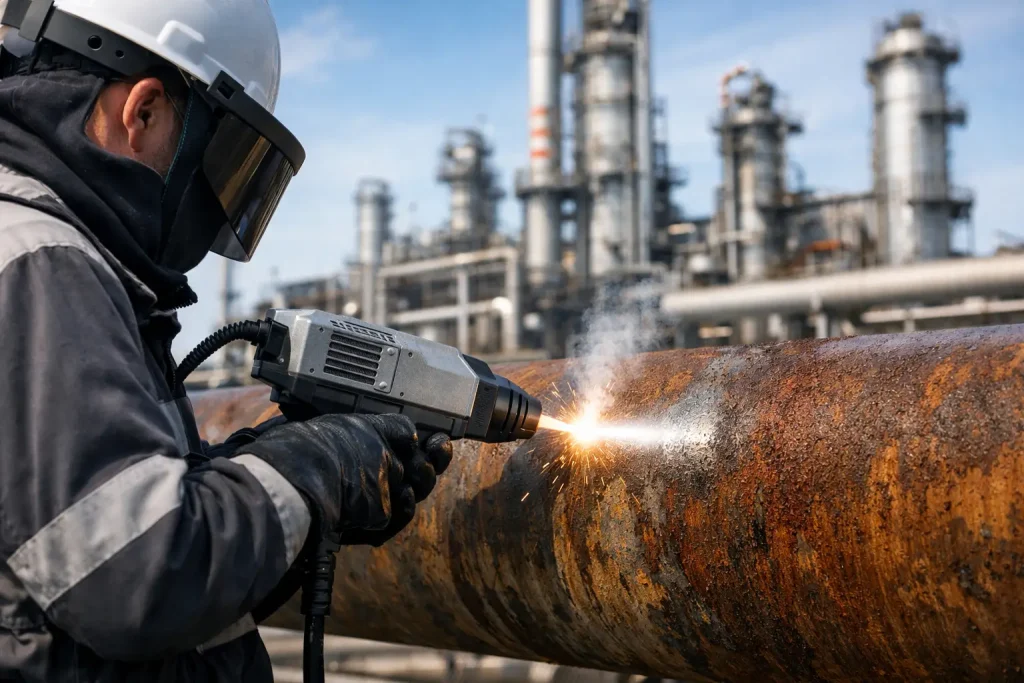
A refinery shutdown schedule rarely has room for trial and error. When corrosion, failed coatings, or heavy surface contamination block inspection or repair work, the cleaning method has to do more than remove material – it has to protect the asset, fit the work window, and avoid creating a bigger disposal problem than the one already on site. That is exactly why a laser cleaning refinery case study matters to maintenance planners and asset integrity teams.
In refinery environments, the cleaning decision is usually tied to a larger operational question. Can the team expose the surface clearly enough for inspection? Can they remove contamination without changing the profile of the base metal? Can they do it in a congested area without building large containment systems or introducing secondary media that must then be recovered and disposed of? Laser cleaning stands out because it answers those questions differently from abrasive blasting and chemical methods.
Where laser cleaning fits in refinery work
Refineries present a mix of cleaning challenges. Carbon steel structures develop corrosion under failed coatings. Stainless components pick up oxide layers, oil residue, and process contamination. Weld zones require precise preparation before NDT, recoating, or localized repair. In many cases, the target is not broad, aggressive material removal across a wide open yard. It is selective cleaning in live industrial conditions where surrounding assets, access limitations, and safety controls shape what is practical.
That matters because not every surface in a refinery should be treated the same way. Abrasive blasting can be effective on large external steelwork, but it also introduces grit, dust, masking requirements, and cleanup demands. Chemical cleaning can help in some situations, but waste handling, operator exposure, and compatibility with adjacent materials can become constraints. Laser cleaning offers a controlled alternative when precision and containment matter as much as speed.
Laser cleaning refinery case study – a practical scenario
Consider a refinery maintenance project involving corroded pipe supports, coating breakdown on localized steel surfaces, and contamination around weld-adjacent areas scheduled for inspection. The site team needed a cleaning process that would expose sound metal without excessive removal of parent material. The work area was active, space was limited, and the shutdown window was tight.
The first issue was access. Traditional blasting would have required additional enclosure planning and media management in a congested area. That setup burden alone risked slowing adjacent work fronts. The second issue was inspection quality. Surface preparation had to remove rust, oxides, and residual coating cleanly enough for evaluators to assess metal condition, but without embedding media or altering the geometry of the component. The third issue was waste. The client wanted to reduce secondary cleanup and avoid unnecessary hazardous disposal streams.
Laser cleaning addressed those constraints directly. The equipment was deployed to target only the affected zones, allowing technicians to strip corrosion products, failed coatings, and surface contamination with a high degree of control. Because the process relies on laser ablation rather than impact media, the underlying substrate remained intact when the correct settings were used. That gave the inspection team a cleaner, more reliable view of the actual metal condition.
The operational benefit was not just the cleaning result itself. It was the reduction in supporting work. There was less setup compared with a conventional blasting arrangement, less material introduced into the work area, and less post-cleaning recovery. For refinery teams coordinating multiple contractors during a maintenance event, that simplification can be as valuable as the cleaning speed.
What changed after cleaning
Once the affected areas were treated, the difference was immediate and visible. Corrosion and residual coating were removed in a defined path, making it easier to distinguish between surface contamination and actual substrate loss. That visual clarity supports faster decision-making on whether an area can proceed directly to recoating, needs localized repair, or should be escalated for further engineering review.
This is where laser cleaning often proves its value in refinery settings. It is not only a cleaning tool. It is an enabling step for inspection, maintenance, and quality control. When a surface is cleaned selectively, teams can preserve more of the asset while still preparing it for the next activity. That can reduce unnecessary rework and prevent over-treatment of components that still have usable life.
For coating preparation, the benefit is similar. A well-cleaned surface gives coating contractors a better starting point, especially on spots where old paint, rust, or oils would otherwise compromise adhesion. The exact surface requirement still depends on the coating system and specification, so laser cleaning is not a universal replacement for every blast profile requirement. But for many localized refinery maintenance tasks, it offers a strong balance of cleanliness, control, and substrate protection.
Why refineries look closely at trade-offs
A credible laser cleaning refinery case study should not present the technology as a perfect answer for every asset and every square foot of steel. The real value comes from matching the method to the application.
For example, if a refinery needs to strip very large open areas at high production rates, abrasive blasting may still make sense depending on the specification, access, and containment plan. If the issue is deeply bonded material across a broad surface where a defined anchor profile is mandatory, the economics may favor conventional preparation. Laser cleaning becomes especially compelling where selectivity, reduced collateral impact, and cleaner site conditions matter more than brute-force area coverage.
That distinction is important for plant managers and procurement teams. Good project planning is not about choosing the newest technology. It is about choosing the method that reduces total disruption while meeting technical requirements. In many refinery jobs, the direct cleaning cost is only one part of the picture. Setup time, scaffolding duration, shutdown coordination, waste disposal, QA hold points, and nearby equipment protection all affect the real project cost.
Safety and environmental value in refinery maintenance
Refineries operate under strict safety and environmental expectations, so cleaning methods are evaluated on more than surface results. Laser cleaning reduces the need for blasting media and chemical agents, which in turn can reduce worker exposure pathways and simplify waste handling. That does not remove the need for controls – laser operations still require trained personnel, proper PPE, and site-specific safety management – but it changes the risk profile in useful ways.
From an environmental standpoint, less secondary waste is a major advantage. Abrasive and chemical systems often generate a larger downstream burden in collection, segregation, and disposal. By contrast, laser cleaning removes contamination without introducing an additional bulk consumable into the process. For refinery operators under pressure to improve sustainability while maintaining asset reliability, that is a practical gain rather than a marketing point.
What decision-makers should evaluate
When assessing whether laser cleaning is appropriate for a refinery project, decision-makers should start with the actual work scope. The most useful questions are straightforward. Is the cleaning localized or extensive? Is substrate preservation critical? Will inspection sensitivity be affected by the cleaning method? How difficult will containment and cleanup be with conventional methods? What is the cost of extra downtime if setup expands?
The answers usually reveal where laser cleaning has the strongest fit. It performs well where teams need controlled removal of rust, oxides, coatings, grease, or residues from valuable assets without damaging the base material. It is also well suited to jobs where visual quality matters, because the before-and-after effect is clear and easy for stakeholders to verify on site.
That clarity is one reason specialized providers such as BKR Engineering are increasingly relevant to industrial maintenance planning. In refinery work, technical capability matters, but so does execution in real site conditions. The value comes from understanding how to tune the process to the contaminant, the substrate, and the operational window.
For refinery operators, the best cleaning method is the one that helps the next task happen faster and with fewer complications. If laser cleaning can expose the surface accurately, reduce waste, and shorten the path to inspection or repair, it earns its place on the maintenance plan. The smartest projects are usually the ones where cleaning is treated not as an isolated activity, but as a lever for safer, cleaner, and more efficient asset work.