
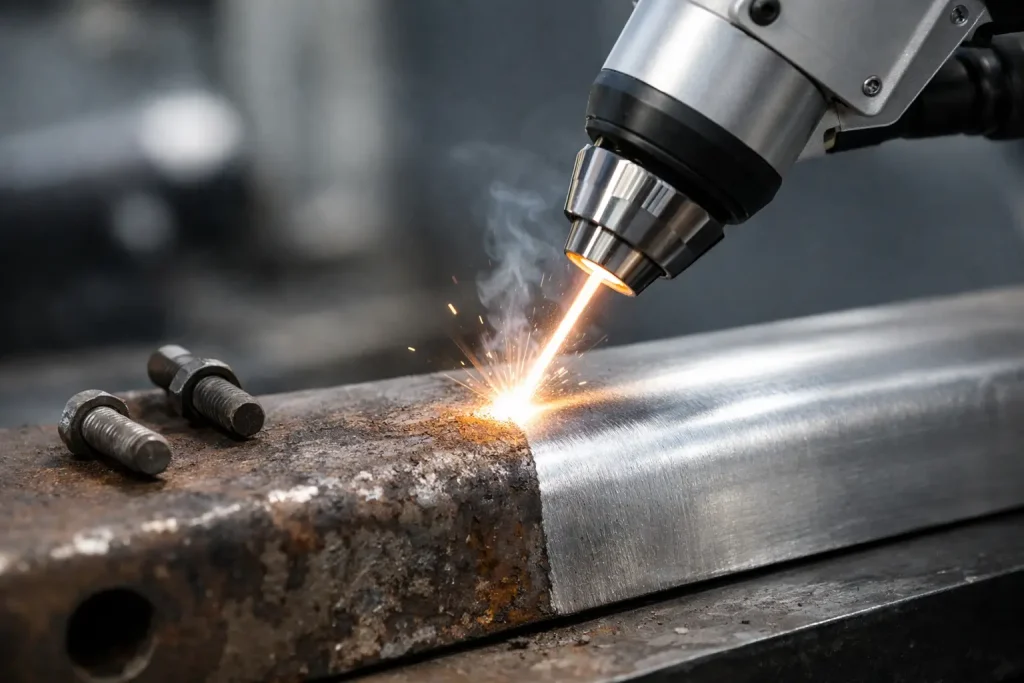
A maintenance team usually asks this question right before approving a trial on a critical asset: does laser cleaning damage metal? It is the right question to ask, especially when the substrate is expensive, the tolerances matter, and a shutdown window is tight. The short answer is that properly controlled laser cleaning is designed not to damage the underlying metal. The longer answer is that results depend on the condition of the surface, the type of contaminant, the metal itself, and how well the process is set up.
That distinction matters. Laser cleaning is not magic, and it is not simply a matter of pointing a beam at a surface and expecting a perfect outcome. It is a controlled ablation process. When the settings are matched to the contaminant layer, laser energy removes rust, paint, oxides, oil residue, or other unwanted material while preserving the base substrate below.
Why the answer to does laser cleaning damage metal depends on control
Laser cleaning works by delivering short, concentrated pulses of energy to the surface. Those pulses are absorbed more readily by contaminants or coatings than by the underlying metal, especially when the process is tuned correctly. That is what makes selective removal possible.
In practical terms, the goal is not to heat the metal indiscriminately. The goal is to target the layer that needs to come off, whether that is corrosion, a coating, or embedded contamination. When power, pulse duration, scan speed, focal distance, and overlap are set correctly, the process strips away the unwanted layer with high precision.
This is why experienced operators matter. A laser cleaning system can be precise, but precision only delivers value when the process is matched to the application. Heavy rust on structural steel, oxide removal on a weld zone, and coating removal on heritage metalwork are not the same job. They require different settings, testing, and quality checks.
When laser cleaning is safe for metal surfaces
For many industrial applications, laser cleaning is one of the safest surface preparation methods available for the substrate. It is especially valuable where abrasive blasting may erode the surface profile too aggressively or chemical cleaning may leave residues, create disposal issues, or introduce safety concerns.
Laser cleaning is generally well suited for carbon steel, stainless steel, aluminum, copper, brass, and other metallic surfaces, provided the process is calibrated to the material and the contamination level. In maintenance and fabrication environments, it is commonly used to remove rust, mill scale, oxides, paint, grease, and surface buildup without unnecessary material loss.
That makes it useful in several situations where base metal preservation is critical. Asset owners may need to clean around welds before inspection, remove corrosion from machinery components, prepare surfaces for recoating, or restore delicate architectural metal features. In each of these cases, preserving the substrate is not a secondary benefit. It is the main requirement.
What can cause metal damage during laser cleaning?
The honest answer is that any cleaning process can damage metal if it is used incorrectly. Laser cleaning is no exception. If settings are too aggressive, dwell time is too long, or the wrong laser type is used for the application, the substrate can be affected.
Potential issues include surface discoloration, localized overheating, texture changes, or unwanted removal of base material. On thin sections or heat-sensitive components, poor process control can increase risk. Reflective metals can also behave differently than heavily oxidized steel, so they require additional attention during setup.
This is where a lot of misunderstanding comes from. People sometimes compare laser cleaning to a universal, one-setting tool. It is not. It is a process that should be tested, adjusted, and verified. In capable hands, the technology offers excellent substrate protection. In unqualified hands, it can be pushed beyond what the material should tolerate.
Does laser cleaning damage metal compared with blasting or chemicals?
This is often the more useful question for plant managers and project teams, because surface cleaning is rarely judged in isolation. It is judged against alternatives.
Compared with abrasive blasting, laser cleaning is typically far gentler on the underlying substrate. Blasting removes contamination by mechanical impact. That can be effective, but it can also change surface profile, remove sound material, and create secondary waste. On delicate metals, sharp edges, machined surfaces, or detailed components, that trade-off may be unacceptable.
Compared with chemical cleaning, laser cleaning avoids many of the concerns tied to chemical handling, residue management, and waste disposal. Chemicals can also present compatibility issues with certain metals or downstream coatings if not managed carefully. Laser cleaning removes contaminants without introducing blasting media or liquid chemicals to the work area.
That does not mean laser cleaning is always the answer. Large open surfaces with low substrate sensitivity may still be cleaned with other methods depending on cost, speed, and site conditions. But where metal preservation, precision, and cleanliness matter, laser cleaning often provides a better balance of performance and control.
Factors that determine whether laser cleaning will affect the substrate
The first factor is the metal itself. Carbon steel behaves differently from aluminum, and both behave differently from copper alloys. Thermal conductivity, reflectivity, thickness, and finish all influence how the laser interacts with the surface.
The second factor is the contaminant layer. Loose rust, bonded oxides, multilayer paint systems, carbonized residue, and grease do not respond the same way. Some layers absorb energy efficiently and come off cleanly. Others require multiple passes or more refined process control.
The third factor is the cleaning objective. Are you cleaning for inspection, for coating adhesion, for weld preparation, or for cosmetic restoration? The target finish matters. A project that needs selective oxide removal from a weld seam has a different tolerance than one that involves decorative restoration on visible metalwork.
The fourth factor is access and geometry. Flat plate is straightforward. Corners, crevices, fasteners, curved sections, and mixed-material assemblies require more careful handling. The more complex the geometry, the more important operator control becomes.
How professionals prevent damage during laser cleaning
The most reliable approach starts with application review and trial testing. Before full-scale work begins, a qualified team should assess the substrate, identify the contamination, and confirm the desired finish. This step is not administrative overhead. It is how you avoid surprises on live assets.
From there, settings are tuned to the job. Power is adjusted to remove the unwanted layer without overdriving the substrate. Scan pattern and speed are controlled to prevent excessive heat buildup. Focus is kept consistent so energy is delivered predictably across the surface.
Visual inspection also matters. One reason laser cleaning is so effective in field conditions is that operators can see the cleaning front develop in real time. That makes it easier to verify removal quality and stop precisely at the base material. For clients, this visual control is a major advantage because it supports confidence, traceability, and cleaner acceptance standards.
At BKR Engineering, this practical discipline is what turns laser cleaning from an interesting technology into a dependable industrial service. The value is not just the machine. It is the controlled execution that protects the asset while reducing downtime and secondary waste.
Where laser cleaning is especially valuable
Laser cleaning is particularly effective where the consequences of substrate damage are high. That includes corrosion removal on structural steel, surface preparation around welds, cleaning before NDT or coating, removal of residue from manufacturing tools, and restoration work on heritage or decorative metal elements.
It is also useful in live industrial environments where blasting containment is difficult or where chemical cleaning creates unnecessary operational burden. Oil and gas facilities, fabrication shops, infrastructure maintenance projects, and high-value buildings often need a method that is precise, contained, and easier to manage within active work zones.
In those settings, the question is not only whether the metal will be damaged. It is whether the cleaning method fits the broader realities of safety, access, waste handling, and outage planning. Laser cleaning is often chosen because it addresses all of those factors at once.
The real answer: safe when specified and executed properly
So, does laser cleaning damage metal? When specified correctly and carried out by experienced professionals, it is specifically intended not to damage the underlying metal. That is why it has become such a strong option for surface preparation, restoration, and maintenance on valuable assets.
Still, the right answer is not a blanket yes or no. It depends on the metal, the contaminant, the cleaning objective, and the quality of process control. If a project involves sensitive surfaces, critical tolerances, or high-consequence equipment, the smartest next step is not to guess. It is to evaluate the substrate, test the process, and choose a cleaning method that protects the asset as carefully as it cleans it.
That is usually where good project outcomes begin – not with the fastest method on paper, but with the one that removes exactly what you need and leaves the metal you paid to keep.