
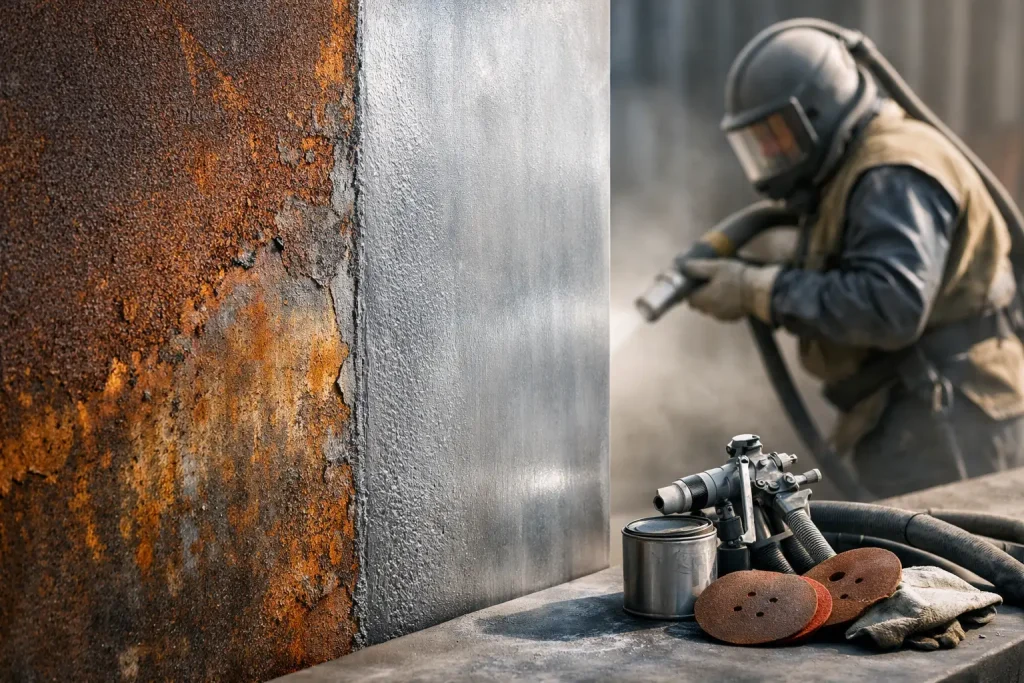
A coating failure often begins long before the paint is applied. Rust hidden in pits, oil around a weld, soluble salts on an outdoor structure, or a glossy layer of old coating can prevent adhesion even when the finished surface initially looks acceptable. For asset owners and maintenance teams, knowing how to prepare steel surfaces means controlling those risks before they become rework, corrosion, or unplanned downtime.
The right preparation method depends on the steel’s condition, the next process, the required cleanliness standard, and the consequences of damaging the base material. A heavily corroded pipe rack, a precision-machined component, and a heritage steel feature may all need contaminant removal, but they should not necessarily be treated the same way.
Start with the required end condition
Steel preparation is not simply about making metal look clean. It is about creating a surface condition that supports the next step, whether that is coating, welding, inspection, bonding, or restoration.
For coating work, the objective is usually to remove corrosion products, loose or failing coatings, oils, and other contaminants while producing the surface profile specified by the coating manufacturer. For weld preparation, the priority is a clean joint area free of paint, oxides, moisture, and hydrocarbons that could affect weld quality. For inspection, the goal may be to expose the actual substrate and reveal pitting, cracking, corrosion loss, or previous repairs without obscuring the evidence.
Before selecting equipment, confirm the coating system or work specification, the substrate condition, and access constraints. This prevents a common and costly mistake: cleaning beyond what the job requires, or using a method that leaves behind contaminants the next process cannot tolerate.
Inspect the steel before cleaning
A proper inspection determines what must be removed and what must be preserved. Look closely at the surface rather than judging it from a distance. Rust staining may be light surface oxidation, but it may also indicate deeper pitting beneath an old coating. Dark deposits can be mill scale, burned residue, oil, or a previous coating layer. Each calls for a different response.
Assess the type and extent of contamination, including rust, mill scale, paint, grease, salts, dust, and process residues. Identify areas with thin sections, sharp edges, welds, machined faces, seals, electrical components, or nearby sensitive equipment. These details influence both the cleaning method and the containment plan.
For critical assets, document the starting condition with photographs and define acceptance criteria before work begins. A clear baseline helps maintenance teams verify results and avoids disagreement over whether a surface is ready for the next operation.
Remove oil, grease, and loose contamination first
Oil and grease can interfere with nearly every subsequent preparation method. Abrasive blasting over an oily surface can spread contamination. Heating residues can bake them onto the steel. Coating over them can lead to early delamination.
Use a suitable degreasing process for the contaminant and site requirements, then remove loose dust, dirt, mud, and flaking material. The surface should be dry before moving into rust or coating removal. If water washing is used, allow adequate drying time and check for flash rust, particularly in humid environments.
Soluble salt contamination deserves special attention on marine, offshore, and outdoor assets. Salts may not be visible, yet they can draw moisture through a coating system and contribute to underfilm corrosion. Where the specification calls for testing, measure salt levels after cleaning rather than assuming visual cleanliness is sufficient.
Choose the right method to prepare steel surfaces
The best method is the one that reaches the required cleanliness without creating unnecessary waste, damage, downtime, or safety exposure. Traditional methods remain useful in certain situations, but their limitations should be understood.
Hand and power tools can remove loose rust and coating from localized areas. They are practical for small repairs or difficult-to-access locations, although they may not remove tightly adherent corrosion or contamination from pits. Tool marks and inconsistent results are also concerns when preparation standards are demanding.
Abrasive blasting can clean large areas quickly and create an anchor profile for many coating systems. However, it introduces spent media, dust, containment requirements, cleanup work, and the possibility of abrasive becoming trapped in complex assemblies. It can also be unsuitable near operating equipment, sensitive surfaces, occupied facilities, or locations with limited shutdown windows.
Chemical stripping and cleaning can be effective for selected coatings and contaminants, but they require careful chemical control, rinsing, worker protection, and hazardous waste management. Residual chemicals left on the steel can create their own adhesion issues.
Laser cleaning offers a precise alternative when selective removal and substrate protection are priorities. Controlled laser ablation removes rust, oxides, paint, oil, grease, and other surface contaminants with minimal contact and without blasting media. The process can be particularly valuable around welds, detailed geometries, sensitive equipment, and high-value components where aggressive mechanical methods could alter the surface.
It is not a replacement for every preparation process. If a coating system requires a specific anchor profile, laser cleaning may be paired with another approved profiling method. The advantage is that it can remove targeted contaminants while reducing waste, setup demands, and the risk of unnecessary base-metal loss.
Control substrate damage and surface profile
Clean steel is not automatically properly prepared steel. Over-cleaning can be as damaging as under-cleaning. Aggressive abrasion may remove sound metal, round edges, damage machined tolerances, or create a profile that does not suit the coating system.
Surface profile matters most when applying protective coatings. Many high-build and industrial coatings need a defined profile to achieve mechanical adhesion. Too little profile can cause poor bonding. Too much can leave sharp peaks that are difficult to coat evenly, creating thin spots where corrosion can restart.
This is why preparation should be evaluated against the coating manufacturer’s technical requirements, not solely by appearance. Use the specified visual standard, surface-profile measurement, cleanliness testing, and inspection hold points. If the steel is being prepared for welding or non-destructive testing rather than coating, prioritize contaminant removal and clear visibility without altering the component’s geometry.
Manage the time between cleaning and coating
Freshly cleaned steel begins reacting with its environment immediately. In humid, coastal, or process-exposed locations, flash rust can develop quickly. Dust, airborne salts, fingerprints, and oily overspray can also recontaminate a surface before coating begins.
Plan cleaning and coating as one coordinated activity. Prepare only the area that can be inspected and coated within the permitted window. Keep prepared surfaces protected from moisture and site traffic, and conduct a final check immediately before primer application.
This planning is especially important during shutdowns. A preparation method that produces extensive cleanup, containment removal, or waste handling may consume valuable outage time after the visible cleaning is finished. Methods with low secondary waste can shorten the path from preparation to inspection and coating.
Build safety and environmental controls into the job
Steel surface preparation can expose workers to dust, noise, abrasive rebound, solvents, lead-containing coatings, and other hazardous residues. The correct controls depend on the material being removed, the work area, and the selected process.
Review coating history before disturbing old paint, particularly on aging infrastructure and industrial assets. Establish containment and waste procedures where hazardous materials may be present. Isolate nearby equipment, protect access routes, and ensure that ventilation and personal protective equipment match the process.
Laser cleaning can reduce secondary waste because contaminants are removed without abrasive media or chemical baths. It still requires trained operators, controlled work zones, appropriate eye protection, fume extraction where needed, and a process plan suited to the site. Safety is not an add-on to surface preparation. It is part of delivering a clean, usable asset without creating another operational problem.
Verify the result before the next trade starts
Verification should be specific to the job. A visual inspection may be sufficient for straightforward maintenance cleaning, while coating preparation may also require profile readings, dust checks, salt tests, or documented cleanliness standards. For inspection preparation, confirm that the cleaning process has exposed the surface without masking defects or damaging relevant evidence.
At BKR Engineering, the practical value of controlled laser cleaning is often most visible at this stage: contaminants are removed selectively, the underlying steel remains clear to inspect, and the work area avoids the heavy residue associated with many conventional methods.
A well-prepared steel surface gives every downstream activity a better starting point. Define the finish you need, select the least disruptive method that can reliably achieve it, and protect that condition until the next operation begins.