
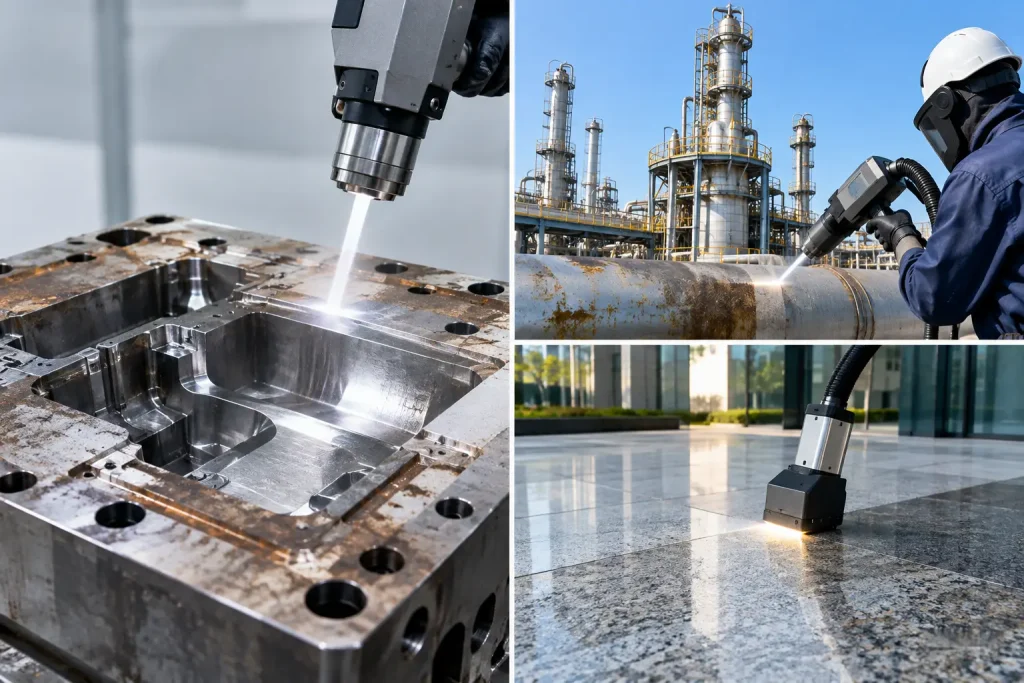
A corroded valve body, a painted structural member, or a contaminated weld may look like a straightforward cleaning task. The risk is that conventional cleaning can remove more than the unwanted layer. Substrate damage prevention is therefore not simply about achieving a cleaner surface. It is about preserving the dimensions, profile, metallurgy, and service life of the asset beneath the contamination.
For facility owners, maintenance teams, and contractors, this distinction affects repair costs, inspection readiness, shutdown duration, and long-term asset integrity. Laser cleaning provides a controlled method for removing targeted contaminants while helping protect the underlying material.
Why substrate damage happens during surface cleaning
Most damage occurs when a cleaning method cannot clearly distinguish between the contaminant and the base material. Abrasive media can erode edges, alter surface roughness, embed particles, or thin softer metals. Mechanical tools may gouge a surface, particularly around weld toes, threads, markings, corners, and intricate geometries. Chemical products can leave residues, attack sensitive materials, or create disposal and containment requirements.
The concern is not limited to visible scratches. A surface can appear clean while its profile has changed enough to affect coating adhesion, fit-up tolerances, corrosion resistance, or inspection results. On heritage features and delicate components, even a small loss of original material can be unacceptable.
The appropriate cleaning method depends on the contaminant, the substrate, the required finish, and the asset’s operating conditions. Heavy corrosion on a large steel structure does not carry the same cleaning requirements as oxidation on a precision component or paint on a historic metal fixture. A practical process begins by defining what must be removed and what must remain untouched.
How laser cleaning supports substrate damage prevention
Laser cleaning uses controlled pulses of light to ablate or lift surface contaminants. Rust, oxides, paint, oils, grease, and coatings absorb laser energy differently from the underlying base material. With the correct settings, the unwanted layer can be removed selectively without aggressive contact with the substrate.
This is the central advantage of laser ablation. The operator is not relying on impact from blasting media or force from a grinding disc. Instead, cleaning parameters are adjusted to suit the material condition and the required outcome. Power, pulse characteristics, scan speed, spot size, and working distance all influence how the contaminant responds.
For steel assets, laser cleaning can remove corrosion and prepare localized areas for inspection, welding, or recoating without unnecessarily disturbing sound surrounding surfaces. For sensitive applications, it can support controlled cleaning where preserving the original profile and details is the priority.
Laser cleaning also produces an immediate visual response. Operators and asset owners can see the contrast between the cleaned area and the remaining contamination as work progresses. That visibility helps verify coverage, identify areas requiring further attention, and avoid over-processing a surface simply because the cleaning method lacks control.
Selectivity is not automatic
Laser cleaning is precise, but precision still depends on proper assessment and operation. Different substrates reflect and absorb energy differently. Coating thickness, corrosion severity, surface geometry, and heat sensitivity must all be considered before work begins.
A qualified service provider should evaluate a representative test area before full-scale execution. This allows the team to confirm removal performance, inspect the resulting substrate condition, and set parameters that meet the job requirement. Where needed, the cleaning specification should be aligned with coating manufacturers, welding procedures, inspection criteria, or conservation requirements.
Protecting the substrate at every stage
Effective surface preparation is a controlled sequence rather than a single cleaning step. The following practices help reduce risk across industrial, commercial, and restoration projects.
Start with the desired end condition
The right question is not, “How do we remove everything quickly?” It is, “What surface condition is required for the next activity?” A component being prepared for visual inspection may need localized corrosion removal. A weld area may require removal of oxides and contaminants without rounding edges or affecting adjacent coatings. A surface planned for recoating may need a defined cleanliness level and suitable profile.
When the end condition is clear, the cleaning approach can be limited to the work that is necessary. This reduces unnecessary exposure of the substrate and helps control labor, downtime, and waste.
Inspect material condition before cleaning
Existing pitting, thinning, cracks, poor prior repairs, and coating failure should be documented before cleaning begins. Cleaning may reveal defects that were hidden by corrosion or paint, but it should not be mistaken for the cause of pre-existing damage.
Pre-cleaning documentation is particularly valuable for asset integrity programs and heritage restoration. It provides a baseline for inspection teams and gives project stakeholders confidence that the substrate is being treated responsibly.
Use controlled trials for variable surfaces
Surface conditions are rarely uniform across an entire asset. One section may have light flash rust, while another has multiple coating layers, oil contamination, or deeply bonded oxides. Applying a single setting everywhere can create inconsistent results.
A small trial area establishes the correct operating window. The team can evaluate cleaning speed, residual contamination, substrate appearance, and whether adjacent materials require masking or additional protection. For high-value assets, this step is a sensible safeguard, not a delay.
Avoid unnecessary contact and secondary contamination
Abrasive and chemical methods can introduce secondary issues. Blasting media may need extensive containment and cleanup. Chemical stripping can generate hazardous waste and may require rinsing, neutralization, and drying. Mechanical cleaning can transfer debris or leave inaccessible residues in joints and crevices.
Laser cleaning is a dry process. Contaminants are removed without chemical solvents or blasting media, which can reduce cleanup demands and help limit waste handling. Localized fume extraction and appropriate site controls remain necessary, especially when removing coatings or residues that may generate airborne byproducts.
Applications where substrate protection matters most
In oil and gas, power, marine, and process facilities, localized corrosion removal often supports inspection and maintenance without expanding the work scope unnecessarily. Cleaning around flanges, valve components, welds, pipe supports, and structural steel requires care because aggressive methods can damage nearby surfaces or create a larger recoating area than planned.
For fabrication and welding, surface contaminants can compromise weld quality and inspection results. Laser cleaning can prepare targeted weld zones by removing oxides, rust, oil, and coatings with a high degree of control. The benefit is not only cleanliness. It is a more consistent preparation process around critical joint areas.
On infrastructure and commercial properties, laser cleaning can remove paint, staining, oxidation, and corrosion from metal features while preserving architectural details. This is especially relevant for heritage buildings, artifacts, fixtures, and decorative elements where aggressive abrasion may erase texture, markings, or original finishes.
For production support, the same principles apply to molds, tooling, and components that cannot tolerate dimensional changes. The cleaning process must protect functional surfaces while removing residues that affect quality or reliability.
Operational benefits beyond the cleaned surface
Substrate damage prevention has direct financial value. Avoiding unintended material removal can reduce rework, replacement needs, and delays caused by failed inspections or coating issues. It can also help teams keep cleaning work localized rather than expanding into a larger repair package.
Laser cleaning can be performed with minimal setup compared with methods that require a blasting enclosure, media recovery, or chemical containment. This is valuable in congested plants, active facilities, and locations where access is limited. Reduced setup can help shorten maintenance windows, although production planning, access requirements, and safety controls still need to be addressed.
Environmental performance is another consideration. A process that avoids chemical stripping agents and abrasive media can reduce the volume of waste generated on site. BKR Engineering supports this practical use of green technology through controlled laser ablation services designed around both surface protection and responsible project execution.
Choosing the right partner for controlled cleaning
The equipment alone does not guarantee a safe result. The provider should understand the relationship between contaminant type, substrate material, cleaning parameters, access constraints, and downstream requirements. Field experience matters when work must be performed around live facilities, sensitive assets, difficult geometries, or strict shutdown schedules.
Ask how the surface will be assessed, whether test cleaning will be performed, how cleaning quality will be verified, and what controls will be used for fumes and adjacent surfaces. For critical assets, request clear documentation of the agreed cleaning area and expected end condition.
The best cleaning outcome is often deliberately modest: contamination is gone, the required surface is exposed, and the base material remains exactly where it needs to be. That is the practical standard worth specifying before any work begins.