
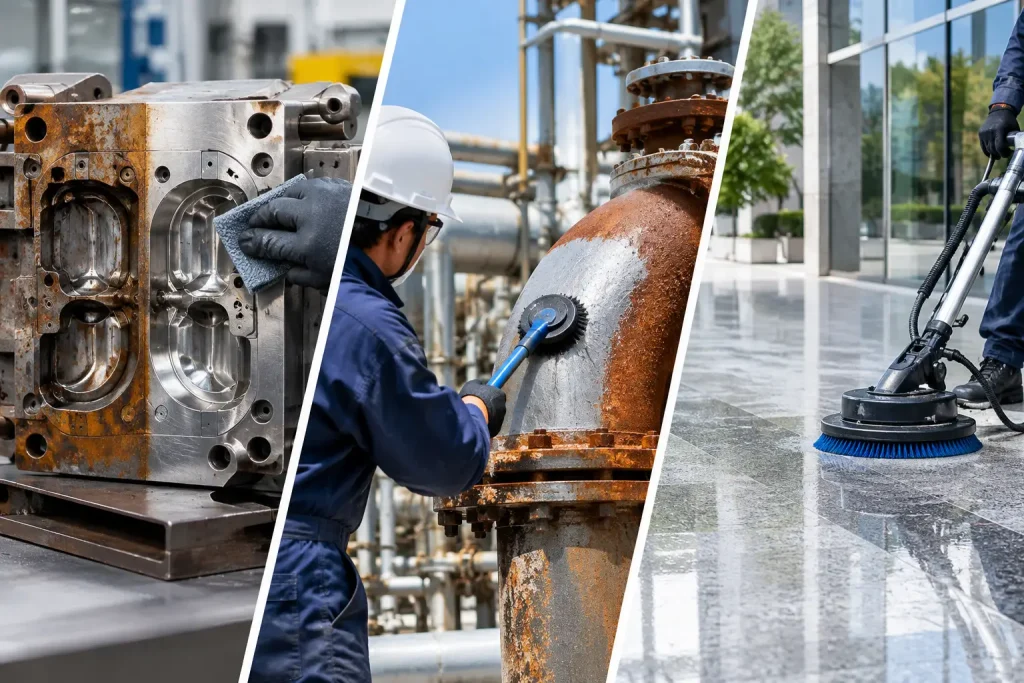
Corrosion rarely appears at a convenient time. It is found on critical pipework before an inspection, at weld zones before repair, on heritage metalwork where aggressive cleaning is unacceptable, or beneath a failing coating during a shutdown. The ability to remove corrosion without chemicals gives maintenance and asset teams a cleaner, more controlled way to prepare these surfaces without introducing liquid waste, abrasive media, or unnecessary risk to the base material.
For high-value assets, the right question is not simply how quickly corrosion can be removed. It is whether the chosen method preserves the substrate, supports the next step in the work scope, and keeps setup, containment, and disposal requirements proportionate to the job.
Why chemical corrosion removal creates operational challenges
Chemical cleaners and rust removers can be effective in the right setting, but they introduce considerations that extend beyond the cleaning task itself. Acidic products may require careful handling, rinsing, neutralization, ventilation, and disposal. Residual chemicals can also affect coating adhesion or contribute to future corrosion if the surface is not properly treated afterward.
For plant operators and contractors, these requirements can add time to a maintenance window. Work areas may need protection from splashes and runoff, while personnel need suitable personal protective equipment and clear procedures for chemical storage and waste management. On complex assets, chemical access can be difficult to control around seals, electrical components, adjacent finishes, and sensitive materials.
A dry, selective process avoids many of these complications. That is where laser cleaning has become a practical option for corrosion removal, inspection preparation, and restoration work.
How to remove corrosion without chemicals using laser cleaning
Laser cleaning uses controlled pulses of laser energy to remove corrosion, oxides, coatings, and surface contaminants. The energy is absorbed by the unwanted layer, causing it to break down and detach from the surface. With the correct settings, the underlying substrate remains intact.
This is not a one-size-fits-all process. Laser parameters are selected according to the material, corrosion type and thickness, surface condition, required finish, and whether the area will be inspected, welded, coated, or returned directly to service. This control is central to the method’s value.
On steel, for example, laser cleaning can remove localized rust and oxide layers while retaining the profile and dimensions of the metal beneath. On more delicate items, such as architectural metalwork, molds, precision components, or heritage features, the process can be adjusted to lift surface contamination without the broad mechanical impact associated with abrasive methods.
The result is highly visible. Operators can see the cleaned path as the laser passes across the surface, making it easier to confirm progress and target only the affected areas. That immediate feedback is useful where corrosion is localized, where inspection points must be prepared precisely, or where sound coatings next to a damaged area should remain undisturbed.
Surface preparation is more than making metal look clean
A bright surface is not automatically a properly prepared one. The required condition depends on what happens next. If the purpose is non-destructive testing, corrosion and old coating must be removed sufficiently to allow reliable inspection. If the purpose is welding, the weld zone must be free of oxide, paint, oil, and other contaminants that could compromise weld quality.
For recoating, the substrate must be clean and stable, with the preparation level matched to the coating system specification. Laser cleaning can be used with a focused work scope, allowing teams to prepare a targeted repair area without stripping an entire asset unnecessarily. This can reduce disruption when a full-scale shutdown or enclosure is not justified.
Where chemical-free corrosion removal delivers the greatest value
Laser cleaning is particularly effective when precision, containment, and substrate protection matter as much as cleaning speed. Common applications include corrosion removal from structural steel, pipes, valves, tanks, machinery, weld seams, and fabricated components. It is also well suited to removing surface oxidation before welding, inspection, coating repair, or bonding.
In oil and gas and process environments, local corrosion may need attention in congested areas where abrasive media and chemical runoff create additional controls. A dry laser process reduces the need to introduce blasting grit or chemical liquids into the work zone. Where access is limited or work must proceed around operating equipment, a more targeted approach can simplify planning.
Construction and infrastructure teams may use laser cleaning to prepare steel connections, remove oxidation from fabricated parts, or restore metal features without damaging surrounding finishes. For property managers and conservation projects, the ability to clean ornate or aged metal selectively can be especially valuable. Aggressive abrasion can erase fine detail, while chemical methods may stain adjacent surfaces or leave residues that are difficult to manage.
Operational benefits for maintenance teams
The benefit of chemical-free corrosion removal is not only environmental. It can improve execution across the project lifecycle.
First, laser cleaning is a dry process. There is no chemical rinse water to collect, no spent acid solution to neutralize, and no abrasive blasting media spread across the work area. Removed material is captured through appropriate fume extraction, helping maintain a cleaner site and reducing secondary cleanup.
Second, it supports selective removal. Teams can clean a narrow weld line, a corroded flange face, a test location, or a defined coating-failure area rather than treating more surface than necessary. This helps preserve adjacent material and can reduce the scope of reinstatement work.
Third, the process can reduce setup demands. Abrasive blasting often requires containment, media handling, and extensive protection of nearby equipment. Chemical cleaning requires controls for storage, runoff, and exposure. Laser cleaning still requires site-specific safety controls, but its compact and localized nature can make it a practical choice for maintenance work where downtime matters.
Finally, it provides a strong visual record of progress. The contrast between corroded and cleaned areas is immediate, which assists work verification and communication between maintenance, inspection, and project teams.
Important limits and planning considerations
Laser cleaning is not automatically the best answer for every corroded surface. Very thick, heavily layered scale across a large area may call for a different strategy, or a combination of methods. Productivity depends on corrosion severity, material type, access, surface geometry, and the required cleanliness standard.
The process must also be performed by trained personnel. Laser safety controls are essential, including a controlled work area, appropriate eye protection, fume extraction, and management of reflective surfaces. Removing corrosion can release particulate matter or contaminants from old coatings, so the cleaning plan must account for what is actually present on the asset.
Before work begins, a competent service provider should assess the substrate, contamination, target finish, access restrictions, and downstream requirements. A trial area can confirm cleaning speed and surface response before a larger scope is approved. This is particularly useful for coated assets, aged materials, and components with tight tolerances.
Choosing a service partner for laser corrosion removal
The equipment matters, but field experience matters just as much. A capable provider should understand how laser parameters affect different substrates and contaminants, how to work safely within active sites, and how to align surface preparation with inspection, welding, or coating requirements.
BKR Engineering provides controlled laser ablation services for projects where conventional cleaning methods create unnecessary waste, risk, or downtime. The approach is designed around selective material removal, substrate protection, and practical on-site execution across industrial, commercial, and restoration environments.
When corrosion threatens an inspection, repair, or coating schedule, the cleanest solution is often the one that removes only what needs to go. A properly planned laser cleaning assessment can show whether chemical-free corrosion removal is the right fit for the asset, the access conditions, and the outcome your team needs.