
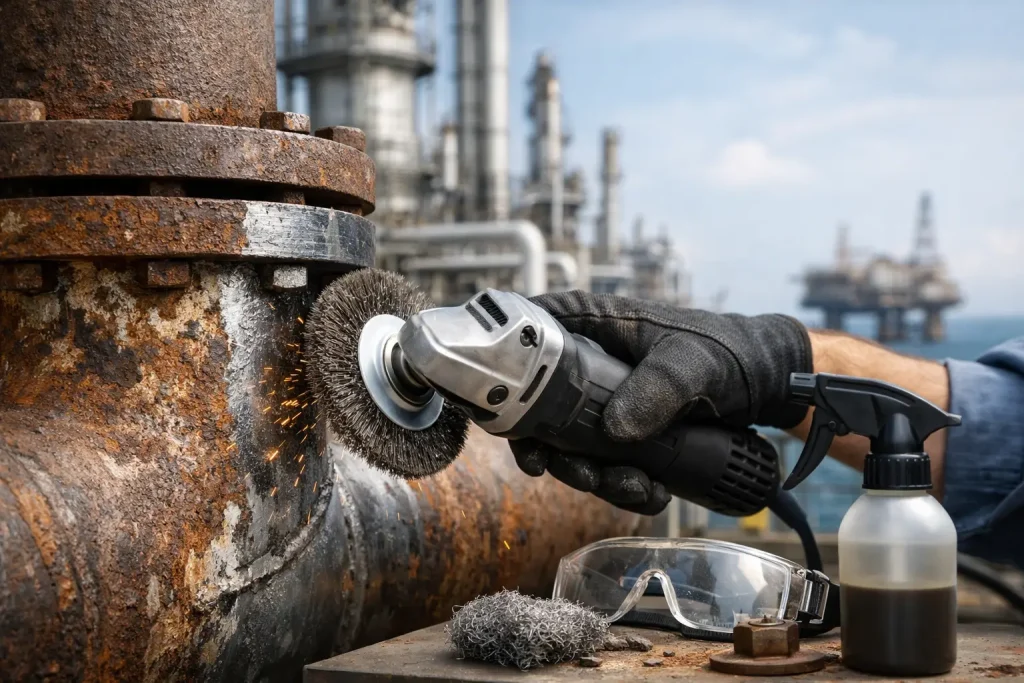
Rust on a handrail is a cosmetic issue. Rust on a pressure vessel, structural connection, pump housing, heritage facade, or weld zone can affect inspection quality, coating performance, safety, and asset life. The best methods for rust removal are therefore not determined by speed alone. The right method must remove corrosion to the required standard while protecting the base material, controlling waste, and fitting the realities of the work site.
For facility owners and maintenance teams, the decision usually comes down to the corrosion level, substrate sensitivity, required surface profile, access constraints, contamination risks, and downtime window. A method that works well on a large steel structure may be unsuitable for a precision component, an operating plant, or an architectural feature with surrounding finishes.
Best Methods for Rust Removal: Start With the Required Outcome
Before choosing equipment or a contractor, define what the cleaned surface needs to achieve. Rust removal for visual restoration is different from preparation for a high-performance protective coating. Likewise, removing localized oxidation to expose a weld for inspection is different from stripping heavy scale from structural steel.
The first question is whether the work requires only removal of loose rust, complete removal of visible corrosion, or a specified surface preparation standard. The second is whether a surface profile is required for the next coating system. Abrasive blasting can create an anchor profile, while laser cleaning generally removes contamination and corrosion selectively without roughening sound material. Both outcomes are valuable, but they solve different problems.
A practical assessment should also identify the base material. Carbon steel can tolerate more aggressive treatment than thin sheet metal, aluminum, copper alloys, machined surfaces, historic metalwork, or equipment with tight tolerances. Removing rust successfully is not useful if the process thins the substrate, embeds abrasive media, damages seals, or spreads debris into sensitive areas.
Abrasive Blasting for Heavy Corrosion and Coating Preparation
Abrasive blasting remains a proven option for large-scale steelwork with heavy corrosion, thick coatings, or mill scale. Media such as steel grit, garnet, aluminum oxide, or other approved abrasives are propelled against the surface to remove contaminants and create a profile for coating adhesion.
Its main advantage is productivity on broad, accessible surfaces. When a tank exterior, bridge element, or fabricated steel assembly needs extensive preparation before recoating, blasting can remove material quickly and leave a defined profile. It is often specified where coating manufacturers require a particular surface roughness.
The trade-off is containment and cleanup. Blasting creates significant airborne dust and spent media, requiring controls that can add time, labor, and cost. In an operating facility, nearby equipment, instrumentation, finished surfaces, and personnel may need protection. Enclosures, ventilation, waste handling, and post-cleaning may also be necessary. Aggressive blasting can be unsuitable around thin substrates, intricate geometry, electrical equipment, or areas where abrasive residue cannot be tolerated.
Mechanical Methods for Accessible, Localized Work
Wire brushes, needle scalers, sanding discs, flap wheels, and rotary tools are widely used for spot repairs and accessible maintenance tasks. They are familiar, readily available, and useful when the work area is small and the required finish is straightforward.
Mechanical cleaning can remove loose rust and failing paint effectively, particularly on brackets, handrails, bolts, and noncritical steelwork. A technician can also target a specific area without mobilizing larger equipment. However, results depend heavily on operator technique, tool access, and the condition of the surface.
These methods may smear corrosion products, leave rust in pits and crevices, or create inconsistent surface preparation. They can also generate dust, noise, vibration, and sparks. For inspection preparation or coating work on critical assets, mechanical tools are often best treated as a limited local solution rather than the default process.
Chemical Rust Removal for Complex Shapes
Chemical methods use acids, chelating agents, converters, or gel formulations to dissolve or react with iron oxide. They can be useful for small parts, intricate shapes, internal recesses, and situations where mechanical contact would be difficult.
Acid pickling can be highly effective, but it requires tight process control. The chemical must be compatible with the substrate, thoroughly neutralized or rinsed where required, and managed with appropriate worker protection. Incomplete removal of residues can affect subsequent coatings or contribute to later corrosion.
For field work, chemical cleaning introduces practical concerns around containment, runoff, ventilation, surface rinsing, and hazardous waste disposal. Rust converters can stabilize certain surfaces, but they are not a substitute for proper surface preparation when a coating specification calls for clean, sound steel. Chemical treatment may be appropriate for selected components, yet it is rarely the simplest choice for live industrial environments or high-value assets where contamination control is essential.
Laser Cleaning for Precision Rust Removal
Laser cleaning uses controlled pulses of laser energy to ablate rust, oxides, coatings, oil, grease, and other contaminants from a surface. The process can be adjusted to target the unwanted layer while preserving the underlying substrate. This selective removal is the central advantage when precision matters.
For localized corrosion on machinery, weld areas, molds, tools, architectural metalwork, heritage features, and complex assemblies, laser cleaning provides a clean and highly visible result without abrasive media or chemical stripping agents. Operators can treat defined areas, including edges, corners, and detailed profiles, while keeping the surrounding surface intact.
The process produces removed material as fine particulate that can be captured through appropriate fume extraction. This reduces the burden associated with spent blasting media and chemical waste. It also avoids the need for water rinsing, which can be particularly valuable where moisture management, runoff, or plant access creates complications.
Laser cleaning is not a universal replacement for blasting. It does not create the same anchor profile needed by every coating system, and very large areas of thick corrosion may be more economically treated with other methods. The strongest case for laser cleaning is where substrate protection, cleanliness, targeted removal, reduced setup, and minimized downtime carry more value than raw area coverage.
BKR Engineering applies controlled laser ablation for projects where conventional methods may create unnecessary risk, waste, or disruption. For a maintenance manager, the benefit is not simply a cleaner surface. It is the ability to prepare a targeted area for inspection, repair, welding, or recoating without turning a localized task into a larger containment and cleanup operation.
Dry Ice Blasting and Other Specialty Options
Dry ice blasting propels carbon dioxide pellets that sublimate on impact. It can remove certain contaminants, oils, and loose coatings with minimal secondary media waste. It is particularly useful where moisture and abrasive residue are unacceptable.
However, dry ice blasting is generally less effective on tightly adhered rust and heavy scale than abrasive blasting or laser ablation. It also requires safe ventilation because carbon dioxide can displace oxygen in enclosed spaces. Like every specialty process, it should be selected for the contamination and environment involved, not because it is perceived as universally cleaner.
Other options, such as high-pressure water jetting, can remove rust and coatings from large surfaces. Water jetting may be effective where dust must be minimized, but flash rusting, wastewater control, drying requirements, and equipment access need careful consideration. The cleaned surface may require rapid coating application or corrosion inhibitors to prevent oxidation from returning.
Choosing the Method That Protects the Asset
The best choice is often made by comparing total project impact rather than hourly cleaning rates. Consider the required preparation standard, the material being cleaned, access, nearby operations, safety controls, waste streams, and the cost of taking equipment offline.
A useful rule is simple: use abrasive blasting when broad-area production and coating profile are the priority; use mechanical methods for limited, noncritical spot work; use chemicals only where their process controls and waste requirements are justified; and use laser cleaning where selective removal and substrate preservation are decisive.
For critical assets, a small test area is often the most reliable way to confirm the result. It shows how the contamination responds, verifies that the base material is protected, and helps project teams agree on the acceptable finish before work begins at scale.
Rust removal should support the next stage of the asset’s life, whether that is inspection, repair, preservation, or recoating. Choosing a process that fits the surface and the operating environment turns corrosion control from a recurring disruption into a more controlled maintenance decision.