
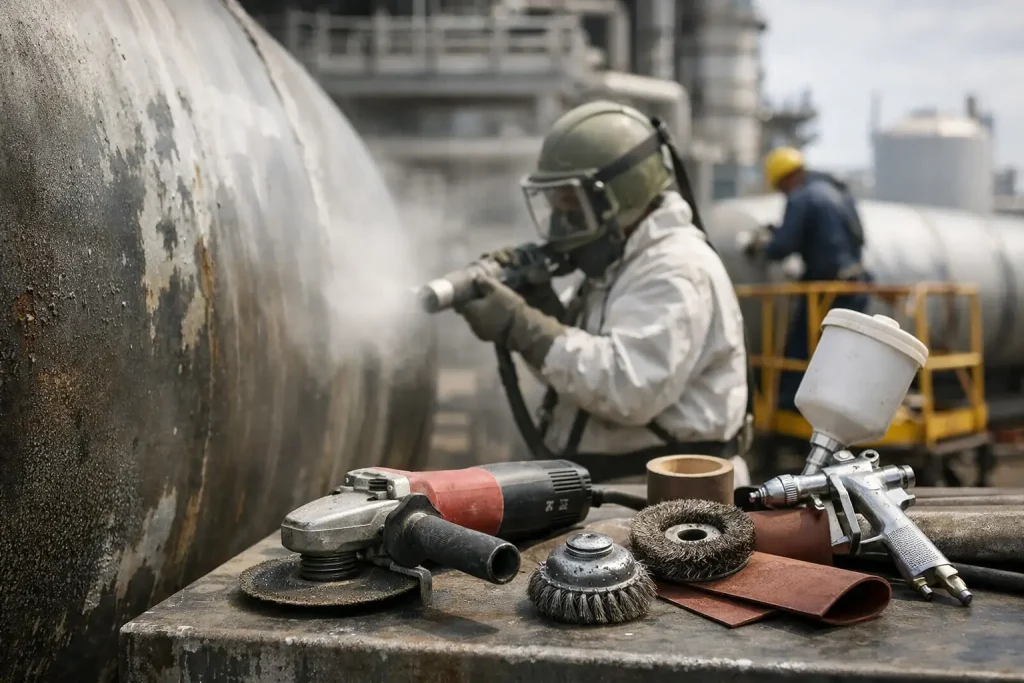
A coating failure rarely begins with the coating itself. It often starts with an unseen layer of corrosion, oil, mill scale, or residual contamination left behind before work begins. Choosing the right surface preparation methods determines whether a repair lasts, an inspection reveals the true condition of an asset, or a production task creates avoidable rework.
For plant managers, maintenance teams, fabricators, and asset integrity professionals, the decision is not simply about making a surface look clean. The method must achieve the required cleanliness profile while protecting the base material, controlling waste, and fitting the realities of an operating site. A process that works well on a large steel structure may be unsuitable for a precision weld, heritage metalwork, or equipment located inside an active facility.
What Surface Preparation Must Accomplish
Surface preparation creates the condition needed for a subsequent task. That task may be coating application, welding, nondestructive testing, corrosion assessment, restoration, or general maintenance. The required result changes with the application.
For protective coating work, the surface may need a defined cleanliness standard and anchor profile to support adhesion. Before inspection, the priority is often removing corrosion products and coatings without obscuring cracks, pitting, weld defects, or substrate loss. In restoration work, selective contaminant removal matters more than aggressive material removal. A clean-looking surface is not automatically a properly prepared one.
The first question should therefore be: what needs to be removed, and what must remain untouched? Rust, oxide layers, old paint, grease, carbon deposits, and mill scale do not respond equally to every process. The substrate also matters. Carbon steel can tolerate methods that may damage aluminum, stainless steel, copper alloys, thin-gauge components, stone, or intricate architectural features.
Common Surface Preparation Methods and Their Trade-Offs
Abrasive blasting
Abrasive blasting propels media such as steel grit, aluminum oxide, garnet, or other abrasives against a surface. It is widely used for heavy corrosion removal and can create a surface profile suitable for many high-performance coatings. On large, accessible steelwork, it remains an effective option.
Its limitations become significant where containment, cleanup, or selective cleaning are required. Blasting generates spent media, removed coating debris, and dust that must be managed properly. It can also remove sound material along with corrosion and may be impractical around sensitive equipment, occupied areas, or confined spaces. Enclosures, ventilation, access controls, and post-job cleanup can add substantially to project duration.
Mechanical cleaning
Wire brushing, grinding, sanding, needle scaling, and power-tool cleaning are familiar site methods. They are readily available and useful for localized repairs, edge preparation, and areas where full blasting access is not practical.
However, mechanical tools can leave tightly adhered rust in pits and irregular surfaces. They may polish rather than fully remove contamination, particularly when oil or grease is present. Grinding also risks reducing material thickness, changing weld geometry, or introducing unwanted surface marks. Results depend heavily on operator technique and access.
Chemical cleaning and stripping
Chemical processes can dissolve or soften rust, oxides, scale, and coatings. They can be effective on complex geometries that are difficult to reach mechanically, and certain formulations are suited to specific alloys or contaminants.
The operational burden is often the deciding factor. Chemical cleaning requires careful selection, controlled application, personal protective equipment, dwell time, rinsing, neutralization, and waste handling. Residues must be removed completely before coating or inspection. For facilities seeking to reduce hazardous waste and avoid liquid cleanup, chemical stripping may not be the preferred route.
Water jetting and hydroblasting
High-pressure and ultra-high-pressure water jetting remove coatings, corrosion products, and contaminants without abrasive media. Water jetting can be valuable for large industrial surfaces and can reduce airborne dust compared with dry blasting.
It does not always produce the same surface profile as abrasive blasting, so coating specifications must be reviewed carefully. Flash rust can also occur on carbon steel unless water quality, drying, and environmental conditions are managed. The process produces wastewater that may contain coating residues, oils, and contaminants requiring collection and disposal.
Dry ice blasting
Dry ice blasting uses carbon dioxide pellets to dislodge certain contaminants. Because the pellets sublimate, there is no spent blast media to collect. This can make it useful for some maintenance cleaning, electrical equipment, food-related environments, and oil or grease removal.
Dry ice is not a universal corrosion-removal solution. It may be less effective against heavily bonded coatings, thick scale, and deep rust. Noise, ventilation requirements, and carbon dioxide exposure controls also need consideration, especially in enclosed areas.
Laser cleaning
Laser cleaning uses controlled laser ablation to remove contamination from a surface. The laser energy is absorbed by the unwanted layer, such as rust, oxide, paint, grease, or coating, allowing it to be removed with a high degree of selectivity. Properly set process parameters help preserve the underlying substrate.
This makes laser cleaning especially valuable when the work demands precision. It can remove corrosion from a weld zone, strip a localized coating area for repair, prepare a surface for inspection, or clean delicate metal features without the broad impact associated with abrasive methods. The process is visually clear in operation, allowing teams to see the contaminant layer lift away and verify progress as work proceeds.
Laser cleaning does not replace every other method. For very large areas of heavy corrosion where a specified anchor profile is required, abrasive blasting may remain the more economical choice. Laser cleaning is often most compelling where access is constrained, containment is difficult, the substrate is sensitive, or only a targeted area requires treatment.
How to Select the Right Method for the Job
The best choice begins with the acceptance criteria, not the equipment available on site. Establish the required cleanliness level, coating manufacturer requirements, inspection scope, substrate condition, and allowable material loss. If coating adhesion depends on a defined profile, confirm whether the selected process can achieve it or whether a secondary profiling step is needed.
Next, assess the work environment. An offshore module, operating process plant, fabrication shop, heritage property, and residential common area have different safety and logistics constraints. Consider dust, noise, ventilation, water runoff, chemical handling, nearby equipment, access restrictions, and whether the work can occur during normal operations.
Downtime should be measured beyond the active cleaning period. A method may appear fast at the point of contact but require hours or days for enclosure construction, masking, media delivery, cleanup, waste segregation, or drying. A more controlled process can reduce the total shutdown window even if its cleaning rate is more targeted.
Finally, consider what the process leaves behind. Abrasive media, wastewater, chemical residues, and removed hazardous coatings can create downstream cost and compliance obligations. Laser ablation produces particulate that should be captured with appropriate extraction and filtration, but it avoids the volume of spent media and liquid chemical waste associated with many conventional processes.
Where Precision Changes the Economics
Selective cleaning is often the difference between a manageable maintenance task and an extensive shutdown. A corroded flange face, weld seam, valve body, machinery component, or test area may not need an entire surrounding structure blasted. Removing only the contaminant layer in the required zone protects adjacent coatings and reduces reinstatement work.
For inspection preparation, this precision is equally practical. Aggressive cleaning can alter the very surface condition an inspector needs to evaluate. Controlled laser cleaning can expose pitting, corrosion patterns, weld features, and potential defects while minimizing unnecessary attack on the sound substrate.
Heritage and architectural restoration present another case for restraint. Decorative metalwork, aged fixtures, and historic surfaces often carry value in their original material and finish. The objective is not to make the item appear newly manufactured. It is to remove damaging contamination while retaining the character and integrity of the underlying material.
BKR Engineering applies controlled laser cleaning where precision, reduced site disruption, and substrate protection are central to the project outcome. The method is particularly suited to maintenance, restoration, production support, and inspection preparation where conventional blasting or chemicals create more disruption than the task can justify.
A well-chosen preparation method should make the next stage of work easier, safer, and more reliable. Start with the surface condition and the required end result, then select the process that removes no more material, creates no more waste, and causes no more downtime than the job truly requires.