
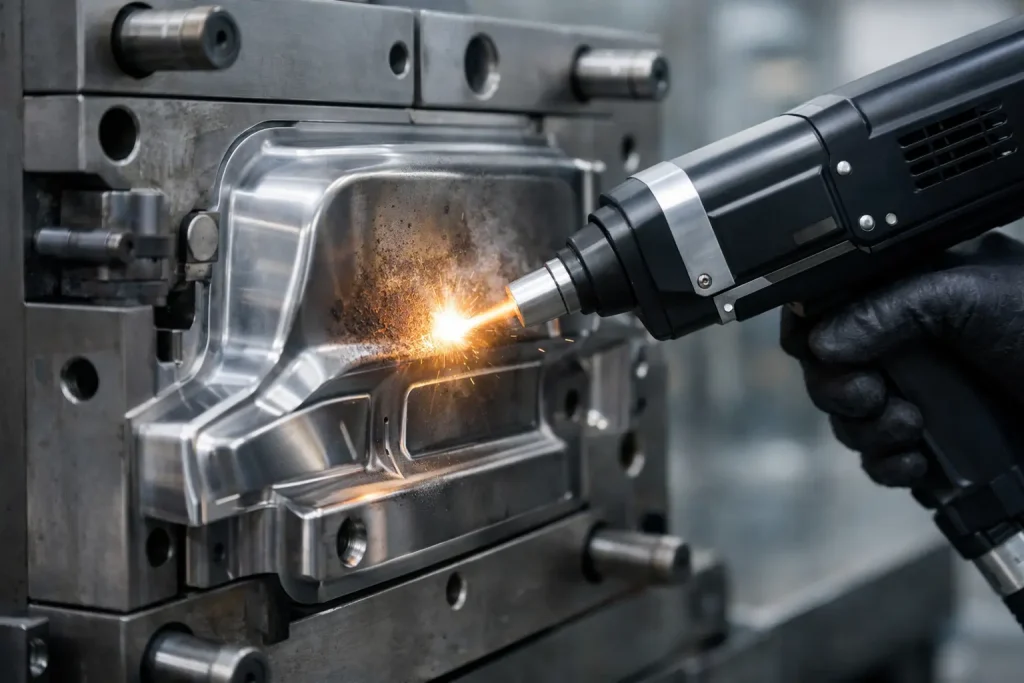
A plastic mould does not need to look badly fouled to start costing money. A thin film of resin residue, vent contamination, release agent buildup, or carbonized deposits can be enough to affect part finish, increase reject rates, and stretch cycle times. That is why laser cleaning for plastic moulds is getting serious attention from manufacturers that need a faster, more controlled way to restore tooling without creating new maintenance risks.
For molders running tight production schedules, the real question is not whether a tool can be cleaned. It is whether it can be cleaned thoroughly, repeatably, and without shortening tool life. Traditional methods can work, but they often bring trade-offs in labor, chemical handling, abrasive wear, or disassembly time. Laser cleaning changes that discussion because it targets contamination with high precision while preserving the underlying mold surface when correctly applied.
Why laser cleaning for plastic moulds is different
Laser cleaning uses controlled laser energy to ablate surface contamination from the mold. In practical terms, the beam interacts with the unwanted layer rather than mechanically grinding the base material away. That makes it especially useful where surface finish, edge definition, vent geometry, and dimensional integrity matter.
This matters on plastic moulds because even small changes to polished cavities, textured surfaces, or shut-off areas can show up in the molded part. A cleaning method that is too aggressive can solve one problem while creating another. Abrasive techniques may alter fine details. Chemical methods may require extra handling, rinsing, drying, and disposal controls. Manual scraping can be slow and operator-dependent.
Laser cleaning offers a more selective process. It can remove carbon, oil, grease, degraded polymer residue, and some coatings from targeted areas with a high level of control. The result is not just a cleaner tool. It is a maintenance approach that supports part quality, process stability, and planned uptime.
Where it delivers the most value
Not every mold contamination problem is identical, and that is where a service-led approach matters. Some tools suffer from baked-on residue around gates and vents. Others accumulate release agents or process contaminants in cavities and hard-to-reach features. Some require cleaning before inspection, repair, or requalification.
Laser cleaning is particularly effective when contamination is localized, repeatable, and difficult to remove without affecting adjacent surfaces. This includes detailed mold features, precision edges, and areas where hand cleaning is slow or inconsistent. It is also valuable when a facility wants to reduce dependence on consumables and lower the cleanup burden associated with blasting media or chemical agents.
For maintenance leaders, the operational benefit is straightforward. A controlled process can reduce unnecessary tool handling, minimize the risk of substrate damage, and shorten the path from dirty mold to production-ready mold. That is often more important than the cleaning method itself.
Common contaminants on plastic moulds
In production environments, plastic moulds can accumulate a mix of residues rather than a single contaminant. Carbonized polymer, vent deposits, oil, grease, release agents, and oxidation on associated metal surfaces can all affect performance. Different contaminants respond differently to laser settings, which is why process control matters.
A polished cavity surface, for example, calls for a different level of care than a more open, less cosmetically critical area. The same applies to molds with textured finishes, intricate inserts, or sensitive venting. The best results come from matching the laser parameters to both the contamination and the tool material.
The practical advantages over conventional cleaning
The strongest case for laser cleaning is not that it replaces every other method. It is that it solves specific maintenance problems better.
First, it protects the substrate. For high-value molds, this is often the deciding factor. When the objective is to remove contamination without altering dimensions or surface finish, a non-contact process has a clear advantage.
Second, it can reduce downtime. Conventional cleaning may involve chemical soak time, media containment, extensive masking, or secondary cleanup. Laser cleaning is typically more direct. There is less mess around the work area and less time spent managing waste streams.
Third, it supports safer and cleaner operations. Facilities looking to reduce chemical exposure and eliminate abrasive residue have a strong reason to consider laser-based methods. Environmental responsibility is no longer a side issue for many manufacturers. It is tied directly to compliance, housekeeping, and operating cost.
That said, there are trade-offs. Laser cleaning is not a one-setting process, and it should not be treated as one. The condition of the mold, the type of residue, the finish requirement, and the production schedule all influence the right approach. In some cases, a hybrid maintenance strategy still makes sense. Laser cleaning may handle precision areas while other methods are reserved for less sensitive surfaces or heavy bulk contamination.
What to evaluate before choosing laser cleaning for plastic moulds
A good decision starts with the tool, not the technology. The first point to review is mold material and surface condition. Hardened steel, coated surfaces, polished cavities, and textured features each require a controlled approach. If the mold already has wear, pitting, or repaired areas, that should be assessed before cleaning begins.
The second point is the type and thickness of contamination. Light resin residue behaves differently from baked-on carbon. Release agent films differ from greasy deposits. A technically grounded provider will evaluate what needs to be removed and what must remain untouched.
The third point is access. Some molds are easy to present for cleaning. Others involve tight geometries, inserts, or limited line-of-sight. Laser cleaning is highly precise, but its effectiveness depends on practical access to the target area.
The fourth point is production impact. If cleaning can be done with less disassembly or faster turnaround, the business case improves quickly. For many operations, labor savings are useful, but the bigger value comes from avoiding prolonged stoppages and preserving tool performance.
Why process control matters more than the machine alone
In this area, experience is as important as equipment. Laser cleaning outcomes depend on beam control, parameter selection, stand-off distance, scan pattern, and operator judgment. A powerful machine without the right process discipline can be the wrong solution for a precision mold.
That is why industrial clients tend to look for a specialist partner rather than a basic equipment operator. The goal is not simply to burn contamination off a surface. The goal is to return the mold to service in the correct condition, with minimal risk and predictable results.
For companies managing high-value assets, that distinction matters. A service provider with field experience understands that cleaning is part of a larger maintenance and production system. It must align with inspection requirements, toolroom standards, safety expectations, and uptime targets.
What results should a manufacturer expect?
When laser cleaning is properly applied, manufacturers can expect cleaner mold surfaces, better consistency in critical features, and a lower risk of cleaning-related damage. That often translates into improved part appearance, fewer defects tied to contamination, and more stable production after maintenance.
Visual results are also important. Laser cleaning gives teams a clear view of the treated area, which helps when inspecting vents, edges, cavity surfaces, or suspect deposits. For maintenance and quality teams, that visibility supports better decision-making. It becomes easier to distinguish between removable contamination and actual tool wear.
Cost outcomes depend on the application. If a mold is simple and contamination is light, conventional cleaning may still be acceptable. But when a tool is expensive, highly finished, contamination-prone, or linked to costly downtime, laser cleaning often delivers stronger long-term value. Reduced scrap, fewer cleaning consumables, and less risk to the substrate can outweigh the upfront service cost.
For manufacturers seeking a more precise alternative to blasting, scraping, or chemical cleaning, this is where the case becomes compelling. Companies such as BKR Engineering approach laser cleaning as a controlled industrial service, not a generic maintenance add-on. That is the right mindset for molds where precision and uptime carry real financial weight.
A better standard for mold maintenance
Plastic molding operations are under constant pressure to protect quality while keeping presses running. Cleaning methods that create waste, prolong maintenance windows, or risk damaging the tool are harder to justify when a more selective option is available. Laser cleaning for plastic moulds gives maintenance and production teams a way to remove contamination with precision and support the life of the asset at the same time.
The best next step is not to ask whether laser cleaning is newer or more advanced. It is to ask whether your current cleaning method is helping the mold return to production in the condition you actually need. That is where better maintenance decisions start.