
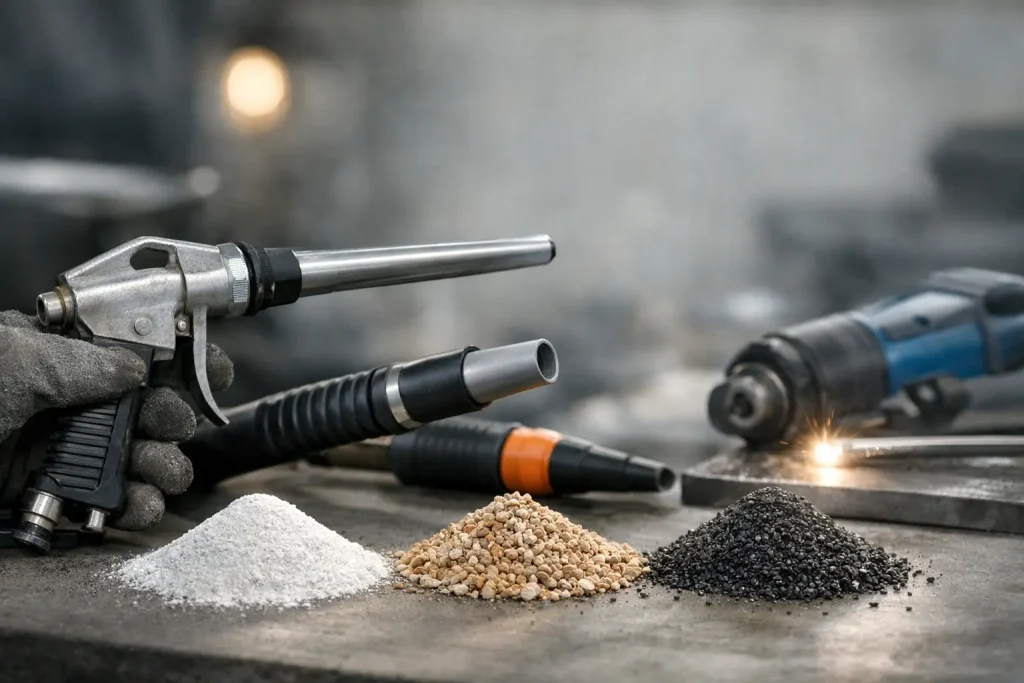
When a maintenance window is measured in hours, not days, surface preparation stops being a routine task and becomes a production risk. That is exactly why abrasive blasting alternatives are getting serious attention from plant managers, contractors, and asset teams who need to remove rust, coatings, or contamination without creating extra downtime, waste, or substrate damage.
For decades, abrasive blasting has been the default answer for heavy-duty cleaning and coating removal. It still has a place. But it also brings familiar challenges – containment, media handling, dust, cleanup, disposal, and the constant question of how much base material is being removed along with the contamination. In high-value environments, that trade-off is not always acceptable.
Why abrasive blasting alternatives matter
The conversation is not really about replacing one process with another in every case. It is about matching the method to the asset, the contamination, and the operational constraints.
If you are working on structural steel in an open yard, abrasive blasting may remain practical. If you are cleaning around sensitive equipment, preparing a weld zone, removing corrosion from a heritage surface, or stripping contaminants in a live industrial environment, the usual blasting setup can quickly become the bigger problem. The right alternative can reduce shutdown scope, avoid secondary waste, and give you more control over the result.
That control matters most when the substrate has value beyond its surface. Stainless steel, aluminum, molds, electrical enclosures, precision components, historic materials, and inspection-critical areas all benefit from methods that remove what you want gone without attacking what needs to stay.
The main abrasive blasting alternatives
Several methods are commonly considered when blasting is too aggressive, too messy, or too disruptive. Each one solves a different problem, and none should be treated as a universal substitute.
Laser cleaning
Laser cleaning uses controlled laser energy to ablate rust, oxides, paint, oil, grease, and other surface contaminants. The key advantage is selectivity. Instead of impacting the entire surface with abrasive media, the process targets the contamination layer with a much higher degree of precision.
For asset owners, that changes the job economics in important ways. Laser cleaning generates minimal secondary waste, avoids blasting media disposal, and can often be performed without full blasting enclosures. In many industrial settings, that means a smaller work footprint and less disruption to nearby operations.
It is especially effective where substrate preservation matters. Corrosion removal on steel, weld preparation, coating spot removal, mold cleaning, and restoration work are all strong use cases. The visual result is also a practical advantage. Teams can see the cleaning path clearly, which helps with quality control and client acceptance.
The trade-off is throughput. On broad, heavily scaled surfaces, laser cleaning may be slower than high-volume blasting. It is not the cheapest choice if the only priority is stripping large, simple areas as fast as possible. But where precision, cleanliness, safety, and reduced downtime matter, it often delivers better overall project value than the hourly comparison alone suggests.
Dry ice blasting
Dry ice blasting propels solid CO2 pellets at the surface. The pellets sublimate on impact, which means there is no spent blasting media left behind. That makes it attractive for cleaning equipment where residue control matters.
This method works well for removing some coatings, grease, organic buildup, and production residues. It is commonly used in manufacturing and maintenance settings because cleanup is lighter than with traditional abrasive media.
Still, dry ice is not a direct replacement for every surface preparation job. It is generally less effective for heavy corrosion, tightly bonded mill scale, or applications where a defined surface profile is needed before recoating. It is often a cleaning solution first and a surface prep solution second.
Chemical cleaning and stripping
Chemical methods can be effective for paint removal, degreasing, oxide treatment, and specialized decontamination. In the right application, they reach complex geometries and can reduce mechanical damage risk.
The problem is everything around the chemistry. Dwell time, neutralization, worker exposure, ventilation, runoff control, and waste disposal all affect the real project cost. In regulated environments or occupied spaces, these factors can make chemical cleaning difficult to justify.
Chemical processes also introduce uncertainty if residues remain on the surface. For coating preparation or inspection-critical work, that can create downstream issues if the process is not carefully managed.
Power tools and mechanical methods
Needle guns, wire brushing, grinding, sanding, and rotary tools remain common alternatives because they are familiar and accessible. For small areas, touch-up work, weld prep, and localized defect removal, they can be practical.
But they are labor-intensive and heavily operator-dependent. Consistency becomes a challenge over large areas, and the risk of overworking the substrate is real. Mechanical methods also create noise, dust, and ergonomic strain, which matters on long-duration maintenance projects.
They are usually best treated as targeted tools rather than primary solutions for large-scale contamination removal.
Water jetting and vapor blasting
High-pressure and ultra-high-pressure water jetting are often used for coating removal and surface cleaning, particularly when dust suppression is a priority. In some cases, water-based methods reduce airborne particulates and help with environmental compliance.
The limitation is that water introduces its own management issues. Containment, runoff, drying time, flash rust, and wastewater handling all need to be addressed. On steel surfaces in humid conditions, the window between cleaning and recoating can become very tight.
Where dry process control is important, water-based methods may complicate the schedule rather than simplify it.
How to choose the right alternative
The best choice depends less on the name of the technology and more on the operating reality of the job.
Start with the substrate. If preserving base material is critical, aggressive mechanical impact is usually a poor fit. Laser cleaning is often the strongest option where selective removal matters and the underlying surface cannot be sacrificed.
Then look at the contaminant. Oil and grease, oxidation, old paint, carbon deposits, and corrosion products do not all respond the same way. Some methods clean well but do not create the surface condition needed for recoating or inspection. Others remove material quickly but leave behind a cleanup problem.
Work environment is just as important. A refinery unit, a fabrication shop, a commercial building, and a heritage restoration site all have different tolerances for dust, noise, waste, moisture, and containment. A process that looks efficient on paper may be impractical once access restrictions and safety controls are added.
Finally, consider the full cost of execution. Media, labor, containment, disposal, rework risk, nearby equipment protection, and outage duration should all be part of the comparison. This is where many abrasive blasting alternatives perform better than expected. The process itself may not always be cheaper by the hour, but the total project burden is often lower.
Where laser cleaning stands out
Among abrasive blasting alternatives, laser cleaning has become especially relevant for companies that need precision without the operational baggage of blasting or chemicals. It fits environments where selective removal, reduced secondary waste, and shorter setup time directly affect project success.
That includes rust removal on structural and process assets, weld seam cleaning, coating and paint removal from sensitive substrates, mold and tooling maintenance, and restoration projects where detail preservation matters. It is also valuable in inspection preparation, where cleaning needs to expose the true surface condition without masking damage or adding contamination.
For many facilities, the biggest benefit is not just the cleaning result. It is the ability to do the work with less disruption around it. Fewer containment requirements, less cleanup, and better substrate control can make the difference between a manageable maintenance task and a shutdown extension.
As a service-led specialist, BKR Engineering sees this most clearly in live industrial settings where conventional methods create too much collateral impact. The technology is advanced, but the reason clients choose it is practical: they need the surface cleaned properly, the asset protected, and the work completed without creating a larger problem.
The smarter question to ask
Instead of asking which method is best in general, ask which method removes the unwanted layer with the least operational penalty. That shift usually leads to a better decision.
Abrasive blasting will remain useful for many heavy-duty applications. But when dust, waste, access, substrate damage, or downtime become serious constraints, alternatives deserve a closer look. The right process can protect more than the surface – it can protect schedule, compliance, and asset life at the same time.
If your cleaning method is creating almost as many problems as it solves, it may be time to choose a process built for control, not just force.
Pingback: A Practical Guide to Non Abrasive Cleaning | BKR Engineering Pte Ltd
Pingback: Corrosion Removal Process for Critical Assets | BKR Engineering Pte Ltd