
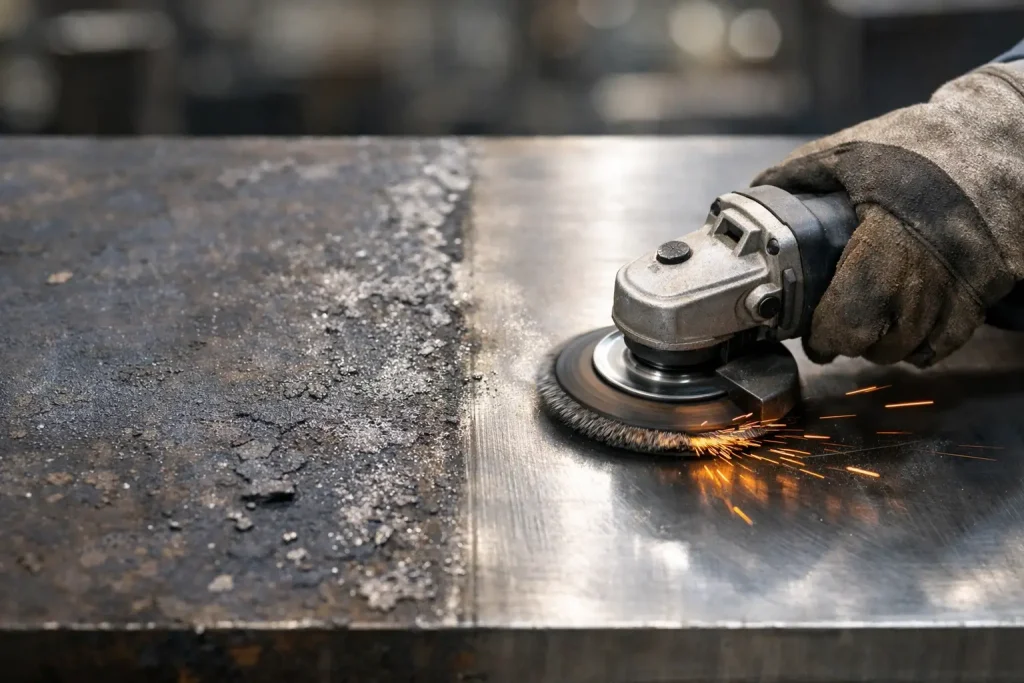
Mill scale can look like a tough, protective skin on newly fabricated steel. In reality, it is a brittle oxide layer that can fracture, trap corrosion beneath a coating, and compromise weld or inspection preparation. Knowing how to remove mill scale starts with understanding the required surface condition, not simply choosing the most aggressive cleaning method.
For a structural member going into a basic fabrication process, mechanical removal may be sufficient. For a pressure vessel, pipeline component, heritage steel feature, or precision repair, the cleaning method must also protect the substrate, control waste, and meet the specification for the next operation.
What Mill Scale Is and Why It Causes Problems
Mill scale forms when hot-rolled steel cools in air. Iron reacts with oxygen at high temperatures and creates a layered surface of iron oxides. The resulting finish is typically blue-gray or black, hard, and tightly adhered when new.
That adhesion does not mean it is a reliable coating. Mill scale and the steel beneath it respond differently to moisture, impact, and temperature changes. Once the scale cracks or lifts, moisture can reach the base metal. Corrosion may then spread under apparently intact areas of scale or paint.
Removal is commonly required before coating, welding, non-destructive testing, corrosion assessment, or restoration. It is also necessary where scale prevents a coating system from achieving the specified adhesion or where an asset owner needs a clean visual surface for inspection.
How to Remove Mill Scale: Select the Method by the End Use
The right method depends on steel thickness, geometry, accessibility, contamination, required finish, and the condition specified for the job. A process that is acceptable for heavy plate may be unsuitable for thin sheet, machined surfaces, or components located inside an operating facility.
Before work begins, confirm whether the surface needs to be merely scale-free, free from visible contamination, or prepared to a defined coating standard. Also identify whether oil, grease, chlorides, paint, or corrosion are present. Removing mill scale alone does not resolve contaminants that can cause premature coating failure.
Mechanical Grinding and Power Tool Cleaning
Angle grinders, flap discs, wire wheels, needle scalers, and rotary tools are widely used because they are familiar and readily available. They can remove localized mill scale effectively, particularly around welds, edges, and small repair areas.
The trade-off is control. Aggressive grinding can gouge the base material, round sharp edges, alter weld profiles, and leave an inconsistent surface. Wire wheels may burnish or polish scale rather than fully remove it, especially in pits and corners. The work also produces dust, noise, sparks, and operator fatigue.
Mechanical cleaning is often practical for small areas when a roughened surface profile is acceptable or required. It is less attractive when the component has complex geometry, the area is extensive, or preserving the original substrate is critical.
Abrasive Blasting
Abrasive blasting removes mill scale quickly across large steel surfaces and can create an anchor profile for protective coatings. Depending on the media and pressure, it can achieve a very thorough surface preparation result.
However, blasting introduces operational requirements that should be planned, not treated as an afterthought. Containment, ventilation, cleanup, media handling, personal protective equipment, and downtime can be substantial. Abrasive rebound can affect nearby equipment, while the process may be impractical in confined areas, active plants, sensitive properties, or occupied commercial sites.
Blasting is also inherently indiscriminate. It removes material by impact, so it may not be the best choice where surrounding paint, markings, or delicate features must remain untouched. If a coating specification calls for a blast profile, blasting may still be necessary after other cleaning steps. Laser cleaning removes the scale but does not create the anchor profile produced by abrasive media.
Chemical Pickling
Acid pickling dissolves mill scale and can reach complex shapes that are difficult to access with mechanical tools. It is commonly used in controlled manufacturing environments where parts can be immersed, rinsed, neutralized, and dried under managed conditions.
On site, chemical removal brings different risks. Acids require careful handling, containment, worker protection, rinsing, and waste disposal. Incomplete neutralization or inadequate drying can leave residues that contribute to corrosion or coating problems. Certain high-strength steels may also require specialist review because inappropriate chemical processing can affect material performance.
Chemical pickling is best considered when a controlled process is available and its waste stream, safety controls, and compatibility with the steel grade have been assessed. It is rarely the simplest option for localized maintenance in a live facility.
Laser Cleaning
Laser cleaning removes mill scale through controlled laser ablation. The laser energy is absorbed by the oxide layer, causing it to break down and detach while the underlying steel is protected through carefully selected operating parameters. The visual result is immediate: the dark oxide layer is removed in a precise cleaning path, revealing the base metal beneath.
For maintenance and restoration work, the main advantage is selectivity. A trained operator can clean scale from a weld zone, flange, steel frame, fabricated component, or detailed architectural feature without the broad impact of blasting or the residue associated with chemical treatment. The process produces dry particulate waste that can be collected, rather than spent abrasive media or chemical liquid waste.
Laser cleaning is particularly useful where plant access is restricted, containment must be minimized, or asset downtime matters. It can also support targeted inspection preparation by clearing oxides and corrosion from the exact area an inspector needs to assess.
The method is not a universal replacement for every surface-preparation process. Large, open steel areas that require a pronounced coating profile may be better suited to blasting. Very heavy scale may require multiple laser passes or an initial mechanical step. A site assessment should establish the scale thickness, required cleanliness, production rate, and final coating requirement before selecting the process.
A Practical Workflow for Reliable Results
A dependable mill-scale removal project follows a sequence rather than starting with the tool. First, inspect the steel for scale condition, rust, oil, paint, weld spatter, and corrosion pitting. Loose or laminated scale behaves differently from a dense layer on new hot-rolled steel.
Next, define what will happen after cleaning. Welding requires a clean, contaminant-free zone. Coating requires a surface condition and profile compatible with the paint system. Inspection preparation may require a clean surface with no risk of damaging dimensions, stamps, or adjacent finishes.
Then test the selected method on a representative area. This small trial confirms removal speed, substrate response, waste generation, and finish quality. It can also reveal hidden issues such as under-scale corrosion or embedded contaminants.
After cleaning, remove dust and residues, inspect the surface under suitable lighting, and protect bare steel promptly. Freshly exposed steel can begin oxidizing quickly in humid or coastal environments. If coating will not be applied immediately, use an approved temporary protection method that will not interfere with the final system.
Safety and Quality Checks That Should Not Be Skipped
Mill-scale removal can expose workers to dust, airborne contaminants, noise, moving tools, lasers, acids, or abrasive rebound, depending on the method used. The correct controls must match the process and site conditions. That includes isolation of the work area, appropriate PPE, trained operators, and a plan for collecting and disposing of debris.
Quality verification should be equally deliberate. Check for remaining scale in pits, weld toes, edges, corners, and behind attachments. Confirm that mechanical methods have not damaged the steel and that any required surface profile remains within specification. Where coating performance is critical, surface cleanliness should be verified against the project requirement rather than judged solely by appearance.
For complex or high-value assets, specialist laser cleaning provides a controlled alternative that can reduce setup, avoid chemical waste, and protect the base material. BKR Engineering approaches each project around the required outcome: remove only what needs to be removed, keep the asset protected, and leave the surface ready for its next stage of service.