
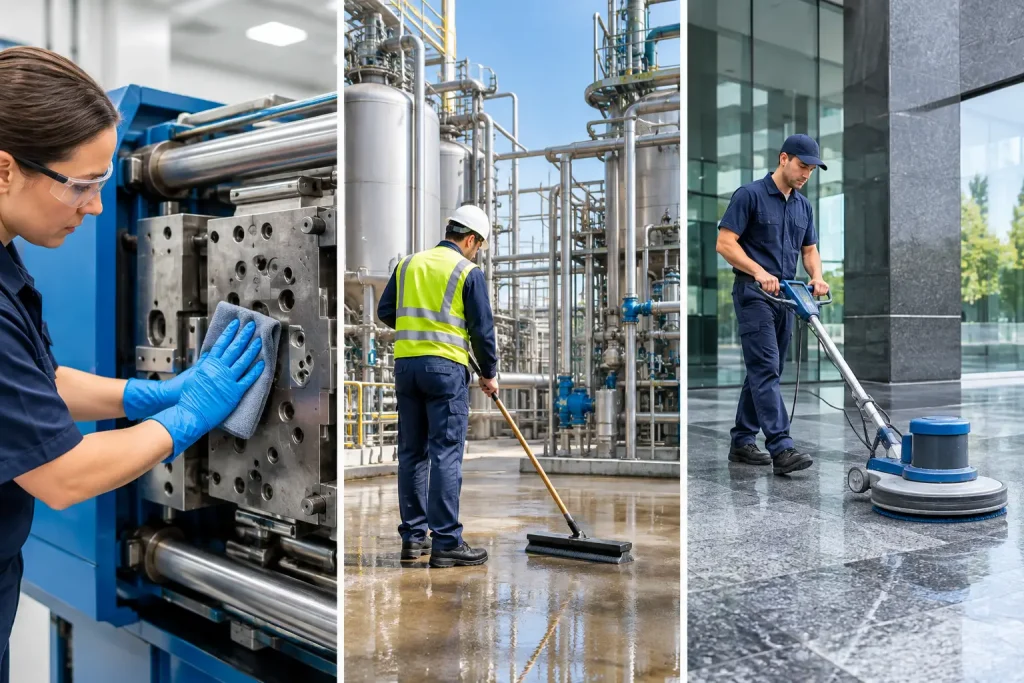
A corroded valve skid, paint-covered weld, or oil-contaminated machine component can turn a small maintenance task into a shutdown decision. Factory cleaning without chemicals gives plant teams a way to remove targeted contamination while reducing the waste, containment, and substrate risk associated with conventional cleaning methods. The result is not simply a cleaner surface. It is a surface prepared for inspection, repair, coating, or production with greater control.
For asset owners and maintenance leaders, the question is rarely whether cleaning is needed. The real question is how to achieve the required surface condition without adding unnecessary downtime, disposal costs, or damage to valuable equipment. Laser cleaning is increasingly used where precision matters most.
Why conventional factory cleaning creates operational friction
Chemical cleaning can be effective for specific deposits, but it introduces a chain of work beyond the cleaning itself. Chemicals must be selected for the contaminant and substrate, transported, stored, applied safely, neutralized where necessary, and disposed of in accordance with site requirements. Residues may also need to be rinsed away before the component can return to service.
Abrasive blasting presents a different set of challenges. It can remove heavy corrosion and coatings quickly across broad areas, but it often requires extensive masking, containment, media handling, cleanup, and environmental controls. On thin materials, machined surfaces, sensitive assemblies, or heritage features, excessive abrasion can alter the substrate or remove material that should remain intact.
These methods still have their place. Large, open steel structures with extensive heavy-scale removal requirements may favor blasting. Certain chemical processes are also appropriate when contamination is inside complex passages that cannot be accessed directly. However, neither approach is automatically the best choice for localized, high-value, or substrate-sensitive work.
How factory cleaning without chemicals works with laser ablation
Laser cleaning uses controlled pulses of laser energy to remove contaminants from a surface. Rust, oxides, paint, coatings, oil, grease, and other unwanted layers absorb the energy differently from the base material. When the process is properly selected and calibrated, the contaminant is ablated while the underlying substrate remains protected.
The practical value lies in selectivity. A technician can clean a weld zone without stripping an entire assembly, remove corrosion from a machined part without aggressive mechanical contact, or prepare a targeted area for non-destructive testing. This precision is particularly valuable when access is limited, the asset cannot be moved, or adjacent materials need to remain untouched.
The process is dry and does not depend on acids, solvents, blast media, or water. Removed material is captured through suitable fume extraction and filtration rather than washed into drains or collected as spent abrasive media. That does not mean the work is waste-free. The removed coating, corrosion product, or contaminant still needs to be managed responsibly. It does mean the cleaning method avoids generating secondary chemical effluent and large volumes of contaminated blasting media.
For plant teams, the visual effect also matters. Laser cleaning produces a clear before-and-after result as the unwanted layer is removed in a controlled path. This supports quality verification during restoration work, weld preparation, and inspection preparation, where it is essential to confirm that the required area has been cleaned.
Where laser cleaning delivers the strongest value
Laser cleaning is most effective when the job requires controlled removal rather than maximum coverage at the lowest initial cost. Maintenance teams often use it for corrosion removal on equipment, targeted paint and coating removal, mold and tool cleaning, weld seam preparation, and surface preparation before repair or recoating.
In oil and gas, fabrication, and infrastructure environments, it can support inspection readiness by exposing base metal and weld areas without introducing cleaning chemicals or abrasive residue. This is useful before visual inspection, ultrasonic testing, magnetic particle inspection, and localized repair work. The ability to clean in place can also reduce the need to remove components solely for surface preparation.
For property and heritage applications, the same control is valuable on metal fixtures, architectural elements, stone-adjacent metalwork, and artifacts where aggressive cleaning can permanently affect appearance or material condition. The correct settings, test area, and operator judgment are critical. A laser is not a universal setting-and-go tool, especially where historic finishes or mixed materials are involved.
Production environments can benefit when residues affect product quality or equipment reliability. Grease, oxidation, and coating residues on jigs, fixtures, molds, and tooling may be removed without introducing liquid cleaning agents that require drying time. Whether this improves cycle time depends on the part geometry, the area to be cleaned, and the level of contamination.
The operational benefits go beyond environmental claims
The environmental advantage of chemical-free cleaning is meaningful, but plant managers also need measurable operational outcomes. Reducing chemical handling can simplify work permits, storage controls, and waste-disposal planning. Eliminating blast media can reduce the cleanup burden and limit the risk of abrasive particles reaching nearby equipment.
Reduced setup can be equally significant. Many cleaning tasks do not require a blasting enclosure, large media recovery system, or washdown area. A laser cleaning service can often be deployed to the work location with the appropriate safety controls, helping teams address localized defects during planned maintenance windows.
Substrate protection is another financial consideration. Replacing a damaged component, re-machining a surface, or correcting over-cleaned material can cost far more than the cleaning activity itself. Controlled laser ablation is designed to remove what needs to go while preserving what needs to remain.
At BKR Engineering, this approach is delivered as a field-focused surface preparation service rather than a generic cleaning exercise. Each project begins with the contaminant, substrate, access conditions, required finish, and operational constraints in view. That allows the process to be matched to the asset rather than forcing the asset into a one-size-fits-all method.
What to assess before choosing laser cleaning
The decision should begin with a practical review of the surface condition. Heavy, widespread scale across a large structure may be better suited to another process, while localized corrosion around flanges, welds, or equipment interfaces may be an excellent laser application. The required cleaning standard matters as well. Removing loose rust is different from preparing steel for a specified coating profile.
Material type and thickness should be evaluated before work begins. Steel, stainless steel, aluminum, and other metals respond differently, as do painted surfaces, composite materials, and coated assemblies. A controlled test patch helps confirm cleaning speed, finish, and the appropriate parameters before full execution.
Access and safety planning are essential. Laser work requires trained operators, controlled work zones, suitable eye protection, and fume extraction based on the material being removed. Coatings may contain hazardous constituents, so the contamination itself must be identified and handled appropriately. Chemical-free does not remove the need for safe work practices.
Production impact also deserves attention. A method that is slower per square foot can still be faster overall if it eliminates lengthy masking, transport, curing, washing, cleanup, or waste handling. Conversely, if thousands of square feet require uniform coating removal, a different method may offer a better overall schedule. The best choice depends on total job time, not just cleaning speed.
From cleaning task to maintenance strategy
The strongest case for factory cleaning without chemicals is often found in repeatable maintenance work. When a facility knows that certain pumps, valves, tools, weld areas, or production fixtures require periodic cleaning, the process can be planned around shutdown windows and inspection schedules. Cleaning becomes a controlled preparation step instead of an emergency response after corrosion or contamination has already progressed.
It also improves coordination between maintenance, integrity, and coating teams. A clearly cleaned surface makes defects easier to identify, supports better repair decisions, and provides a more predictable starting point for subsequent work. For high-value assets, that clarity can be more valuable than an aggressive cleaning method that removes evidence along with contamination.
The right cleaning method should protect the asset, support the next task, and avoid creating a disposal problem that outlives the job. Where precision, reduced waste, and minimal disruption are priorities, laser cleaning offers a practical path from surface contamination to confident maintenance action.