
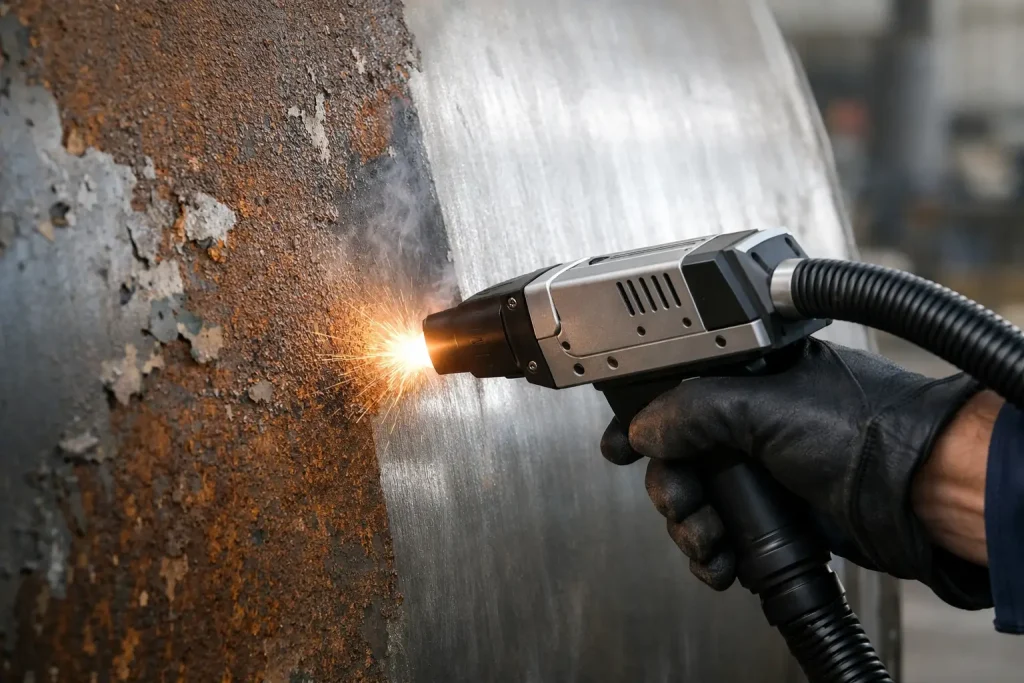
Paint removal gets expensive when the process damages the surface you still need to keep. For plant equipment, structural steel, fabrication work, and heritage assets, a laser paint removal service offers a more controlled way to strip coatings without the mess, waste, and substrate loss associated with blasting or chemicals.
The appeal is straightforward. You want the coating gone, but you do not want to roughen precision parts, thin the metal, trap media in hard-to-reach areas, or create a disposal problem that slows the job. Laser cleaning addresses those concerns by targeting the coating layer with high precision, leaving the underlying material largely unaffected when the process is properly selected and controlled.
What a laser paint removal service actually does
Laser paint removal uses short, concentrated pulses of light energy to break the bond between the paint and the substrate. In practical terms, the coating absorbs the energy, heats rapidly, and is ablated from the surface. The process is selective, which is why it is useful where the base material matters as much as the coating removal itself.
This is not the right fit for every painted surface or every project condition. Paint type, coating thickness, substrate, geometry, and required finish all affect productivity. But on many industrial and restoration jobs, laser cleaning solves a problem that other methods create – how to remove the unwanted layer without creating new damage, cleanup, or safety issues.
For owners and contractors, that difference shows up in real project outcomes. There is less secondary waste to manage, less masking and containment than many traditional methods require, and greater confidence that the cleaned surface is ready for inspection, recoating, welding, or further repair.
Where laser paint removal makes the most sense
A laser paint removal service is especially valuable when the substrate must be preserved. That includes painted steel structures, weld zones, machine components, marine and offshore equipment, tanks, pipes, fabricated assemblies, and architectural elements where profile control matters.
It is also well suited to projects with tight access or sensitive surroundings. Abrasive blasting can require extensive enclosure setup, media recovery, and broad-area protection. Chemical stripping can introduce compatibility concerns, residue management, and added safety controls. Laser cleaning is more targeted, so teams can often work with a smaller footprint and less disruption to nearby operations.
In maintenance environments, this matters because shutdown windows are short. Asset owners do not want a coating removal method that expands the scope through containment, cleanup, and waste disposal. In restoration work, the issue is different but just as critical. The job may involve delicate surfaces, detailed edges, or localized paint removal where over-cleaning would be unacceptable.
Why many teams are moving away from blasting and chemicals
Traditional methods still have their place. If you need to strip very large areas of thick coatings at the lowest upfront processing cost, blasting may remain part of the conversation. If the surface is simple, access is easy, and substrate condition is less critical, conventional removal can be adequate.
But many projects are not that simple. Blasting media can erode the base material, create dust, and leave residue in crevices or sensitive assemblies. Chemical methods can be effective, yet they introduce handling requirements, ventilation concerns, rinse needs, and hazardous waste streams. Both approaches can add labor before and after the actual removal work.
Laser cleaning changes that calculation. Because there is no abrasive media impacting the surface, there is no grit embedding and far less risk of altering the substrate profile beyond what the application allows. Because there are no stripping chemicals saturating the work area, there is less concern about chemical runoff and disposal. That makes the process attractive for companies focused on safety, environmental performance, and overall project control.
The operational benefits decision-makers care about
For facility owners and maintenance leaders, the value of laser paint removal is not just technical. It is operational.
First, it supports substrate protection. If the job involves stainless steel, carbon steel, aluminum, or a sensitive fabricated surface, preserving the base material is often more important than removing the coating as fast as possible by brute force. Rework costs more than careful removal.
Second, it can reduce downtime. A cleaner process with less setup and less waste handling can shorten the total project duration, even when raw removal speed is not the only benchmark. This is particularly important in live industrial environments where access windows are limited and surrounding equipment must remain protected.
Third, it improves site cleanliness and control. Teams do not have to manage large volumes of spent abrasive or chemical residue. That can simplify logistics and make it easier to perform work in constrained areas, near operating assets, or in locations with strict environmental requirements.
Fourth, it supports inspection and follow-on work. When paint is removed precisely, defects such as corrosion, cracking, or weld discontinuities become easier to identify. Surface preparation for recoating can also be more controlled, which matters when coating performance depends on consistent preparation rather than aggressive surface attack.
What affects performance on a real project
Not every paint removal job will run at the same speed or deliver the same economics. That is why project evaluation matters.
Coating chemistry is one factor. Some paints absorb laser energy more readily than others. Multi-layer systems, aged coatings, and heavy industrial paint builds may require different settings or multiple passes. Substrate type also matters because the goal is selective removal without harming the underlying material.
Surface geometry is another variable. Flat, accessible surfaces are straightforward. Tight corners, curved assemblies, weld seams, bolts, flanges, and complex profiles require more careful handling but are often where laser cleaning shows its value, since those same features are difficult to clean well with blasting or chemicals.
Then there is the project objective. Are you removing all paint down to bare metal, exposing a weld zone, preparing a small repair area, cleaning around a defect for inspection, or stripping a heritage element where detail preservation is essential? The right process depends on the finish requirement, not just the fact that paint is present.
Service quality matters more than the equipment alone
Laser systems are advanced tools, but project success depends on how they are applied in the field. The service provider needs to understand coating behavior, substrate sensitivity, access constraints, production pressures, and safety controls.
That is why experienced execution matters. A capable contractor will assess the coating system, define the target outcome, and match the process to the asset rather than treating every job the same. In sectors such as oil and gas, construction, fabrication, and infrastructure maintenance, that field judgment is often what separates a successful job from a costly delay.
BKR Engineering has built its laser cleaning work around that practical reality – combining controlled laser ablation with on-site service experience for clients who need precision, reliability, and a cleaner path to maintenance or restoration.
When laser paint removal is the better investment
The lowest quoted removal price is not always the lowest project cost. If a cheaper method creates substrate damage, longer shutdowns, broad containment needs, or significant waste disposal costs, the numbers can shift quickly.
Laser paint removal tends to be the better investment when the asset is high value, the work area is sensitive, access is constrained, or environmental controls are strict. It is also compelling when the cleaned surface must support the next step without compromise, whether that is inspection, welding, coating, repair, or restoration.
For procurement teams, this means evaluating total impact, not just line-item pricing. Consider labor around setup and cleanup, waste handling, operational disruption, quality risk, and the cost of unintended damage. In many cases, the controlled nature of laser cleaning justifies itself by reducing those hidden costs.
Choosing the right laser paint removal service
A good provider should be able to explain where laser cleaning fits, where it does not, and what results are realistic for your coating system and schedule. That conversation should cover substrate type, coating thickness, access conditions, required cleanliness level, and how the work will interface with shutdown planning or live-site restrictions.
It should also be clear how safety and environmental controls will be managed. One of the strengths of laser cleaning is its reduced waste profile, but professional execution still requires proper process control, fume extraction where needed, and disciplined site practices.
Most importantly, the provider should think like a project partner, not just a machine operator. The best outcomes come from aligning the cleaning method with your maintenance, fabrication, or restoration objective from the start.
If your project demands paint removal without sacrificing the surface underneath, laser cleaning is worth serious consideration. The right service does more than strip a coating – it protects asset value, keeps work moving, and gives your team a cleaner starting point for whatever comes next.