
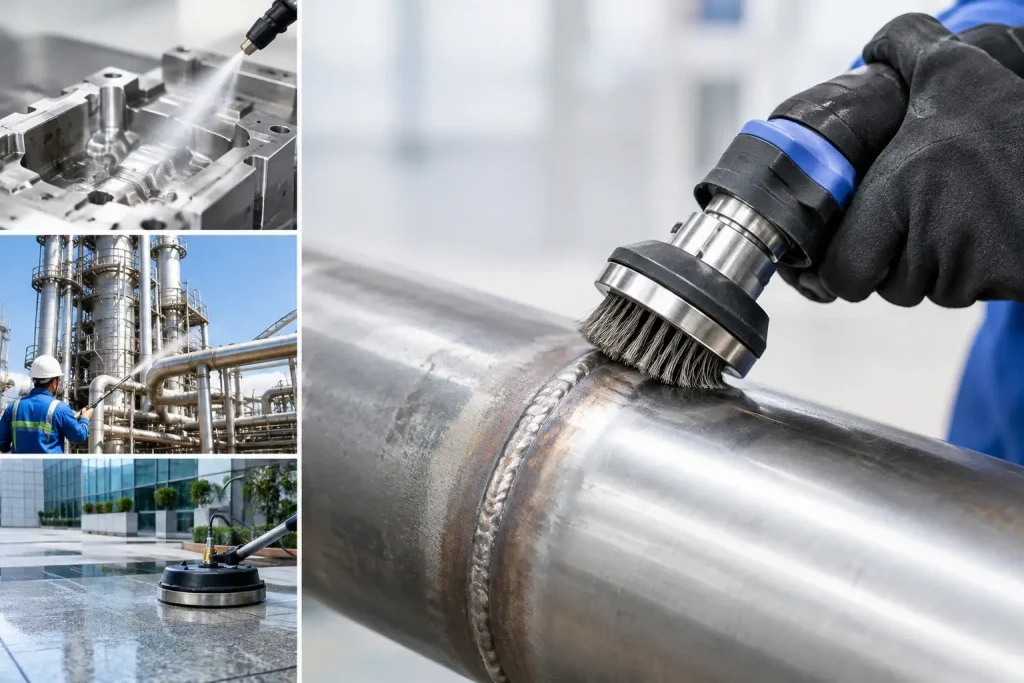
A newly completed weld can still fail a downstream inspection if heat tint, oxide scale, shop contamination, or old coating residue obscures the surface. This weld seam cleaning case study examines how controlled laser ablation can prepare fabricated steel welds for inspection and coating while protecting the surrounding base material.
The project challenge: clean the weld, preserve the steel
The project involved fabricated carbon steel components requiring localized weld cleanup after repair work. The weld seams and adjacent heat-affected zones showed a combination of oxide discoloration, light surface rust, welding residue, and handling contaminants. Before protective coating could proceed, the client needed a visibly clean, consistent surface that would support meaningful visual inspection and reliable coating adhesion.
The requirement was not simply to make the weld look better. The maintenance team needed to remove contaminants selectively without changing weld geometry, roughening nearby surfaces unnecessarily, or introducing media residue into the work area. Access was also limited. The work had to be completed in an active industrial environment where containment, cleanup, and coordination with other trades could affect the schedule.
Conventional abrasive blasting was considered, but it would have required more extensive masking and containment for a relatively narrow treatment area. It also would have generated spent abrasive and dust requiring collection and disposal. Chemical cleaning presented a different concern: chemical handling, rinse requirements, and the risk of leaving residues where coating preparation was the next step.
Laser cleaning offered a more controlled option for the specific scope. The process could target the weld seam, toe region, and heat-affected zone while keeping the intervention local to the contamination.
Weld seam cleaning case study: the laser approach
Before cleaning began, the service team reviewed the material condition, weld profile, access constraints, and the client’s acceptance requirements. This initial assessment matters because laser parameters are not selected by appearance alone. Oxide scale, rust, paint residue, oil, and weld discoloration respond differently to laser energy, and the correct settings depend on the contaminant, substrate, and required finish.
A small test area was used to establish an effective cleaning range. The objective was to remove the unwanted surface layer while leaving the steel intact. The laser beam was moved methodically across the weld and surrounding area, with the operator adjusting travel speed, overlap, and power density to account for changes in contamination thickness.
As the surface layer was ablated, the underlying metal became visible without the broad abrasion associated with blasting. The contrast was immediate: dark oxidation and residue were removed from the weld face and toe, allowing the weld profile to be assessed more clearly. This visual effect is one of the practical advantages of laser cleaning. Teams can see the cleaning boundary and surface condition develop in real time rather than waiting for media removal and final cleanup.
The work proceeded in controlled passes rather than one aggressive treatment. That approach took more operator attention than a broad, high-output cleaning method, but it reduced the risk of over-processing areas that required only light decontamination. For weld seams near machined features, edges, identification marks, or adjacent coatings that must remain in place, this selectivity can be decisive.
What was removed
The laser cleaning process addressed the contaminants that mattered to the next stage of work: oxidation around the weld, light corrosion, welding residue, and surface grime. The cleaned zone provided a more uniform condition for visual examination and coating preparation.
Laser ablation does not add blasting media, chemical stripper, or rinse water to the job. Material removed from the surface is captured through appropriate fume extraction and housekeeping controls. The exact control measures should always reflect the coating type, contaminant, work location, and site safety requirements, particularly where legacy coatings or process residues may be present.
What was intentionally left unchanged
The goal was not to polish the steel or alter the weld profile. The underlying substrate, weld contour, and adjacent sound material were preserved. That distinction is central to surface preparation work on high-value assets. A clean surface is valuable only if the cleaning method does not create a new defect, remove identifying features, or compromise dimensional tolerances.
For this reason, laser cleaning is best viewed as a precision process, not a universal replacement for every heavy-scale removal job. Thick multilayer coatings across large open areas may call for a different approach, or a combined strategy. But for localized weld treatment, inspection preparation, repair zones, and areas where containment is difficult, the control offered by laser ablation is especially useful.
Operational results that mattered to the client
The most immediate result was improved weld visibility. Once oxides and residue were removed, the inspection team could assess the weld surface without contamination masking potential discontinuities. Cleaning did not replace the required inspection method, but it created the surface condition needed for inspection to be carried out with greater confidence.
The second result was a cleaner path to coating. Coating performance depends heavily on surface condition. Contaminants such as oil, rust, loose oxides, and welding residues can interfere with adhesion even when the coating itself is correctly specified and applied. By cleaning the affected weld areas before coating, the team reduced a common source of premature coating failure around repairs.
The third result was reduced site burden. Because the treatment was localized and media-free, the job avoided the large containment footprint and secondary cleanup often associated with abrasive methods. That can translate into less disruption around operating equipment, fewer consumables moving through the worksite, and a simpler waste-management profile.
There is a scheduling benefit as well. On maintenance projects, the critical path often includes more than the cleaning itself. Setup, masking, containment, waste collection, demobilization, and permit coordination can consume significant time. Laser cleaning does not eliminate planning or safety controls, but it can reduce the amount of supporting activity needed for a targeted weld seam scope.
Why surface condition before inspection cannot be treated as a cosmetic issue
Welds are high-consequence areas in many assets. In fabrication, infrastructure maintenance, oil and gas facilities, and structural repair work, the weld and its heat-affected zone can be the first areas to corrode or show coating breakdown. If contamination remains in place, it can conceal relevant surface features and make inspection judgments less reliable.
A clean weld seam also supports better decision-making. Maintenance teams can distinguish between superficial oxidation, coating failure, and conditions that require further evaluation. This prevents unnecessary rework on one hand and avoids the false confidence that can come from inspecting through rust, scale, or residue on the other.
The level of cleaning should match the next operation. For visual inspection, a clearly exposed weld profile may be the requirement. For certain non-destructive examination methods, the surface may need a more specific condition. For coating, the coating manufacturer’s preparation requirements remain the governing standard. A capable service provider should align the cleaning process with that requirement rather than applying one finish to every job.
When laser weld cleaning is the right fit
Laser cleaning is particularly effective when the work involves localized corrosion removal, weld discoloration, post-weld residue, spot repairs, or coating removal around a seam. It is also well suited to assets where the base material must be protected, where access makes blasting impractical, or where the owner wants to minimize abrasive media and chemical waste.
It may be less efficient for extensive, uniform cleaning over very large areas with heavy scale. In those cases, production rate, access, surface profile requirements, and total area must be evaluated honestly. The right choice is the method that achieves the required surface condition safely, predictably, and at a sensible total project cost – not simply the method with the fastest cleaning rate in isolation.
BKR Engineering approaches this assessment as a service decision, not a one-size-fits-all equipment demonstration. The process begins with the contaminant, substrate, access conditions, and end requirement, then defines a controlled cleaning plan around the asset.
For asset owners and project teams, the practical lesson is straightforward: weld seam cleaning should be specified as part of the inspection and coating strategy, not treated as an afterthought. When the surface is clean enough to reveal the real condition of the weld, every decision that follows becomes more reliable.