
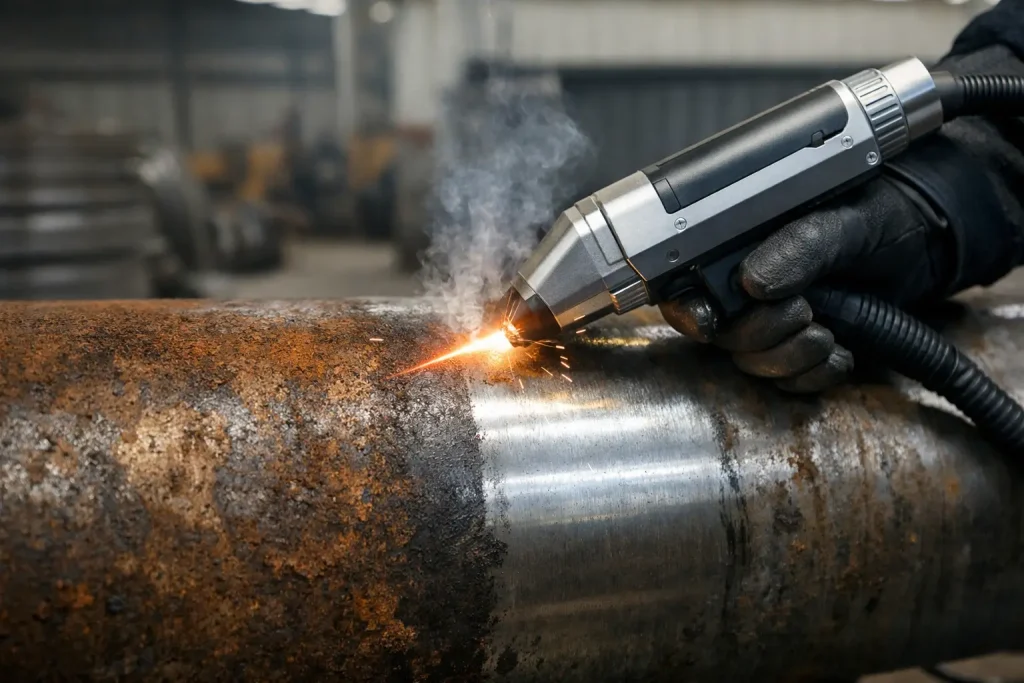
A steel structure can look serviceable until corrosion, mill scale, or failed coating begins to compromise inspection, welding, or repainting work. Laser descaling for steel gives maintenance teams a controlled way to remove those unwanted layers while preserving the base material beneath them. The result is not simply a cleaner surface. It is a surface that can be assessed, repaired, coated, or returned to service with greater confidence.
For asset owners, the practical question is not whether steel needs cleaning. It is whether the cleaning method introduces avoidable damage, waste, setup time, or safety exposure. In applications where precision matters, laser cleaning can provide a strong alternative to abrasive blasting, grinding, and chemical stripping.
How laser descaling for steel works
Laser descaling uses concentrated laser energy to interact with contaminants on the steel surface. Rust, oxides, scale, paint, oil, and other unwanted layers absorb the energy differently from the underlying metal. When the process is set correctly, the contaminant is loosened, vaporized, or broken down into fine residue while the steel substrate remains intact.
This selective action is the central advantage. Abrasive methods remove material through impact, which can alter surface profiles, drive contaminants into the surface, or affect thin, detailed, or sensitive components. Chemical methods can be effective, but they require handling, containment, neutralization, and disposal. Laser cleaning is a dry process, with the removed material captured through appropriate fume extraction and filtration.
The effect is immediately visible. An operator can move across a corroded panel, weld area, machine component, or steel frame and watch the original surface emerge in real time. That visual control is valuable on site because it helps teams verify progress and stop once the required cleaning level has been achieved.
Where laser cleaning delivers the most value
Laser descaling is not intended to replace every surface-preparation method. Its value is highest where selective removal, access, cleanliness, and substrate protection are more important than treating the largest possible area at the lowest cost per square foot.
For example, it is well suited to weld preparation and weld inspection. Scale, oxidation, coating residues, and localized corrosion can obscure defects or interfere with welding quality. Laser cleaning can prepare the immediate weld zone without blasting surrounding equipment, cables, instruments, or finished surfaces.
It is also effective for maintenance of structural steel, pipework, valves, tanks, flanges, machinery, and fabricated assemblies. In oil and gas, power generation, marine, construction, and process facilities, localized corrosion often develops around joints, supports, fasteners, and difficult-to-reach areas. Mobilizing a blasting operation for a small but critical repair can create disproportionate disruption. A laser system can often address the target area with a much smaller work footprint.
Coating removal is another practical application. When a coating has failed only in selected areas, stripping the entire component may not be necessary. Controlled laser ablation can remove the failed layer around corrosion spots, edges, or repair zones, allowing targeted recoating. This approach can reduce material consumption and shorten the path to return-to-service work.
Heritage and architectural steel require additional care. Decorative ironwork, historic fixtures, steel features, and intricate metal details may not tolerate aggressive blasting or heavy mechanical abrasion. Laser cleaning allows operators to work progressively, test settings, and retain details that can be lost through harsher methods.
Operational benefits beyond a clean surface
The most meaningful benefit of laser descaling for steel is control. Teams can remove a specific contaminant from a defined location without turning the work area into a blasting zone. This is particularly useful in operating plants, occupied buildings, constrained construction sites, and locations near sensitive equipment.
Reduced secondary waste is another major consideration. Abrasive blasting produces spent media mixed with the material removed from the surface. Chemical cleaning generates liquid waste that may require specialized treatment. Laser cleaning produces a comparatively small amount of particulate residue, although that residue still requires proper collection and disposal. The environmental benefit comes from reducing consumables and avoiding the large waste streams associated with many conventional processes, not from eliminating site controls altogether.
Setup and containment requirements can also be lower. There is no blast media to transport, recover, or clean up, and no chemical bath to manage. Depending on the project, this can reduce downtime and make localized work more practical during planned maintenance windows. For facility managers, less disruption around the work zone can be as valuable as the cleaning result itself.
Laser cleaning also supports better inspection preparation. Corrosion products, coatings, and deposits can hide pitting, cracking, defective welds, or section loss. Cleaning the surface precisely gives inspectors a clearer view of the actual condition of the asset. The process does not repair underlying damage, but it can reveal the information needed to make a sound repair decision.
What determines the right cleaning approach
A successful laser descaling project begins with the condition of the steel and the required finish. Light flash rust, heavy scale, multilayer coatings, oily deposits, and tightly bonded oxides do not respond in exactly the same way. The thickness and composition of the contaminant affect the laser settings, travel speed, number of passes, and expected productivity.
The steel itself matters as well. Thick structural members generally offer more tolerance than thin sheet, precision components, plated surfaces, or heat-sensitive assemblies. Although laser cleaning is non-contact, it is not a one-setting process. Power, pulse duration, beam size, and scanning pattern must be matched to the substrate and the material being removed.
Access is equally important. Laser cleaning is especially attractive for corners, seams, profiles, and localized repairs, but line-of-sight is still required. Large, open surfaces with heavy corrosion may be more economical to blast if the project can accommodate containment, media handling, and cleanup. The right method depends on scope, access, surface specification, operating constraints, and lifecycle cost, not on a single technology claim.
Safety and quality controls on site
Industrial laser work requires trained operators and disciplined controls. The cleaning zone must be managed to protect personnel from laser exposure, reflected energy, fumes, and airborne particles. Appropriate laser safety measures, controlled access, eye protection, fire precautions, and fume extraction are part of professional execution.
Quality control should be defined before work begins. A project may require removal to bare metal, partial coating removal, a specific surface profile, cleaning around a weld, or preparation for a particular coating system. Test patches are useful because they confirm the cleaning rate and finish before full production starts. They also give maintenance, inspection, and coating teams a common reference for acceptance.
For coating projects, cleaning is only one part of the system. Surface condition, remaining profile, ambient conditions, salt contamination, and coating manufacturer requirements still need to be considered. A clean steel surface is valuable only when the next step is performed under the correct conditions.
A practical partner for critical steel assets
The best results come from treating laser descaling as an engineered service rather than a generic cleaning task. A qualified provider should review the contaminant, substrate, access limitations, safety requirements, production schedule, and desired finish before recommending an approach. That upfront evaluation prevents a precise technology from being applied to the wrong problem.
BKR Engineering supports steel cleaning and surface-preparation work with controlled laser ablation suited to maintenance, restoration, inspection preparation, and production environments. For projects where substrate protection, reduced waste, and minimized disruption matter, a site assessment and sample test can turn an uncertain cleaning scope into a clear, workable plan.
When corrosion or failed coatings stand between an asset and its next inspection, repair, or coating cycle, the most effective next step is often to evaluate the surface in place. A small test area can show exactly what laser cleaning can remove, what the underlying steel reveals, and whether precision descaling is the right route for the work ahead.