
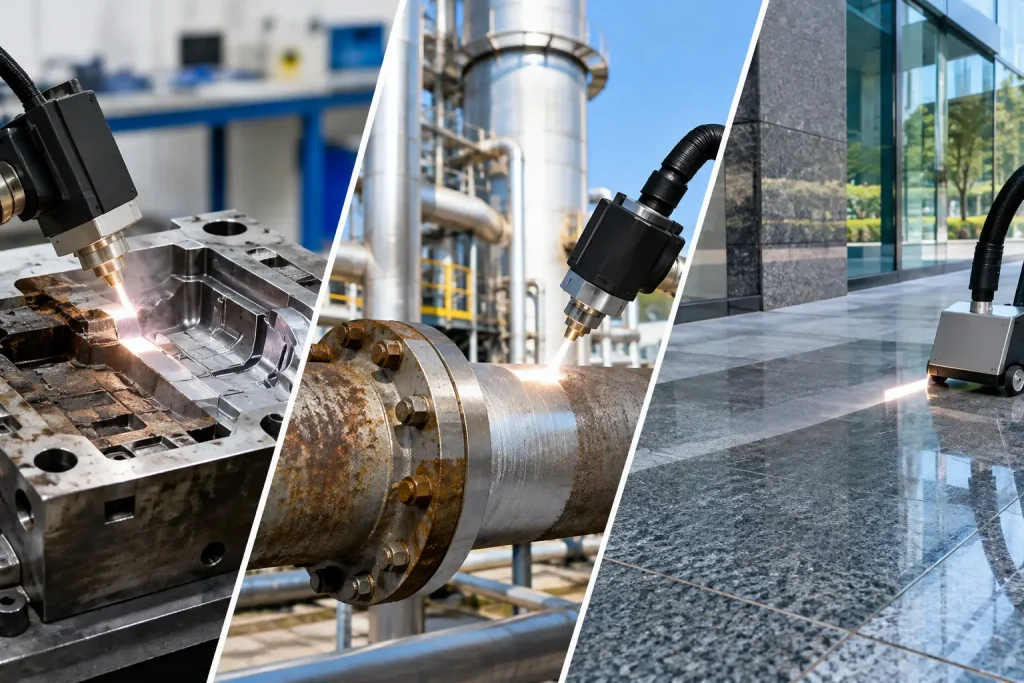
Laser cleaning limitations should be assessed before a maintenance scope is written, not after equipment arrives on site. For asset owners, inspection teams, and facilities managers, the relevant question is rarely whether a laser can remove a contaminant. It is whether it can achieve the required surface condition safely, consistently, and within the access, containment, and shutdown constraints of the job.
Laser ablation can be highly selective. That selectivity is valuable when the objective is to remove corrosion, coatings, deposits, or staining while retaining a sound underlying substrate. It does not make laser cleaning a universal replacement for every preparation method. Material type, contamination thickness, geometry, access, production conditions, and acceptance criteria all affect suitability.
Why laser cleaning limitations matter in project planning
A successful project starts with a defined outcome. “Clean” is not a sufficient specification for a storage tank, an NDT inspection location, a process skid, or a heritage facade. The required result may be corrosion removal, access to sound base metal, removal of a localized coating, recovery of inscriptions or stone detail, or a surface condition suitable for a particular inspection method.
Laser cleaning works by delivering controlled energy to the surface. The target layer absorbs energy and is removed or altered more readily than the substrate. This interaction varies considerably between materials. A thin oxide on steel, a heavy multilayer coating, marine encrustation, carbonaceous deposits, and biological staining on porous stone should not be treated as equivalent cleaning problems.
The practical implication is that a representative trial is more informative than assumptions based on photographs alone. A trial can establish the likely cleaning rate, achievable finish, fume and debris controls, access requirements, and any areas where another method may be more appropriate.
The main laser cleaning limitations
Thick or variable coatings can slow progress
Laser cleaning is often well suited to targeted removal and controlled restoration. However, thick, layered, or poorly characterized coatings can take longer than expected. Coating thickness may vary across an asset, particularly on repaired plant, marine equipment, older structural steel, and previously maintained facades.
Some coatings also respond differently from one layer to the next. An outer paint layer may ablate predictably while an underlying primer, corrosion product, or tightly bonded residue requires changed parameters or additional passes. Where large areas of heavy coating must be removed to a specified profile, the project team should compare the required finish and production rate against available shutdown time.
Geometry and access affect consistency
A laser beam requires line-of-sight access. Flat, open surfaces are generally simpler to treat than deep recesses, narrow gaps, complex brackets, pipe supports, threads, undercuts, and densely packed equipment. The challenge is not only reaching the area, but maintaining appropriate beam angle, standoff distance, visibility, and operator control.
This is particularly relevant inside storage tanks and process equipment. Restricted entry routes, internal obstructions, elevated work, and confined-space controls can govern the work plan. BKR Engineering’s patent-pending confined-space laser-cleaning technology is intended to support practical access and controlled work in these environments without disclosing proprietary design details. Its value should be assessed against the tank layout, access points, ventilation arrangement, residue management plan, and inspection objectives.
The substrate must be understood
Laser cleaning can preserve a sound substrate when parameters are selected for the material and condition. That does not mean every substrate carries the same tolerance for energy input. Thin sections, heat-sensitive components, certain alloys, aged finishes, fragile stone, and decorative architectural details need careful evaluation.
For commercial stone and heritage restoration, the goal is usually recovery rather than aggressive stripping. Where routine washing has reached its limit, laser treatment may help remove selected dark deposits, staining, corrosion marks, or surface accretions while retaining original material and detail. Yet stone composition, porosity, weathering state, previous repairs, and the nature of the staining all matter. A small test area is essential before defining a wider restoration scope.
Surface preparation requirements may exceed cleaning alone
Removing corrosion or contamination does not automatically create the correct surface for every coating system or inspection process. Some specifications require a defined surface profile, particular roughness, or a stated visual cleanliness standard. Laser cleaning may remove the unwanted layer effectively while leaving a profile that differs from abrasive methods.
For NDT preparation, the key consideration is whether the cleaned area allows the intended technique to produce reliable results. Dye penetrant testing, magnetic particle inspection, ultrasonic testing, and visual examination each have different sensitivities to residual coatings, surface condition, geometry, and access. Pre-inspection laser cleaning can be useful where localized preparation and substrate preservation are priorities, but the inspection provider should confirm the acceptance condition before work begins.
Fumes, residues, and site controls remain part of the job
Laser cleaning does not eliminate the need to manage what has been removed. Ablated coatings, corrosion products, deposits, and contaminants can create fumes, particulates, or residue that require extraction, containment, collection, and disposal under the applicable site requirements.
The nature of the original material is important. A coating history, process contamination information, and any known hazardous-material records should be reviewed during planning. In operating facilities, work permits, isolation requirements, ventilation, fire controls, exclusion zones, and coordination with adjacent activities can be as decisive as the cleaning method itself.
Productivity depends on the actual workface
Quoted cleaning rates can be misleading when they are separated from the real workface. Productivity is influenced by target material, thickness, surface area, access, repositioning, masking, safety controls, setup, verification, and the proportion of time spent treating difficult details rather than open surfaces.
A small, targeted repair area may favor laser cleaning because selectivity and limited disruption are more valuable than raw square-foot output. A broad surface with uniform, heavy material may call for a different approach, or a combined method. The best choice depends on the required result, not on the assumption that one technology should handle the entire scope.
Applying the assessment to common maintenance scopes
Storage tanks and confined spaces
Tank cleaning and surface preparation often involve difficult access, internal corrosion, deposits around welds or fittings, and a need to minimize unnecessary disturbance of sound material. Laser cleaning may be considered for localized corrosion removal, weld-area preparation, coating removal in defined zones, and pre-inspection access.
The limitations are closely tied to the tank’s entry configuration and internal condition. Teams should establish whether the work is internal or external, whether entry is permitted, the condition of the atmosphere, the available power and ventilation, the residue type, and the inspection or repair plan that follows cleaning. A controlled trial can clarify whether the method reaches the required areas and supports the turnaround schedule.
NDT and integrity inspection preparation
Inspection teams need a surface that supports valid examination, not merely an improved appearance. Laser cleaning can be useful for preparing localized test areas on vessels, piping, welds, structural members, and heavy equipment where avoiding broad abrasive impact is desirable.
Before selecting the method, define the inspection technique, required test area dimensions, coating and contaminant types, and any concern about surface alteration. Coordinate the cleaning sequence with the NDT provider so the prepared condition is reviewed promptly and protected from recontamination.
Heavy industrial and marine equipment
On process plants, refineries, shipyards, and marine facilities, equipment often combines corrosion, old coatings, tight access, and operational constraints. Laser cleaning may assist with restoration of selected components, localized preparation for repair, and cleaning around sensitive features where broad mechanical methods are unsuitable.
Its limitations become more pronounced where surfaces are highly irregular, contamination is exceptionally heavy, or work must proceed around live operations. Planning should include isolation needs, access routes, lifting or platform requirements, adjacent equipment protection, and the expected follow-on repair or coating activity.
Commercial stone and heritage surfaces
For property owners and conservation teams, replacement can be costly and can remove the character that made a facade, feature, or monument worth retaining. Laser cleaning may provide an option where routine washing no longer recovers the original appearance or detail.
It should not be treated as a cosmetic shortcut. The work needs a careful assessment of stone type, mortar condition, patch repairs, previous coatings, salts, moisture, and the desired visual outcome. Test panels help establish a suitable result and identify areas that need a gentler or different treatment.
Information needed for a useful assessment
A project discussion is more productive when it includes clear photographs, location and access details, approximate area, material and contamination information, and the required end condition. It also helps to provide any coating history, safety documentation, inspection specifications, shutdown window, and constraints on containment or operations.
Where possible, identify a representative trial area that includes both typical conditions and the most difficult section. A trial should be judged against agreed criteria: removal quality, substrate condition, accessibility, residue controls, and practical production rate. This gives maintenance and asset-integrity teams a defensible basis for choosing the next step.
Laser cleaning is most valuable when its precision addresses a real project constraint: preserving substrate, preparing a critical inspection area, reaching a difficult location, or restoring material that would otherwise be replaced. Discuss the application with BKR Engineering early, bring the relevant operating and material information, and use a representative trial to determine whether laser cleaning is the right fit for the work.