
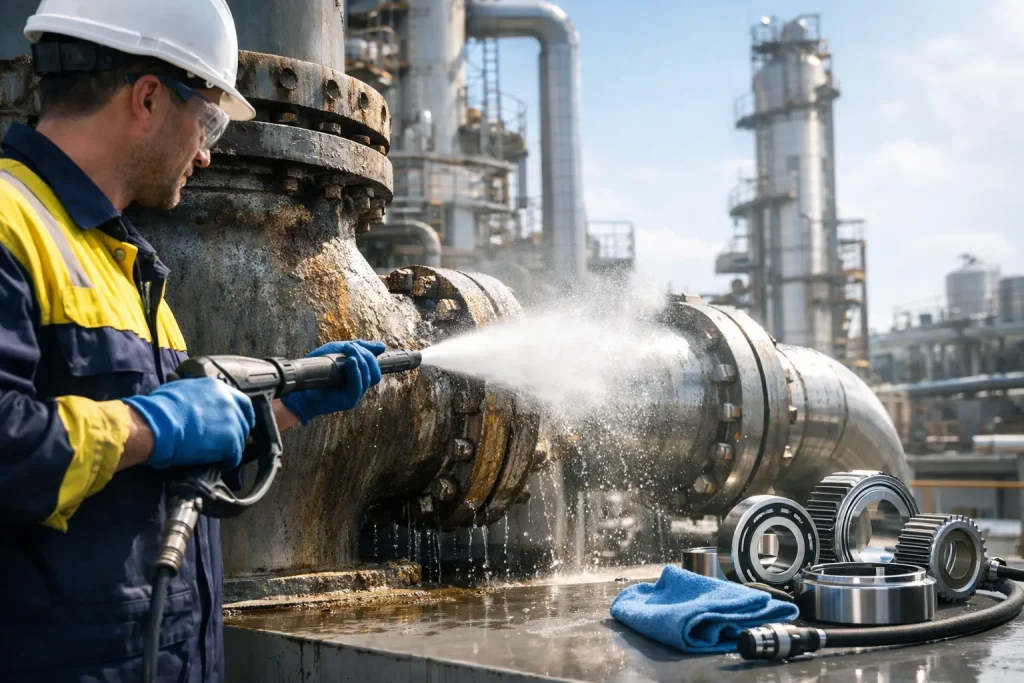
A corroded flange, peeling coating, or oil-contaminated weld is not simply a cleaning issue. It can hide wall loss, compromise a coating system, delay an inspection, or turn a routine maintenance task into an unplanned outage. Cleaning for asset integrity is the disciplined removal of surface contaminants so teams can see the true condition of an asset, perform repair work correctly, and protect the base material throughout its service life.
For plant managers, integrity engineers, and contractors, the question is not whether a surface should be cleaned. The real question is how to remove only what must go while preserving the metal, profile, surrounding equipment, and work schedule. That distinction determines whether cleaning supports reliability or introduces a new source of risk.
Why Surface Condition Drives Asset Integrity
Surface contamination affects far more than appearance. Rust can conceal localized pitting. Oxides can interfere with weld quality. Old paint and failed coatings may trap moisture against steel, accelerating under-film corrosion. Grease, salts, and process residues can prevent a new protective coating from bonding as specified.
When the surface cannot be evaluated clearly, inspection results become less reliable. A technician may be unable to distinguish superficial oxidation from active corrosion, or a coating inspector may not be able to verify whether a substrate is ready for recoating. Cleaning is therefore a prerequisite for informed integrity decisions, not an isolated housekeeping activity.
The stakes are especially high on pressure-containing equipment, structural steel, pipelines, storage assets, marine components, process skids, and critical fabricated assemblies. A small defect in the wrong location can have consequences for safety, production, compliance, and repair cost. The same principle applies to heritage metalwork and architectural features, where aggressive cleaning can permanently damage details that cannot be replaced.
Cleaning for Asset Integrity Requires Selective Removal
Not every contaminant calls for the same method. Abrasive blasting can be effective when a large area requires a defined surface profile before coating. Chemical cleaning may be appropriate for certain residues, geometries, or tightly controlled processes. These methods also create considerations around containment, media recovery, secondary waste, chemical handling, and access restrictions.
For localized corrosion removal, coating stripping, weld-zone preparation, or inspection access, laser cleaning offers a different level of control. Pulsed laser energy is directed at the unwanted surface layer. Rust, oxides, paint, oil, grease, and other contaminants absorb the energy and are ablated, while the underlying substrate can remain intact when the process is correctly selected and operated.
That selectivity matters when the base material is valuable, thin, machined, or difficult to replace. It also matters around welds, bolt connections, nameplates, edges, electrical equipment, and adjacent areas that should not be exposed to blast media or chemical runoff. The visible cleaning line created by laser ablation gives project teams immediate confirmation of where contamination has been removed and where work remains.
Laser cleaning is not a universal replacement for every preparation method. Large-scale coating removal across broad open surfaces may still favor other approaches depending on production rate, coating specification, access, and project economics. Asset integrity programs benefit most when the cleaning method is matched to the required outcome rather than selected by habit.
Start With the Required Inspection or Repair Outcome
Effective work begins by defining what the cleaned surface must enable. An inspection preparation scope may require enough contaminant removal for visual examination, ultrasonic testing, magnetic particle testing, or dye penetrant inspection. A coating scope may require a documented cleanliness level and surface condition compatible with the coating manufacturer’s requirements. A weld repair scope may need removal of oxides and hydrocarbons from the joint area without altering adjacent material.
This outcome-based approach prevents overcleaning. Removing a coating from an entire structure when only targeted inspection windows are needed consumes time and increases disruption. Conversely, a surface that looks clean but retains oil, corrosion products, or soluble contamination may not be fit for its intended repair or protection system.
Before mobilization, teams should establish the substrate type, contaminant type, affected area, required final condition, access constraints, and whether the asset can remain in service. These factors determine laser settings, work sequence, safety controls, and the realistic productivity rate. A trial area is often worthwhile for high-value assets or unfamiliar coatings because it confirms both cleaning performance and substrate response before full deployment.
Corrosion and Oxide Removal
Corrosion removal is often the most visible integrity application. The goal is not to make every component look new. It is to remove corrosion products sufficiently to reveal the actual steel condition, identify pitting or section loss, and prepare the area for further assessment or repair.
Controlled laser ablation can be particularly useful around corroded welds, complex geometries, flanges, valves, and localized structural defects. It avoids leaving behind blast media that can migrate into process areas or mechanical interfaces. For shutdown work, this can reduce the setup associated with containment and cleanup, especially where only a limited area needs attention.
Coating Removal and Recoating Preparation
Failed coatings are frequently a symptom of an underlying surface condition problem. Moisture intrusion, poor adhesion, incompatible prior repairs, and corrosion beneath the film can all contribute to premature failure. Selective coating removal allows teams to expose affected areas for inspection without stripping sound coating unnecessarily.
For spot repairs, the edge of the remaining coating is as important as the exposed substrate. A controlled cleaning process can help create a defined transition zone while limiting disturbance to surrounding paint. Final preparation requirements still depend on the specified coating system, so cleaning should be coordinated with the coating contractor and inspection plan rather than treated as a separate task.
Weld and Fabrication Support
Weld quality begins before the arc is struck. Oil, mill scale, oxides, and coatings near the joint can contribute to porosity, inclusions, or inconsistent weld performance. Cleaning the weld area precisely helps fabricators prepare joints while avoiding unnecessary abrasion of nearby surfaces.
After welding, laser cleaning can also remove heat tint, oxidation, and residues to support visual examination and downstream inspection. In fabrication environments, this can be valuable for components that need a clean finish without the dust and media management associated with conventional blasting.
Downtime, Safety, and Waste Are Part of the Integrity Case
The best cleaning method is not judged only by removal speed. Total job duration includes isolation, access, containment, cleaning, waste handling, inspection, reinstatement, and demobilization. A process that appears fast at the surface may lose its advantage if it requires extensive enclosure construction, media cleanup, or hazardous waste disposal.
Laser cleaning can reduce these secondary activities because it does not rely on loose abrasive media or chemical stripping agents. This is useful in congested plants, operating facilities, enclosed spaces, and sensitive locations where contamination control is a major concern. Less secondary waste can also simplify the environmental burden of a project.
Safety remains a planned activity, not an assumed benefit. Laser work requires trained operators, controlled work zones, appropriate laser safety measures, ventilation or fume extraction where needed, and coordination with site operations. The correct controls depend on the material being removed, the work environment, and the asset’s operating condition. A reputable service provider will assess these conditions before work starts.
Measure Value Beyond the Cleaned Square Foot
Asset owners should evaluate cleaning work against the avoided cost of poor visibility, substrate damage, delayed inspection, coating failure, or prolonged downtime. The relevant comparison is rarely just the hourly rate or the price per square foot. It is the total cost to reach a verified, usable surface condition.
Useful project measures include inspection readiness, coating repair quality, reduced containment requirements, waste generated, time spent inside a shutdown window, and the number of follow-on defects identified before they become failures. For critical assets, the ability to inspect a precise area without damaging the substrate can be more valuable than the fastest possible bulk removal rate.
BKR Engineering approaches laser cleaning as a field service decision, not a technology demonstration. The right scope considers asset condition, access, safety controls, inspection objectives, and the next step after cleaning. That practical coordination is what turns a clean surface into an integrity outcome.
Build Cleaning Into the Maintenance Plan
Cleaning is most effective when it is planned before corrosion becomes severe or a coating failure spreads. Targeted cleaning during routine inspections can expose early defects, support condition assessment, and allow smaller repairs to be completed before a major outage is required.
For recurring assets, document the location, contaminant type, cleaning method, final condition, and inspection findings. Over time, those records help identify repeat failure patterns and improve maintenance intervals. They also make future scopes more predictable for operations, procurement, and contractors.
A clean surface is not the end of the job. It is the point at which an asset can finally be assessed honestly, repaired with confidence, and returned to service with fewer unknowns.