
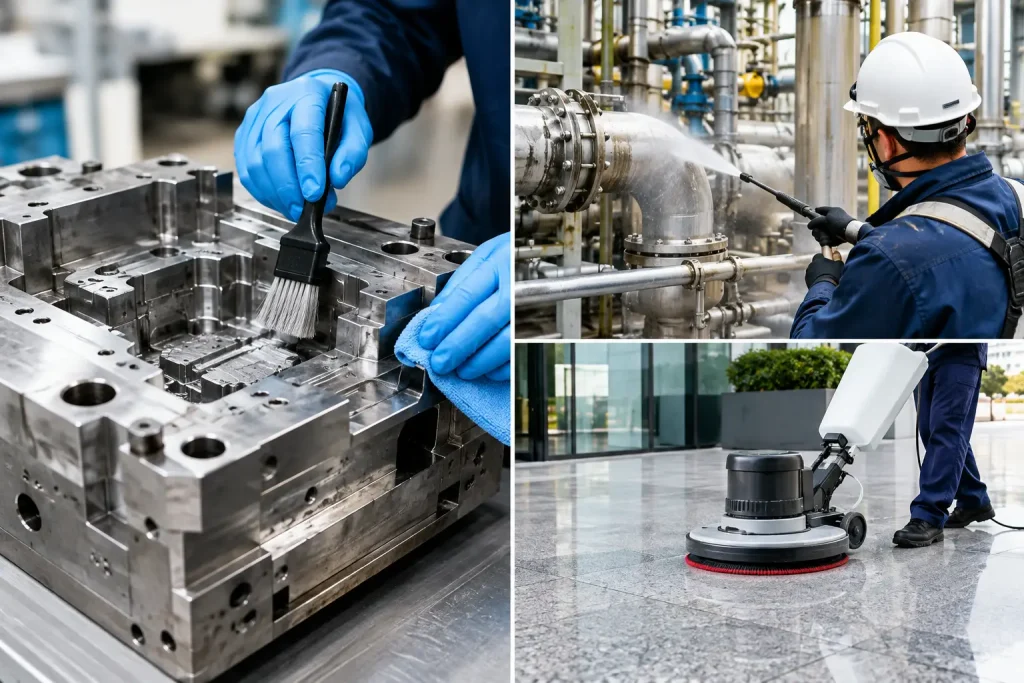
A corroded valve body, fouled pump housing, or coated inspection area can conceal the condition that maintenance and integrity teams need to see. Knowing how to clean industrial tools is therefore not simply a matter of improving appearance. The right method removes contaminants while preserving dimensions, markings, edges, and the underlying substrate needed for repair, inspection, or continued service.
For process plants, refineries, shipyards, tank operators, and commercial facilities, the cleaning method should be selected around the asset’s material, condition, access constraints, and next step. A surface being prepared for NDT requires a different outcome from heritage stone with embedded atmospheric staining. Specialist laser cleaning can be a useful option where conventional washing, hand tools, or abrasive methods have reached their limits, but it must be assessed against the application rather than treated as a universal answer.
Start With the Required Surface Condition
Before choosing equipment or a cleaning process, define what must be removed and what must remain. “Clean” can mean removing loose rust from steelwork, exposing a weld for inspection, reducing carbonized deposits on machinery, stripping a failed coating, or recovering the original appearance of architectural stone. These are materially different tasks.
The required finish should also relate to the planned follow-on work. For NDT, the objective may be a clear, consistent inspection area free from corrosion products, coatings, oil residues, or deposits that could interfere with an examination. For restoration, the objective may be selective removal of surface contamination while retaining the original profile, decorative detail, or patina where appropriate.
A practical assessment begins with the base material, contaminant type, thickness and adhesion of the unwanted layer, total treatment area, access conditions, and downtime window. Photographs help, but representative samples or a site trial are often the most reliable way to establish whether the process can achieve the required condition.
How to Clean Industrial Tools and Equipment Systematically
Industrial tools and equipment should be cleaned in a sequence that prevents contamination from being moved around or driven further into the surface. First, isolate the asset and confirm its operating status, temperature, surrounding hazards, and any permit requirements. Loose debris, oils, and process residues may need separate handling before a precision surface-preparation method is used.
Next, identify sensitive features. These may include machined faces, identification plates, seals, electrical components, thin sections, protective finishes intended to remain in place, or historic surface details. A cleaning process that performs well on a thick steel bracket may be unsuitable for a delicate casting, a nonferrous metal, or a weathered masonry joint.
The treatment itself should be controlled in small areas before progressing across the whole component. This allows the operator and asset owner to check the exposed substrate, confirm that the required contamination is being removed, and adjust settings or technique where needed. Visual inspection during the work is particularly valuable when coatings vary in thickness or corrosion is uneven.
Finally, verify the result against the intended purpose. This might involve a visual standard, an NDT provider’s preparation requirement, a coating specification, or agreed restoration acceptance criteria. Cleaning is only useful when it leaves the asset ready for its next decision or process.
Where Laser Cleaning Can Help
Laser cleaning uses controlled laser energy to remove selected surface layers. Depending on the material and contamination, it can be applied to corrosion products, coatings, carbon deposits, oxide layers, and ingrained surface soiling. The visual change can be immediate, which helps maintenance teams judge progress and identify areas requiring further attention.
For heavy industrial equipment restoration, the method can be well suited to components where aggressive mechanical cleaning could remove sound material or obscure surface features. Process-plant machinery, marine equipment, fabricated steelwork, and selected repair areas may benefit when access, substrate preservation, and local containment are important considerations.
Pre-inspection preparation is another relevant application. Corrosion, paint, and deposits can prevent inspectors from seeing surface-breaking indications or properly assessing a weld, nozzle, fitting, or structural element. Laser cleaning can create a targeted inspection window without treating an entire asset unnecessarily. The exact acceptance standard should be agreed with the inspection or NDT party before work starts.
Storage tanks present a more complex case because access, geometry, internal condition, and confined-space controls shape the cleaning plan. BKR Engineering’s patent-pending confined-space laser-cleaning technology is intended to support practical access and controlled treatment in difficult tank environments without disclosing proprietary design details. Its potential advantages include more targeted surface preparation in restricted areas and less reliance on highly abrasive approaches. Suitability still depends on the tank’s service history, contaminant type, ventilation requirements, structural condition, and project safety arrangements.
Avoid Treating Laser Cleaning as a Blanket Solution
Laser cleaning is selective, not automatic. Some coatings, deposits, and substrates respond well; others require alternative methods, supplementary preparation, or a combination of processes. Thick multilayer coatings can take longer than expected. Deep pitting cannot be cleaned away because it is loss of base material, not surface contamination. Residues in joints, crevices, or inaccessible internal features may also require a different approach.
Heat response must be considered carefully. Parameters are selected to suit the material and layer being removed, but sensitive substrates, thin metal, certain composites, and some finishes need particular caution. The goal is controlled cleaning, not the broadest possible removal rate.
Production constraints can affect feasibility too. A large treatment area may favor a different method from a localized repair or inspection zone. Similarly, an asset that cannot be isolated, accessed safely, or adequately contained may need a revised work plan. A representative trial is valuable because it tests the actual surface condition rather than relying on assumptions based on photographs or generic material descriptions.
Surface Preparation for NDT and Coating Decisions
Inspection preparation should be planned with the inspection method in mind. Magnetic particle testing, dye penetrant testing, ultrasonic examination, and visual inspection do not all have identical surface expectations. A clean, visible surface may be sufficient for one activity, while another requires a more specific level of coating removal, dryness, profile, or access.
Cleaning also helps maintenance teams make better repair-versus-replace decisions. Once loose corrosion, failed coatings, and deposits have been removed, the remaining metal condition is easier to assess. Pitting, weld profile, damage, previous repair work, and material loss become more apparent. That visibility can help asset owners direct repair budgets to the areas that need intervention rather than replacing equipment on appearance alone.
For surfaces intended for recoating, cleaning is only one part of the preparation plan. The coating manufacturer or project specification should define the required surface condition, profile, cleanliness, and timing before application. Laser cleaning may support that preparation where it achieves the specified outcome, but it does not remove the need for proper coating-system selection and quality control.
Restoring Stone and Heritage Surfaces
Commercial stone restoration requires a different mindset from industrial corrosion removal. The objective is often to recover the surface after routine washing no longer improves its condition, while preserving original material, texture, carving, and architectural detail. Pollution staining, biological growth, old surface coatings, and ingrained discoloration can conceal the character of a facade or feature without necessarily justifying replacement.
A carefully assessed laser-cleaning approach can offer selective treatment for suitable stone and heritage surfaces. However, stone type, porosity, weathering state, previous repairs, mortar condition, and the nature of the staining all influence the approach. A small trial area is essential to judge appearance, consistency, and any risk of exposing uneven weathering or earlier interventions.
When appropriate, restoration can extend service life and avoid unnecessary replacement of sound original fabric. The desired outcome should not always be a uniformly new appearance. For conservation-sensitive work, retaining evidence of age and material character may matter as much as removing visible staining.
Information Needed for a Useful Assessment
A productive project discussion starts with clear evidence of the problem. Provide photographs showing close-up detail and the wider asset context, the material or asset type, the suspected contaminant, the approximate area, and the desired end condition. For tanks and restricted-access areas, include dimensions, access points, operating status, and known confined-space requirements.
It also helps to state what happens after cleaning: NDT, coating, repair, return to service, visual restoration, or condition assessment. This clarifies the preparation standard and allows the cleaning method to be evaluated against the decision it needs to support.
Where surface condition, access, or substrate sensitivity is uncertain, ask for a representative trial or project discussion before committing to a full scope. The most useful cleaning plan is the one that reveals what the asset needs next while respecting the material that still has value.