
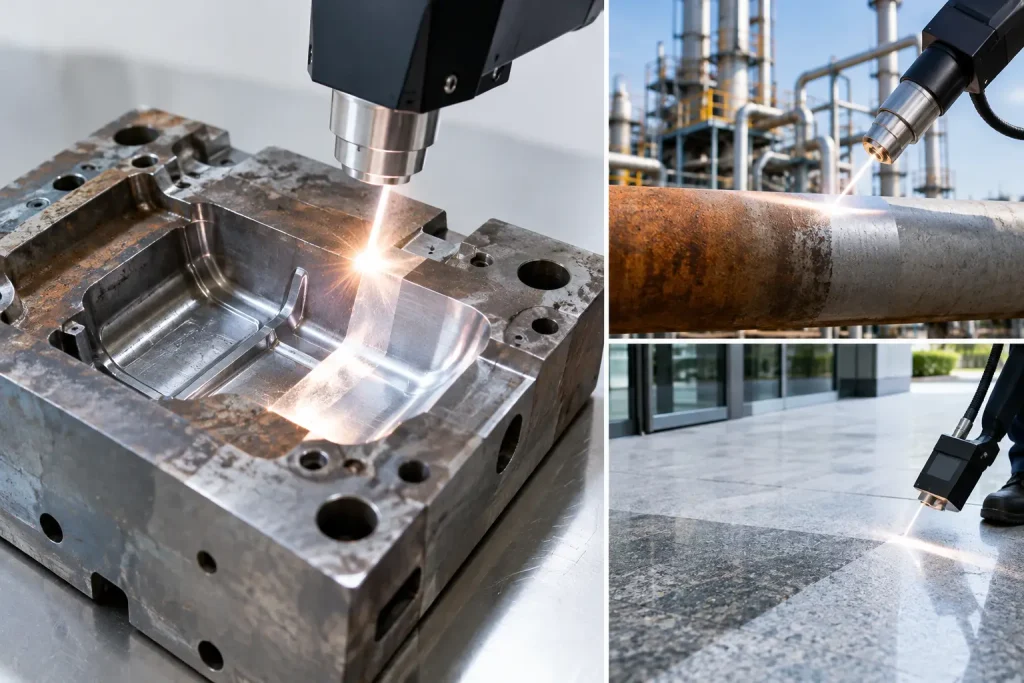
A heritage bronze panel with dark oxidation, a thin-gauge stainless component marked by heat tint, and a painted architectural feature all present the same question: can laser clean delicate surfaces without altering the material beneath? With the right laser parameters, experienced operation, and a suitable contaminant-substrate combination, the answer is often yes. But laser cleaning is not a one-setting solution. Selective removal depends on careful assessment before the first pass begins.
For asset owners and maintenance teams, that control is the value. Instead of relying on abrasive media or chemical products that can spread contamination, wear away detail, or create difficult waste streams, laser ablation can target the unwanted layer while preserving the intended surface condition.
Can Laser Clean Delicate Surfaces Safely?
Laser cleaning uses short, controlled bursts of light energy to interact with contaminants such as rust, oxides, paint, oil, grease, carbon deposits, and selected coatings. The unwanted material absorbs energy differently from the base substrate. When settings are properly matched to the workpiece, the contaminant breaks down or detaches while the underlying surface receives minimal effect.
That distinction matters on sensitive work. A corroded steel structure may tolerate a more assertive cleaning approach than a decorative metal fitting, precision mold, historic artifact, composite component, or finely finished weld. The goal is not simply to make a surface look clean. It is to remove only what must be removed while retaining dimensions, texture, markings, edges, and material integrity.
Laser cleaning is therefore best viewed as a controlled surface-preparation process, not a universal replacement for every cleaning method. It is highly effective when selectivity is required, but it must be specified and operated correctly.
What Makes a Surface Delicate?
“Delicate” does not always mean fragile. In industrial work, a surface can be delicate because it has a tight tolerance, an intentional finish, a thin section, a protective layer that must remain, or details that cannot be rounded off by abrasive cleaning. In restoration, delicacy may come from age, patina, original paint layers, ornamentation, or uncertainty about the materials used in prior repairs.
A surface may also be operationally sensitive. For example, cleaning a weld area before inspection requires removal of oxidation and residue without creating a roughened profile that interferes with examination. Cleaning electrical enclosures or machinery near critical equipment may require a method that avoids water, chemical runoff, and loose blasting media.
The base material is only one part of the decision. The condition and thickness of the contaminant, the required final appearance, access constraints, and whether the work must proceed during normal operations all affect the process design.
The contaminant often determines the approach
Laser cleaning performs particularly well where there is a clear difference between the absorption behavior of the contamination and the substrate. Rust on steel, oxide layers on metal, localized paint, grease residues, and carbonaceous deposits can often be removed selectively.
However, not every layer should be removed completely. On heritage metals, a stable patina may be part of the asset’s character and protection. On coated equipment, the requirement may be to strip only a failed area for repair rather than expose the entire base material. A capable service provider defines the removal boundary first, then selects parameters that work within it.
Precision Comes From Parameters, Not Promises
A laser can be gentle or aggressive depending on how it is configured. Pulse duration, wavelength, power, repetition rate, spot size, scan speed, overlap, and the number of passes all influence how energy reaches the surface. Small changes can produce very different results.
For delicate surfaces, lower-energy test areas and progressive cleaning passes are often more appropriate than trying to remove everything in one pass. The operator watches for changes in color, reflectivity, texture, and cleaning rate, then adjusts the process accordingly. This measured approach helps prevent unnecessary heat input or alteration of the substrate.
The visual effect of laser cleaning can be striking. A dark oxide layer may lift away to reveal bright metal beneath, or a coating may disappear in a sharply defined path. Yet appearance alone is not the acceptance criterion. A surface can look clean while still being unsuitable for its next task. If the item is being prepared for coating, bonding, welding, inspection, or restoration, the finish must be evaluated against that purpose.
Trial cleaning is a practical safeguard
A representative test patch is one of the most valuable steps in delicate cleaning work. It confirms whether laser ablation can remove the target material at an acceptable rate and whether the desired substrate finish can be retained. It also gives project stakeholders a visible reference for approval before wider work begins.
For a complex asset, the test should include the range of conditions likely to be encountered: heavy corrosion, light staining, edges, corners, recessed areas, and previous repair zones. This is particularly useful on heritage building elements and artifacts, where contamination, coatings, and underlying materials may vary across a single object.
Where Laser Cleaning Has Clear Advantages
Delicate cleaning projects often carry risks that conventional methods struggle to manage. Abrasive blasting can remove corrosion quickly, but it can also erode sharp features, alter surface roughness, and generate large volumes of spent media. Chemical cleaning may be effective for certain contaminants, but it introduces handling requirements, residue concerns, and waste disposal obligations.
Controlled laser ablation does not require blasting grit, chemical stripping agents, or water. The removed material is captured as fume and particulate through appropriate extraction and filtration. For operators working in active plants, commercial properties, and constrained construction areas, that can reduce containment needs and cleanup time.
The method is also highly localized. Teams can focus on a corroded joint, a weld seam, a small coating defect, or a detailed architectural component without treating a broad surrounding area. That precision can reduce rework and minimize disruption to adjacent finishes or equipment.
At BKR Engineering, this is approached as a service decision rather than a technology demonstration. The practical question is whether laser cleaning delivers the specified result with less risk, downtime, waste, and site preparation than the available alternatives.
Important Limits and Trade-Offs
Laser cleaning is not automatically safe for every delicate surface. Highly reflective materials can require additional control. Heat-sensitive substrates, thin materials, layered finishes, plastics, and some composites need thorough evaluation. Certain contaminants may also be too thick, too variable, or too strongly bonded for laser cleaning to be the most economical primary method.
Production speed is another consideration. Laser cleaning is exceptionally precise, but broad-area coating removal may be faster with another method when substrate protection is not a priority. The best choice depends on the size of the work, access, required cleanliness standard, environmental constraints, and shutdown window.
Safe implementation also requires more than setting up the laser. The work area needs appropriate laser safety controls, trained personnel, fume extraction, and a process that protects nearby people and assets. On site, planning should account for line of sight, reflective surfaces, ventilation, access permits, and the handling of residues.
How to Specify Delicate Laser Cleaning Work
A clear scope prevents a cleaning project from becoming a trial-and-error exercise. Start by identifying the base material, the contaminant to be removed, and the exact condition that must remain after cleaning. Photographs, close-up inspection, material records, and a small test area can establish a realistic standard.
Next, define what the cleaned surface is for. Inspection preparation, repainting, restoration, welding, and precision assembly each have different requirements. A surface intended for recoating may need a different finish from one being conserved for display. If there is uncertainty, involve the coating supplier, inspector, conservator, or engineering authority early.
Finally, assess the operating environment. The ability to work without abrasive media and chemical washdown can be a major benefit in live facilities, sensitive properties, and locations where waste control is a concern. Still, the project plan should account for extraction, access, safety exclusion zones, and verification of the finished surface.
A Better Question Than “Will It Damage the Surface?”
The more useful question is: what must the laser remove, and what must it preserve? That shifts the conversation from a broad claim of safety to a measurable cleaning objective. It also encourages the right safeguards – inspection, test cleaning, parameter control, and acceptance criteria.
For high-value assets, delicate cleaning should never be treated as an afterthought. When the work is planned around the material, contamination, and final use of the surface, laser cleaning can provide an efficient, low-waste way to reveal and preserve what matters most.