
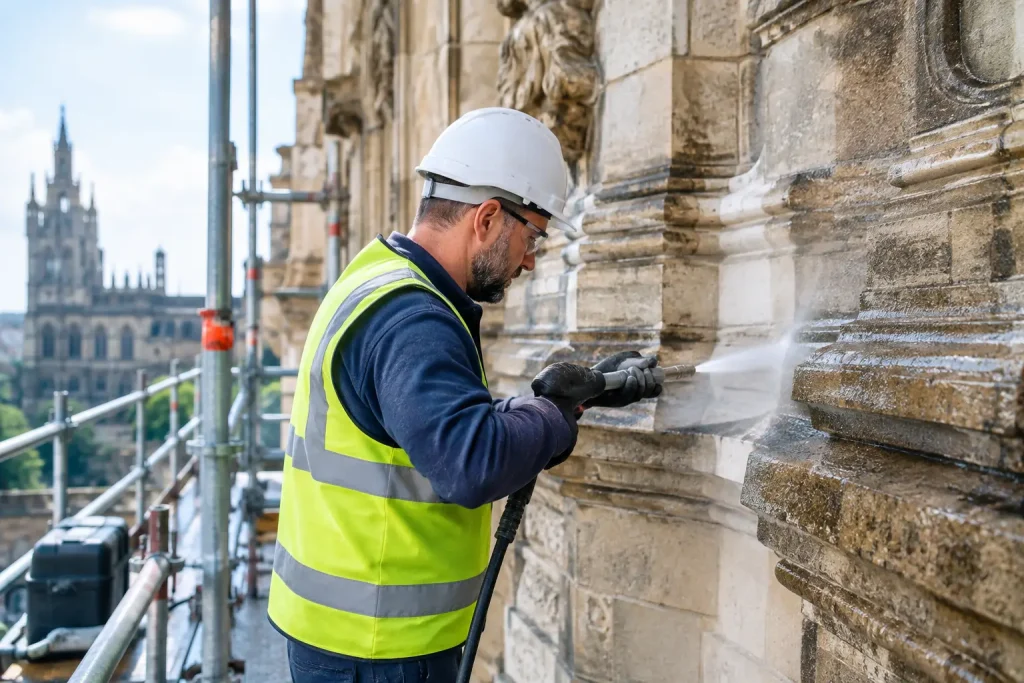
A heritage façade can look like it needs aggressive cleaning when decades of soot, oxidation, paint failure, and biological growth have obscured its original character. That assumption is where costly damage often begins. The best solutions for heritage restoration start with a different question: what must be removed, what must remain, and how can the work be controlled at every stage?
For owners, conservation teams, contractors, and facility managers, restoration is not simply a cleaning scope. It is a material-preservation project with practical demands around access, schedule, safety, public visibility, and long-term maintenance. The right method depends on the substrate, the contaminant, the building or artifact’s significance, and the level of finish required after treatment.
Start With the Existing Material, Not the Cleaning Method
Heritage assets rarely have uniform surfaces. A single building may contain cast iron, wrought iron, steel, bronze, stone, brick, terracotta, timber, decorative plaster, and later-applied coatings. Each material responds differently to moisture, abrasion, heat, vibration, and chemical exposure.
Before selecting a restoration method, carry out a condition assessment that identifies the base material, surface contaminants, previous repairs, coating layers, corrosion severity, and areas of active deterioration. Historic paint may be significant in its own right. Likewise, the dark surface on aged metal may be a stable patina worth retaining rather than a contaminant to strip away.
A small test area is one of the most valuable controls in the project. It allows the project team to confirm cleaning effectiveness, assess any change in texture or color, establish a visual acceptance standard, and set realistic production rates. Testing also prevents a common failure: selecting a method based only on how quickly it removes material.
The Best Solutions for Heritage Restoration Use Selective Removal
A restoration method should remove only what is unwanted while preserving the original substrate and its defining features. That principle sounds straightforward, but it separates conservation-led work from general surface preparation.
Abrasive blasting can be effective on heavily corroded industrial steel, but it may be unsuitable for delicate historic profiles, carved details, thin metalwork, soft stone, or surfaces where original tool marks and patina matter. Even when blasting is technically possible, containment, airborne dust, media recovery, and cleanup can add substantial complexity in occupied or public-facing locations.
Chemical stripping can soften paint and certain deposits, but it introduces its own variables. Residues must be managed carefully, porous materials can retain chemicals, and the process may generate hazardous waste. Water-based cleaning may be appropriate for some masonry or stone applications, yet it requires careful moisture control. Excess water can carry salts into porous surfaces, stain materials, or worsen existing deterioration.
The most dependable approach is usually a combination of methods, selected by material and location rather than applied as a single universal solution. Mechanical repair, localized consolidation, low-pressure cleaning, hand removal, and controlled laser ablation can each have a role when properly specified.
Why Laser Cleaning Is Valuable for Sensitive Surfaces
Laser cleaning uses focused light energy to remove targeted contaminants from a surface. In restoration work, its central advantage is control. Parameters can be adjusted so that rust, oxides, paint, oil, grease, or unwanted coatings are ablated while the underlying material is protected.
This makes laser cleaning particularly useful for heritage metalwork, decorative iron gates, railings, architectural fixtures, machinery, cast components, and detailed surfaces that are difficult to clean with conventional abrasive methods. It can reach intricate profiles without media becoming trapped in joints, recesses, or decorative features.
The visual result also supports better decision-making on site. As corrosion or coating layers are removed, the operator and project team can see the substrate condition in real time. Cracks, repairs, pitting, casting marks, stamped details, and remaining coating layers become more visible, helping teams distinguish between surface contamination and actual material loss.
Laser cleaning is not automatically the correct choice for every heritage surface. Soft, friable, highly reflective, painted, or composite materials require assessment and testing. The goal is not to use advanced equipment for its own sake. The goal is to select the least invasive process that achieves the required conservation and maintenance outcome.
Protect Original Character While Preparing for Repair
Cleaning is often only one stage of heritage restoration. Once a surface is exposed, it may require crack repair, corrosion treatment, repainting, protective coating, repointing, or structural intervention. The cleaning method should support these next steps, not create new problems for them.
For metal elements, removing corrosion and failed coatings without roughening or thinning the base material can improve the quality of inspection and coating adhesion. It also gives engineers and asset owners a clearer view of section loss, previous repairs, and areas that need localized fabrication work.
For architectural details, retaining sharp edges, casting texture, inscriptions, and decorative relief is essential. Over-cleaning can make a historic component look unnaturally new and may erase evidence of its construction and age. The desired finish should therefore be agreed upon before work starts. In some cases, the right result is a fully prepared surface for recoating. In others, it is a carefully cleaned surface that retains stable patina and visual depth.
Plan for Site Constraints and Public Safety
Heritage projects are frequently carried out in active properties, public buildings, museums, transit areas, commercial developments, or residential estates. That creates constraints that are as important as the technical cleaning process.
A practical work plan should address access, protection of adjacent finishes, noise, dust, waste handling, ventilation, work hours, and pedestrian or occupant safety. Methods that require extensive containment or generate secondary waste can affect project duration and site logistics significantly.
Laser cleaning can reduce several of these burdens because it does not rely on blasting media or chemical stripping agents. Contaminants removed during the process can be captured through appropriate fume extraction and filtration arrangements. This reduces cleanup requirements and avoids the large volumes of spent abrasive media or chemical waste associated with other methods.
For project stakeholders, that can mean a more manageable restoration scope in sensitive locations. It does not eliminate the need for safety planning. Laser operations require trained personnel, controlled work zones, appropriate eye protection, and site-specific risk controls. However, when managed by an experienced service provider, the process can offer a cleaner and more contained alternative for suitable applications.
Balance Restoration Quality Against Whole-Project Cost
The lowest-cost cleaning method on paper is not always the most economical project decision. A method may appear inexpensive per square foot but create added expenses through enclosure construction, waste disposal, tenant disruption, rework, or damage to adjacent finishes.
Whole-project cost should consider setup time, production rate, access requirements, waste streams, shutdown periods, post-cleaning repair, and the expected service life of the completed work. It should also account for the risk of losing original material. Once historic texture, detail, or patina has been removed, it cannot be restored by a later repair scope.
This is where a test panel and a clearly defined acceptance standard provide value. They turn broad terms such as clean, restored, or ready for coating into measurable expectations. The team can then compare methods based on finish quality, substrate protection, site impact, and realistic delivery time.
Work With a Specialist That Understands Both Surface and Schedule
Heritage restoration requires more than equipment. It requires operators who understand how materials behave and who can adapt the process when site conditions reveal something unexpected. Corrosion may be deeper than anticipated. An old coating may contain multiple layers. A decorative element may have repairs that become visible only after cleaning begins.
BKR Engineering approaches laser cleaning as a controlled surface-preparation service, not a one-size-fits-all treatment. For suitable heritage applications, the process can remove unwanted surface layers with precision while helping owners reduce waste, protect valuable substrates, and limit disruption to the surrounding site.
The most successful restoration projects preserve more than a building component or artifact. They preserve evidence of craftsmanship, material history, and place. Choose methods that give the project team enough control to reveal that history carefully, then protect it for the next generation.