
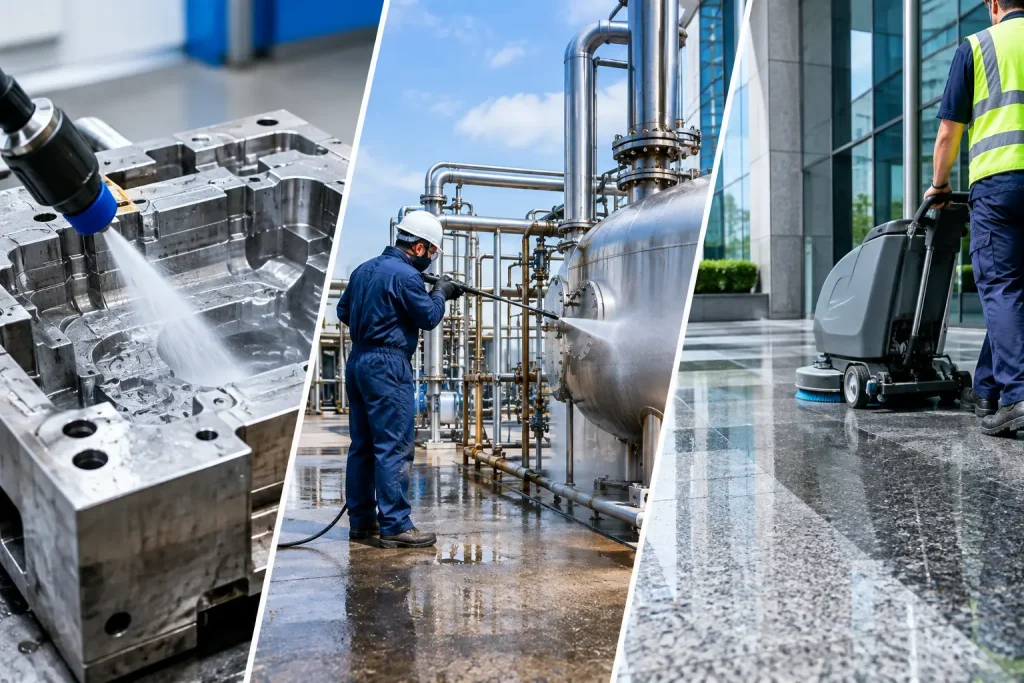
The best surface cleaning technologies are not always the ones that remove material fastest. For a refinery component, structural steel member, precision mold, heritage fixture, or weld zone, the real requirement is controlled removal: eliminate the unwanted layer while preserving the substrate, keeping people safe, and avoiding a lengthy shutdown.
That changes the selection process. A method that works well on heavily corroded outdoor steel may be too aggressive for thin metal, sensitive equipment, or surfaces being prepared for inspection. The right choice depends on the contaminant, base material, access conditions, cleanliness standard, and the waste a project can reasonably manage.
Best Surface Cleaning Technologies for Industrial Work
Industrial cleaning methods generally fall into five practical categories: laser cleaning, abrasive blasting, dry ice blasting, chemical cleaning, and high-pressure water jetting. Each has a place. The strongest maintenance programs select the technology around the job risk, rather than treating every rusted or coated surface the same way.
Laser cleaning and controlled ablation
Laser cleaning uses focused pulses of light to remove rust, oxides, paint, coatings, oil, grease, and other contaminants. The energy is absorbed by the unwanted layer, allowing it to break down or detach while the underlying substrate can remain intact when the process is correctly specified and operated.
Its defining advantage is selectivity. Operators can target corrosion on a steel surface, remove a localized coating defect, clean a weld area, or prepare a component for inspection without the broad impact associated with conventional abrasive methods. This makes laser cleaning especially effective where dimensional accuracy, surface integrity, and controlled treatment matter.
The process is also dry. It does not require blasting media, chemical stripping agents, or large volumes of water. Contaminants are captured through appropriate extraction and filtration, reducing secondary waste and cleanup requirements. For active facilities, that can mean less containment work, faster mobilization, and fewer disruptions around adjacent equipment.
Laser cleaning is not automatically the best option for every large-scale coating removal project. Very thick coatings over extensive open areas may be more economical with another method, depending on access and production deadlines. Its value is highest when precision, waste reduction, substrate protection, and local control are central to the scope.
A practical benefit is visual confirmation. The contrast between contamination and cleaned substrate makes the cleaning effect immediately visible, helping site teams assess progress and identify areas that need further treatment.
Abrasive blasting
Abrasive blasting propels media at high velocity to remove corrosion, mill scale, coatings, and surface contamination. It remains a productive option for broad areas of heavily corroded steel, particularly when a specified surface profile is required before protective coating application.
The trade-off is aggression. Blasting can alter the substrate profile, damage thinner sections, force media into nearby equipment, and create significant dust or spent-abrasive waste. Projects may require full containment, isolation of surrounding operations, ventilation controls, and substantial post-cleaning work.
For structural steel rehabilitation, abrasive blasting can still be appropriate. For precision parts, localized repairs, occupied buildings, sensitive machinery, or heritage materials, its lack of selectivity can become a costly limitation. The decision should account for the complete job setup, not only the removal rate.
Dry ice blasting
Dry ice blasting uses compressed air to propel carbon dioxide pellets onto a contaminated surface. The pellets sublimate on impact, leaving no blasting media behind. It is useful for cleaning oils, grease, soot, residue, and certain production contaminants, especially around electrical or mechanical equipment where a dry process is preferred.
Because dry ice is relatively soft, it generally does not create the surface profile needed for coating adhesion and is not the primary choice for removing heavy rust or tightly bonded coatings. It can also be noisy, air-intensive, and dependent on reliable dry ice supply. Still, it offers a useful option for equipment cleaning where media cleanup must be minimized.
Chemical cleaning and stripping
Chemical methods use acids, alkalis, solvents, or proprietary stripping formulations to dissolve or loosen contaminants. They can be effective for complex shapes, internal passages, or deposits that are difficult to reach mechanically. In controlled applications, chemical cleaning can provide a uniform result.
The operational concerns are significant. Chemical selection must match the substrate to prevent etching, staining, embrittlement, or corrosion. Facilities must also manage worker exposure, rinsing, spill prevention, ventilation, and hazardous waste disposal. Residual chemicals can create downstream coating or contamination issues if neutralization and verification are incomplete.
Chemical cleaning is most defensible when its access or dissolution advantages outweigh those handling requirements. It is less attractive when a dry, localized method can achieve the required cleanliness without generating liquid waste.
High-pressure and ultra-high-pressure water jetting
Water jetting removes coatings, corrosion products, marine growth, and process deposits with pressurized water. It can cover large areas efficiently and does not leave abrasive media behind. It is commonly considered for tanks, vessels, concrete, pipelines, and infrastructure where water management is feasible.
However, water is not a neutral project variable. Runoff may contain paint particles, hydrocarbons, salts, or metal contaminants that require collection and treatment. Flash rust can occur on prepared ferrous surfaces, creating a narrow window before coating work. High-pressure water also introduces safety, access, and drainage considerations that need careful planning.
Water jetting is a strong candidate for suitable outdoor or contained environments. It becomes more difficult in enclosed facilities, near sensitive machinery, or where wastewater handling adds time and cost.
How to Choose the Right Cleaning Method
Start with the contaminant. Loose rust, dense oxide scale, multilayer paint, oil residue, biological buildup, and heat-affected discoloration do not respond in the same way. Next, assess the base material and its tolerance for impact, heat, moisture, and chemicals. Carbon steel, stainless steel, aluminum, stone, concrete, and historic finishes all require different controls.
Then look beyond the cleaned surface. Can the work be contained? Will the method interrupt nearby operations? Is there enough room for blasting equipment, water recovery, or ventilation? What waste stream will be generated, and who is responsible for handling it? These questions often determine the actual project cost more than the hourly cleaning rate.
The required finish also matters. If the objective is visual restoration, an inspection-ready surface, localized coating removal, weld preparation, or decontamination before repair, a selective technology may be the better fit. If the objective is a defined anchor profile across a large steel structure, an abrasive approach may be necessary. The specification should describe the required result, not merely name a familiar method.
A small on-site trial is often the most reliable decision tool. It validates cleaning speed, confirms substrate response, reveals containment needs, and gives stakeholders a clear view of the finished surface before a larger commitment is made.
Where Laser Cleaning Delivers the Strongest Return
Laser cleaning earns its place where the cost of collateral damage or downtime is high. Common applications include corrosion removal before inspection, localized paint or coating removal, weld cleaning, mold and tooling maintenance, equipment restoration, oil and grease removal, and delicate architectural or heritage surface treatment.
It is particularly valuable in operating plants where abrasive dust, water runoff, and chemical fumes would create additional permits, isolation work, or cleanup. By concentrating treatment on the affected area, laser ablation can reduce the scale of the job around it. That practical control supports safer maintenance planning and better asset availability.
BKR Engineering applies laser cleaning as a service-led solution, evaluating the surface condition, access constraints, and required outcome before work begins. This approach is designed for clients who need more than a cleaning method – they need a dependable path to inspection, repair, restoration, or production readiness.
The best choice is the technology that meets the cleaning standard with the least unnecessary disruption. Before committing to a full scope, define the substrate, contaminant, acceptance criteria, and waste controls, then test the method under actual site conditions. A well-planned trial can turn surface cleaning from a shutdown risk into a controlled maintenance advantage.