
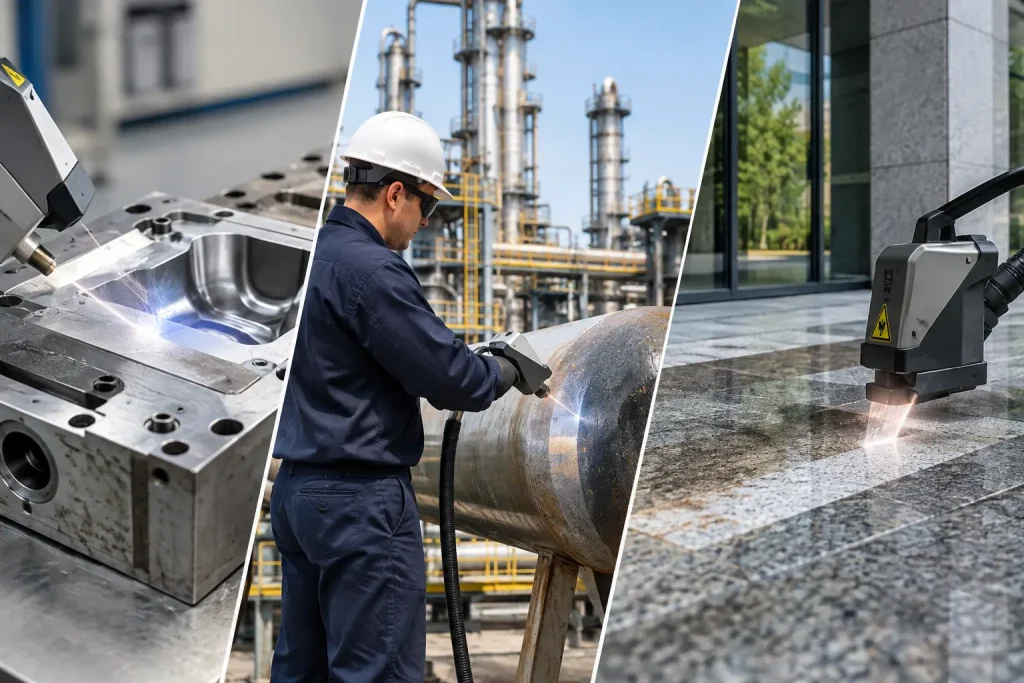
A seized valve, corroded flange, or contaminated weld area can turn a routine maintenance task into an extended outage. Laser cleaning for plant maintenance gives maintenance teams a controlled way to remove surface contaminants at the point of work, often without the containment, media handling, or chemical cleanup associated with conventional methods.
The visible result is immediate: rust, paint, oxide, oil residue, and old coatings lift from the surface in a focused cleaning path. The greater value is operational. When the base material must be preserved and work must move quickly, laser ablation can support better inspection, repair, coating preparation, and asset life decisions.
Why surface preparation affects maintenance outcomes
Surface condition drives the quality of many maintenance activities. A corroded surface can conceal pitting. A coating can hide weld defects. Oil and process residue can interfere with inspection, bonding, or recoating. If contaminants remain, a repair may look complete while the underlying condition remains uncertain.
Traditional cleaning methods can solve part of the problem, but they introduce their own constraints. Abrasive blasting may require isolation, extensive masking, media recovery, and cleanup. Mechanical abrasion can remove material along with corrosion, particularly on thin, machined, or detailed components. Chemical cleaners may create liquid waste, require dwell time, and raise handling concerns.
Laser cleaning uses controlled pulses of laser energy to target the contaminant layer. When settings are matched to the material and condition, the unwanted layer absorbs the energy and is removed while the underlying substrate is preserved. This selective action is the reason the process is particularly useful where surface integrity matters.
Where laser cleaning for plant maintenance delivers value
Laser cleaning is not a replacement for every cleaning method. Large, heavily corroded structures may still favor abrasive techniques when production speed over a broad area is the only priority. However, it is highly effective for targeted work where precision, access, cleanliness, or substrate protection are decisive.
Inspection and integrity preparation
For asset integrity teams, clear visibility is essential. Laser cleaning can remove corrosion products and coatings from selected areas before visual inspection, ultrasonic testing preparation, weld assessment, or corrosion mapping. Rather than stripping an entire component, the team can clean the exact zone that requires evaluation.
This is valuable around welds, pipe supports, pressure components, structural steel connections, and equipment bases. A clean surface helps inspectors distinguish superficial oxidation from actual metal loss, cracking, or coating failure. It also reduces the risk that loose debris will compromise follow-up work.
Weld preparation and post-weld cleanup
Weld quality depends on surface condition before the arc is struck. Paint, oxide, grease, and corrosion at the weld joint can contribute to contamination and rework. Laser cleaning can prepare localized weld areas without grinding aggressively into the parent material.
After welding, the same process can remove heat tint, oxidation, and residue in a controlled area. This can be especially useful where appearance, corrosion resistance, or dimensional consistency matters. The right approach depends on the metal, alloy, weld procedure, and required surface standard, so a test area should guide the final cleaning parameters.
Coating removal and recoating preparation
Maintenance coatings fail in predictable places: edges, fasteners, joints, splash zones, and areas exposed to heat, moisture, or chemicals. Removing failed coating only where it has broken down can reduce unnecessary disruption to sound adjacent surfaces.
Laser cleaning supports spot repair by stripping paint, oxide, and corrosion in defined sections. It can also prepare a clean, stable surface for a new coating system. The required profile and cleanliness specification still matter. Some coating systems require a defined anchor profile that laser cleaning alone may not produce, so the service plan should be aligned with the coating manufacturer’s requirements and the asset’s exposure conditions.
Equipment restoration and precision components
Plant maintenance often involves parts that should not be treated like bulk steel. Electrical enclosures, molds, dies, pumps, turbines, machined assemblies, heritage fixtures, and detailed fabricated components may have surfaces that are easily damaged by aggressive blasting or hand tools.
Because laser cleaning is contactless and highly localized, it can remove selected contaminants without introducing blasting media into sensitive equipment. That does not mean every delicate component is automatically suitable. Material type, coating chemistry, geometry, heat sensitivity, and accessibility must be assessed before work begins.
The operational advantages are more than cosmetic
The clean line left by a laser is compelling, but plant managers should evaluate the process by its effect on the maintenance window. The strongest case for laser cleaning is usually built around reduced setup, better control, and less downstream cleanup.
A laser system does not use abrasive media or chemical stripping agents. That can eliminate the logistics of bringing media onto site, collecting spent material, and managing contaminated waste. With proper fume extraction and work controls, the debris generated from ablated contaminants can be captured near the source rather than spread across the work area.
The method can also reduce preparation time in congested locations. There may be no need to construct a blasting enclosure for a small, targeted task, although barriers, permits, exclusion zones, and safety controls are still required. For shutdown work, those avoided setup steps can make a material difference to the schedule.
Selective cleaning also protects value that is difficult to replace. Removing corrosion without unnecessarily thinning the base metal helps maintenance teams preserve tolerances, markings, edges, and surrounding coatings. This matters when an asset is expensive, aging, or difficult to take offline.
What a well-planned laser cleaning job requires
Laser cleaning performs best when it is treated as a controlled maintenance process, not simply a faster way to make a surface look clean. The work begins with identifying the substrate, contaminant, required finish, access limitations, and the reason for cleaning.
A field assessment should establish whether the objective is corrosion removal, coating stripping, weld preparation, inspection access, or restoration. Each objective may require different parameters. The team should also consider nearby equipment, cable runs, ignition risks, reflective surfaces, ventilation, and the need to protect adjacent finishes.
Safety is non-negotiable. Industrial laser cleaning requires trained operators, controlled work zones, appropriate laser safety measures, and effective fume extraction. Coatings and residues can release hazardous particulates or vapors when removed, particularly in older facilities or process environments. Understanding the contaminant is as important as understanding the metal beneath it.
For planned outages, a short trial on a representative area can prevent costly assumptions. It confirms cleaning speed, surface outcome, containment needs, and compatibility with the next step, whether that is inspection, welding, or coating. It also gives project stakeholders a direct view of the result before full deployment.
Choosing the right service partner
The technology is only part of the solution. Plant teams need a service provider that can work within live-site rules, maintenance schedules, permit requirements, and quality expectations. They also need practical judgment about when laser cleaning is the right choice and when another preparation method is more suitable.
BKR Engineering applies controlled laser ablation with a service-led approach shaped by field experience in demanding industrial environments. The focus is not merely on removing contamination. It is on preparing the right surface, in the right area, with minimal disruption to the surrounding asset and worksite.
Before approving a scope, ask for clarity on the target contaminant, expected surface condition, production rate, fume-control approach, safety plan, and acceptance criteria. A credible scope defines both what will be removed and what must remain untouched.
A practical option for critical maintenance windows
For facilities under pressure to improve reliability while reducing waste and shutdown exposure, laser cleaning offers a practical middle ground between aggressive bulk cleaning and slow manual work. It gives teams control where control is most valuable: around critical surfaces, sensitive equipment, and time-sensitive repairs.
The best first application is often a recurring pain point, such as corroded weld zones, failed coating patches, inspection windows, or components that repeatedly require careful hand cleaning. A focused trial can show whether laser cleaning can turn that task into a cleaner, safer, and more predictable part of the maintenance plan.