
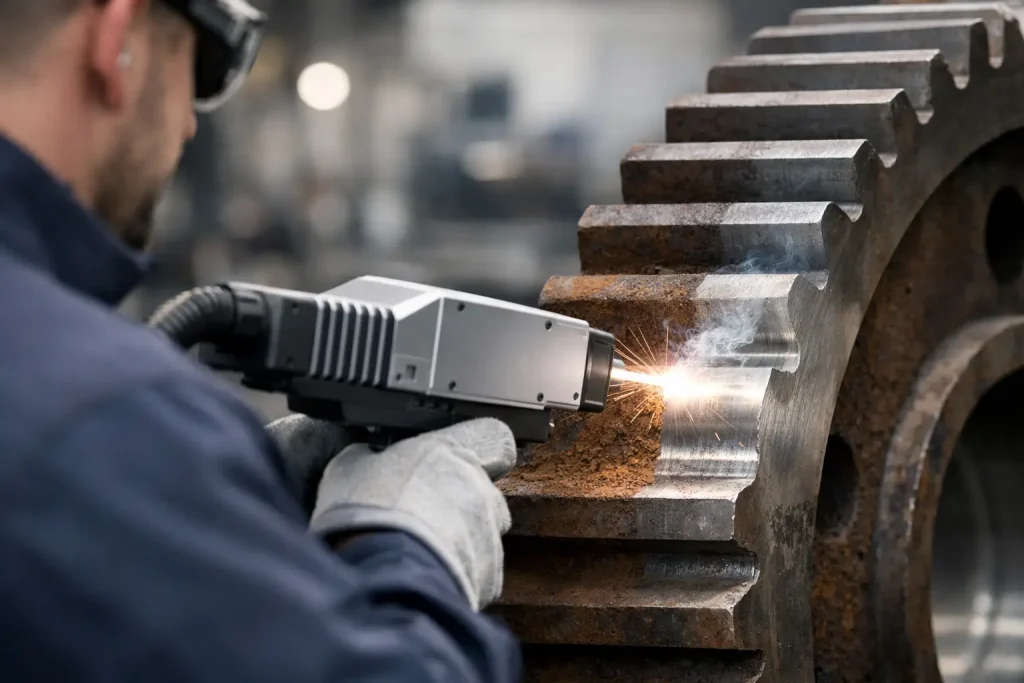
A corroded flange, painted steel frame, or contaminated weld can look like a routine maintenance issue until the chosen cleaning method creates a bigger one. Abrasive blasting can spread media and dust, chemical stripping can introduce disposal and exposure concerns, and aggressive mechanical tools can alter the surface that must be preserved. So, is laser cleaning safe for industrial assets? Yes, when it is specified for the material and managed by trained specialists using proper controls.
Laser cleaning is not simply a faster way to remove rust or coatings. It is a controlled surface-preparation process. The laser delivers energy to the unwanted layer, causing contaminants such as oxides, paint, oil, grease, and corrosion products to break down or detach while the underlying substrate remains largely unaffected. That selectivity is a major safety advantage, but it does not remove the need for disciplined planning.
Is Laser Cleaning Safe in the Field?
Laser cleaning can be a safe and practical alternative to blasting and chemical cleaning when the work area, equipment settings, material condition, and operator protections are assessed before work begins. The process avoids loose abrasive media, reduces contact with chemical strippers, and can substantially limit the spread of secondary waste.
The word “safe,” however, should never be treated as a blanket claim. A high-powered laser is industrial equipment, and its risks must be actively controlled. The primary considerations are laser radiation, reflected beams, airborne particulates generated during ablation, fire risk from combustible residues, and the condition of the asset being cleaned.
For plant managers and asset owners, the real question is not whether laser cleaning is inherently risk-free. No industrial process is. The better question is whether the risks can be controlled more effectively than with the alternatives while delivering the required cleaning standard. For many maintenance, restoration, inspection, and fabrication applications, the answer is yes.
Why Selective Removal Improves Asset Safety
Abrasive methods remove material through impact. This can be effective on large, open steel surfaces, but it may also roughen sensitive substrates, erode edges, embed blasting media, or reach areas beyond the intended work zone. Chemical products can penetrate coatings effectively, yet they may require extended dwell times, rinsing, containment, and hazardous waste handling.
Laser ablation works differently. The operator can adjust parameters including power, pulse characteristics, scan speed, and beam size to target the contaminant layer. When correctly calibrated, the process can remove corrosion, oxide scale, coating residues, and surface contamination without grinding away sound base metal.
This matters when cleaning welds before inspection, preparing surfaces for recoating, restoring heritage metalwork, or servicing components with tight tolerances. Preserving the substrate reduces the likelihood of introducing defects that lead to rework, premature failure, or unnecessary replacement.
The visible contrast created during laser cleaning also gives maintenance teams a useful level of control. Operators can see the transition from contamination to clean substrate in real time, allowing them to stop at the required condition rather than continue with a generalized, more aggressive cleaning cycle.
The Substrate Still Needs Assessment
Selective does not mean automatic. Different materials absorb and respond to laser energy differently. Carbon steel, stainless steel, aluminum, copper alloys, stone, and composite materials all require application-specific evaluation. Coating thickness, corrosion depth, surface geometry, and previous repair history can also affect the cleaning approach.
Deep pitting corrosion, for example, cannot be erased by cleaning. Laser treatment can remove the oxide and expose the true surface condition, which is valuable for inspection, but it will not restore metal that has already been lost. On heat-sensitive or thin materials, settings must be selected carefully to avoid unwanted thermal effects.
A competent service provider begins with a test area. This confirms cleaning performance, protects the asset, and helps define a realistic scope for production work.
Protecting People During Laser Cleaning
The strongest safety benefit comes from treating laser cleaning as a controlled work activity rather than a handheld tool that can be used anywhere without preparation. Professional operations establish an exclusion zone, manage access, and use warning signage appropriate to the equipment and site conditions.
Eye protection is essential. Laser radiation can cause serious eye injury, including through reflected energy from shiny or uneven surfaces. Operators and authorized personnel must use laser-rated protective eyewear matched to the laser wavelength and operating conditions. Ordinary safety glasses are not an acceptable substitute.
Airborne emissions also require attention. The plume produced during ablation may contain fine particles from rust, paint, oil, coatings, or other contaminants. The makeup of that plume depends on what is being removed. Local fume extraction, suitable filtration, and appropriate respiratory protection are selected based on the material, coating history, ventilation conditions, and site risk assessment.
Combustible residues deserve the same care. Oil, grease, some coatings, and accumulated debris can create a fire hazard if they are not identified before work begins. Good planning includes cleaning or isolating excessive flammable contamination where needed, keeping suitable fire protection available, and monitoring the work area throughout the operation.
Electrical safety, trip hazards from cables, access restrictions, and work-at-height controls remain relevant as well. Laser cleaning improves the cleaning process, but it does not replace the wider permit-to-work and site safety systems required in industrial environments.
Where Laser Cleaning Reduces Operational Risk
Laser cleaning is particularly useful where containment, cleanup, and downtime drive project risk and cost. Unlike abrasive blasting, it does not leave spent grit across nearby equipment, drains, scaffolding, or process areas. Unlike chemical stripping, it does not typically create volumes of liquid rinse waste requiring collection and disposal.
This can reduce disruption in operating facilities, particularly around pumps, structural steel, pipework, heat-affected zones, and production equipment. It also makes laser cleaning well suited to localized work, where treating only the required area is safer than mobilizing a large blasting setup.
For inspection preparation, the benefit is equally practical. Removing localized corrosion or coating from a weld, joint, or component can reveal the actual surface condition without broad removal of protective systems around it. For coating repair, the process can create a clean, controlled surface while limiting damage to adjacent areas.
There are limits. Laser cleaning may not be the most economical choice for every large-scale coating removal project, especially where extensive open surfaces can be safely blasted within a dedicated enclosure. Production rate depends on contaminant type, layer thickness, required finish, and access. A project should be evaluated on total operational impact, not only square meters per hour.
Planning a Safe Laser Cleaning Project
Safe outcomes begin before the laser is switched on. The work scope should identify the substrate, contaminants, coating composition where known, access limitations, nearby operations, and required surface standard. This prevents an otherwise effective cleaning method from being used in the wrong conditions.
A practical project plan should address four areas: material testing, work-zone control, plume management, and verification. Test cleaning confirms settings and substrate response. Work-zone control protects nearby personnel from laser exposure. Plume management addresses emissions at the source. Verification confirms that the cleaned surface meets the needs of inspection, welding, coating, or restoration.
For older coatings, unknown paint systems, or assets with a complex maintenance history, pre-work assessment is especially valuable. The nature of the removed material determines the appropriate containment, filtration, PPE, and waste-handling measures. Treating every coating as harmless is not a safe assumption.
At BKR Engineering, laser cleaning projects are approached as surface-preparation tasks with operational consequences, not as one-size-fits-all cleaning jobs. That means matching the method and controls to the asset, the contaminant, and the site environment.
A Safer Choice When Control Matters
Laser cleaning is safe when it is properly planned, operated, and supervised. Its main advantage is control: control over what is removed, control over how much of the substrate is affected, and control over the waste and disruption created around the job.
For high-value assets, that control can protect more than the surface. It can support safer maintenance execution, clearer inspection results, cleaner work areas, and shorter interruptions to operations. The most useful next step is a site-specific assessment that tests the cleaning result and defines the controls before the work reaches the asset.