
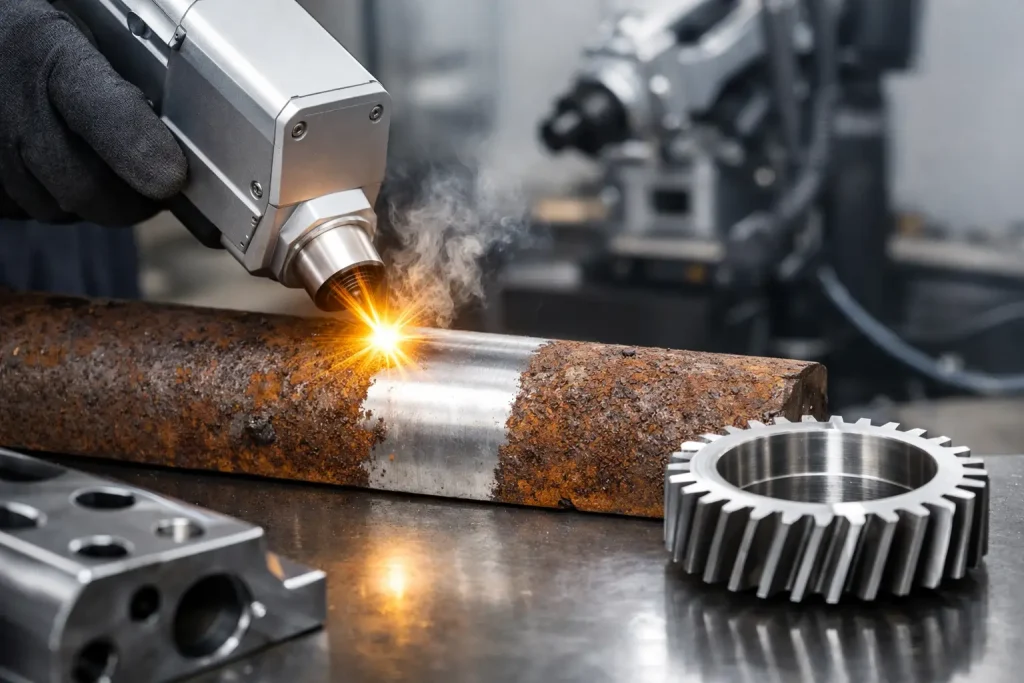
A corroded flange, a painted steel beam, or a fouled mold surface can turn into a bigger maintenance problem fast when the cleaning method creates more disruption than the contamination itself. That is why laser cleaning benefits are getting serious attention from plant managers, contractors, and asset teams looking for precise surface preparation without the mess, waste, and material loss that often come with abrasive blasting or chemical cleaning.
For many operations, the appeal is straightforward. Laser cleaning uses controlled laser energy to remove rust, oxides, coatings, grease, and other contaminants from a surface while leaving the base material largely unaffected when the process is set correctly. The result is not simply a cleaner surface. It is a different way to approach maintenance, restoration, and production support with better control over risk, downtime, and waste.
Why laser cleaning benefits stand out in industrial work
Traditional cleaning methods still have their place, but they often force a compromise. Abrasive blasting can be effective and fast over large areas, yet it may erode the substrate, create secondary waste, and require extensive containment. Chemical cleaning can reach complex geometries, but it introduces handling risks, disposal issues, and concerns about residue.
Laser cleaning changes that equation by targeting the contaminant layer rather than attacking the entire surface. In practical terms, this matters most where the base material has value, dimensional tolerance matters, or the work area is difficult to isolate. In oil and gas, fabrication, infrastructure maintenance, and restoration, those conditions are common.
The strongest case for laser cleaning is not that it replaces every other method. It is that it solves a specific set of problems exceptionally well.
Precision without unnecessary material loss
One of the most important laser cleaning benefits is selective removal. With the right laser settings, operators can remove rust, paint, oxides, carbon deposits, oil residue, or other surface contaminants while minimizing impact on the underlying metal, stone, or other substrate.
That precision matters in weld preparation, mold cleaning, heritage restoration, and inspection preparation. If you need to expose the true condition of a surface before NDT, recoating, or repair, removing only what should be removed is a major advantage. You get a cleaner working surface without introducing unnecessary roughness, profile change, or mechanical stress.
This is also where laser cleaning can outperform more aggressive methods on delicate or high-value components. The process is controllable. That does not mean it is automatic or risk-free. It means outcomes depend on proper setup, skilled operation, and a clear understanding of the substrate and contaminant type.
Better control on complex or sensitive surfaces
Not every cleaning job is a flat steel plate in an open yard. Assets often include edges, corners, weld seams, fasteners, engraved details, and mixed-material assemblies. Laser cleaning is especially useful in these situations because the beam can be directed with a high degree of control.
For restoration work or localized maintenance, that control helps reduce collateral damage. For industrial assets, it can support targeted intervention rather than broad-area removal that affects surrounding coatings or surfaces that are still serviceable.
Less downtime and less site disruption
For most asset owners, the real cost of cleaning is rarely limited to the cleaning itself. Setup, containment, adjacent work restrictions, shutdown coordination, waste handling, and post-cleanup can easily become the larger burden.
This is where laser cleaning benefits become financial benefits. Because the process does not rely on blasting media or liquid chemicals, site logistics are often simpler. There is less secondary contamination, and in many cases less need for large enclosures or complex cleanup operations. That can shorten job duration and make it easier to work in live plant environments, congested construction areas, or occupied properties.
The exact time savings depend on the application. Large-scale coating removal across broad surfaces may still favor other methods in some cases. But for localized rust removal, weld line cleaning, equipment maintenance, or selective coating removal, laser cleaning can reduce downtime in ways that matter directly to production and access planning.
A cleaner process for active facilities
Maintenance teams often face a difficult balance. The surface needs attention, but the surrounding environment cannot tolerate dust migration, abrasive rebound, or chemical exposure. Laser cleaning supports cleaner execution in active facilities because it limits the spread of consumables and residues associated with traditional methods.
That can improve coordination with adjacent trades and reduce the operational footprint of the cleaning work. In practice, this is especially valuable in plants, mechanical rooms, fabrication shops, and commercial buildings where access is tight and other systems remain in service.
Improved safety and environmental performance
Another reason decision-makers look closely at laser cleaning benefits is the safety and environmental profile. Abrasive blasting creates spent media. Chemical cleaning creates liquid waste and can require special storage, transport, and disposal. Both can introduce exposure concerns that need careful management.
Laser cleaning avoids blasting media altogether and significantly reduces secondary waste. The removed contaminant still has to be managed properly, especially if it contains hazardous material, but the waste stream is typically smaller and more controlled. That can simplify compliance and lower disposal-related cost.
There are also practical worker safety advantages when the method reduces chemical handling and minimizes the physical mess of the job. Of course, laser cleaning introduces its own safety requirements, including eye protection, controlled operation, fume extraction where needed, and trained technicians. It is a safer option when it is run correctly, not simply because it uses newer technology.
Consistent surface preparation for downstream work
Cleaning is often only the first step. The real objective may be inspection, coating adhesion, welding, bonding, restoration, or precision assembly. A cleaning method that leaves inconsistent residue or damages the substrate can create problems later, even if the surface looks acceptable at first glance.
Laser cleaning supports more consistent preparation because it can remove specific contaminants with repeatable control. That is useful when preparing weld seams, exposing corrosion for assessment, or removing coatings before repair. The cleaner and more controlled the surface condition, the more confidence teams can have in the next operation.
This benefit is easy to underestimate. Failed coatings, poor weld quality, and incomplete inspections are expensive outcomes. A precise cleaning process helps reduce the chance that hidden residue or surface damage undermines the work that follows.
Useful across heavy industrial and delicate applications
A common misconception is that laser cleaning only fits specialized or high-tech environments. In reality, its value spans a wide range of projects. Heavy industrial assets benefit from controlled rust and oxide removal, especially where substrate preservation and reduced downtime matter. Fabricators use it for weld cleaning and surface prep. Property and restoration teams use it on stone, masonry, metal fixtures, and sensitive architectural details where conventional cleaning would be too aggressive.
That range is possible because laser cleaning is not defined by one contaminant or one substrate. It is defined by control. The same principle that protects a heritage surface can also support maintenance on industrial equipment, provided the system is selected and operated for the job.
At BKR Engineering, that practical range is part of the value. Clients are not buying a machine. They are buying a controlled service outcome that fits the material, the contamination, and the operating environment.
Where laser cleaning is not always the best choice
A credible assessment of laser cleaning benefits should also address the limits. Laser cleaning is not the lowest-cost answer for every job, and it is not always the fastest option across very large, uniform surfaces. If a project involves broad-area removal where substrate sensitivity is low and containment is easy, conventional methods may remain competitive.
The economics depend on several variables, including contaminant thickness, area size, access, shutdown cost, waste disposal requirements, and the value of preserving the substrate. A process that appears more expensive on hourly rate can still be the better choice if it reduces downtime, avoids damage, and cuts cleanup and disposal costs.
That is why evaluation matters. The right question is not whether laser cleaning is better in general. It is whether it performs better for the actual asset, condition, and site constraints in front of you.
What decision-makers should look for
If you are considering laser cleaning, focus on outcomes rather than technology claims. Ask whether the provider understands your substrate, the type of contamination, the required finish, and the downstream purpose of the cleaning. Ask how they will manage safety, fume control, access limitations, and production impact.
Experience also matters. Controlled laser ablation delivers its best results when technicians know how to balance removal speed with surface protection. That field judgment is especially important in mixed environments such as construction sites, operating plants, and restoration projects where the wrong cleaning settings can create delays rather than solve them.
The strongest case for laser cleaning usually appears when the cost of damage, downtime, waste, or overcleaning is high. In those situations, precision stops being a nice feature and becomes the reason the job succeeds.
If your team is trying to remove contamination without trading one problem for another, laser cleaning is worth serious consideration. The best cleaning method is the one that leaves your asset ready for the next step, with less disruption than the last time you had to do it.