
A weld can look sound on the surface and still contain the start of a future failure. Rust at the weld toe, oil drawn into the arc, paint left near the joint, or an inconsistent bevel can all affect fusion, porosity, and weld quality. Effective weld preparation methods address these risks before the first pass is deposited, protecting both production schedules and long-term asset integrity.
For fabrication teams, maintenance planners, and asset owners, preparation is not simply a cleaning task. It is a controlled process that establishes the right joint geometry, fit-up, surface condition, and temperature for the specified welding procedure. The correct approach depends on the material, service environment, welding process, access constraints, and the contaminants present.
What Weld Preparation Must Accomplish
Before welding begins, the joint needs to be accessible, correctly configured, and free of materials that could interfere with the weld. This includes visible contamination such as loose rust, paint, grease, and dust, but also less obvious oxides, moisture, salts, and residues from previous maintenance work.
Preparation has two connected objectives. First, the joint must meet the geometry in the welding procedure specification, including bevel angle, root face, root opening, and alignment. Second, the surfaces around the weld zone must be clean enough to support stable arc behavior and sound metallurgical bonding.
The required cleaning area is not always limited to the exact groove. Heat, filler metal, and shielding conditions affect a wider area around the joint. For critical work, the applicable procedure, client specification, and material requirements should define the preparation width, acceptance criteria, and inspection hold points.
Common Weld Preparation Methods
Mechanical Grinding and Wire Brushing
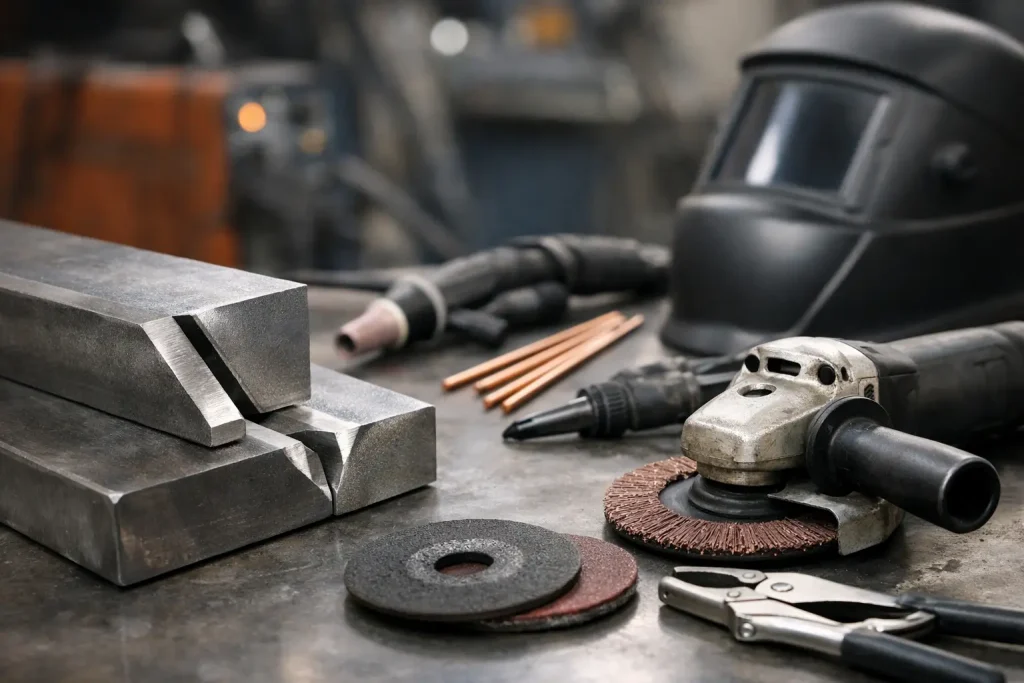
Grinding discs, flap wheels, needle scalers, and wire brushes are familiar tools for removing light corrosion, mill scale, old weld spatter, and surface irregularities. They are readily available and useful for localized touch-up work, edge dressing, and preparing a bevel after cutting.
Their limitation is consistency. A worn abrasive, excessive pressure, or poor access can leave contamination in pits and tight corners. Aggressive grinding may also alter edge geometry, create unnecessary heat, or embed abrasive particles into softer materials. Stainless steel requires dedicated tools to avoid transferring carbon steel contamination that can later contribute to corrosion.
Wire brushing is generally best treated as a finishing step for loose material rather than the sole method for heavy rust, adherent coatings, or oily deposits. It can make a surface look cleaner without fully removing what is affecting weld quality.
Abrasive Blasting
Abrasive blasting can rapidly clean large steel areas and create a uniform profile where coatings have to be removed before welding. It is often considered for structural steel, tank work, pipe spools, and heavy maintenance projects where access allows full containment.
However, blasting brings practical costs. Media recovery, dust controls, enclosures, cleanup, and disposal requirements can extend a shutdown window. Abrasive media may also enter adjacent equipment or remain in narrow joint configurations. Where the base material is thin, sensitive, or historically significant, the impact of blasting requires careful evaluation.
Blasting is a productive option when broad coverage and surface profile are required. It is less attractive when the work calls for selective cleaning beside live assets, precise coating removal at a weld seam, or minimal site disruption.
Solvent and Chemical Cleaning
Solvents and chemical cleaners are commonly used to remove oil, grease, cutting fluids, and fingerprints before welding. They can be effective on contaminants that mechanical methods do not address well, particularly when the surface is otherwise clean and accessible.
The trade-off is process control and waste management. A cleaner must be compatible with the substrate and followed by adequate drying. Residual chemicals, shop rags, runoff, and flammable vapor controls all need attention. Chlorinated products should be avoided around welding because heating can produce hazardous fumes.
Chemical cleaning may be appropriate for defined, light-duty degreasing. On complex industrial assets, it can become labor-intensive and create disposal obligations that outweigh the apparent simplicity of the method.
Thermal Cutting and Gouging
Oxy-fuel cutting, plasma cutting, and air carbon arc gouging are used to create access, remove defective weld metal, or prepare a groove for repair. These methods are valuable where substantial material removal is needed, but they can leave oxide layers, hardened edges, rough profiles, and carbon contamination.
The cut edge frequently needs follow-up grinding or cleaning before welding. The required extent depends on the base metal and procedure. High-strength steels, stainless alloys, and corrosion-resistant materials deserve particular care because heat-affected surface conditions can influence subsequent welding performance.
Laser Cleaning for Selective Surface Preparation
Laser cleaning uses controlled laser ablation to remove surface contaminants while preserving the underlying substrate. It is especially suited to weld zones affected by rust, oxides, coatings, paint, oil, grease, or old heat tint where a precise cleaning boundary matters.
Rather than impacting the surface with abrasive media or introducing chemical agents, the laser energy targets the contaminant layer. Operators can clean a narrow weld path, the surrounding heat-affected area, or localized sections of a large asset without processing the entire component. The visual contrast between the contaminated surface and the cleaned metal also gives project teams immediate confirmation of coverage.
For maintenance work, this selectivity can reduce masking, enclosure needs, cleanup, and the risk of damaging adjacent surfaces. BKR Engineering applies laser cleaning as a field-ready preparation solution where downtime, substrate protection, and waste reduction are operational priorities.
Laser cleaning is not automatically the answer for every project. It does not replace bevel machining, fit-up correction, or bulk material removal. Large-scale coating removal may be faster with another method depending on coating thickness, access, and production volume. Its strongest advantage is controlled removal in targeted areas where precision and cleanliness justify the approach.
Joint Geometry and Fit-Up Still Matter
Cleaning alone cannot compensate for poor joint preparation. A groove that is too narrow may restrict torch access and cause lack of fusion. An oversized root opening can increase heat input, filler consumption, and distortion. Misalignment can concentrate stress and create inspection issues even if the deposited weld appears acceptable.
Beveling may be performed by machining, grinding, thermal cutting followed by cleanup, or specialized portable equipment. The selected method should produce the groove profile specified in the approved procedure without leaving conditions that compromise the weld. Burrs, sharp edges, heavy oxides, and slag should be removed before final fit-up.
Once components are aligned, tack welds require the same discipline as production welds. Tack areas should be clean, sound, and positioned to support the final weld sequence. Cracked or contaminated tacks should not be buried under subsequent passes.
How to Choose the Right Preparation Approach
The best method is determined by the job, not by habit. Start with the welding procedure and material specification, then assess the actual site condition. Carbon steel exposed to light atmospheric corrosion presents a different problem from stainless steel with heat tint, or a repair weld on a painted offshore support.
Consider four practical questions:
- What must be removed: loose rust, adherent scale, coating, oil, salts, or defective weld metal?
- How sensitive is the base material to abrasion, heat, embedded media, or cross-contamination?
- What access, containment, and shutdown limitations apply at the work location?
- What cleanliness and joint-condition requirements will inspection verify before welding?
These questions help avoid an expensive mismatch. For example, abrasive blasting may be efficient on an open structural steel project, while laser cleaning may be the better choice beside equipment where dust, spent media, and chemical waste are unacceptable. A solvent wipe may handle fresh oil after machining, but it will not correct oxide scale left by thermal cutting.
Build Preparation Into the Welding Plan
The most reliable projects define preparation before crews arrive. The work package should identify the joint type, cleaning method, tool restrictions, required surface condition, preheat requirements, inspection responsibilities, and how the cleaned surface will be protected before welding begins.
Timing matters. Freshly cleaned carbon steel can flash rust in humid or coastal conditions, while cleaned surfaces can be recontaminated by handling, grinding dust, or nearby work. Where there is a delay between cleaning and welding, teams should establish a clear reinspection point rather than assuming the joint remains acceptable.
A clean, correctly fitted joint gives welders the conditions they need to produce repeatable work. Treat weld preparation as part of the welding operation itself, and it becomes easier to reduce rework before it reaches inspection, startup, or service.