
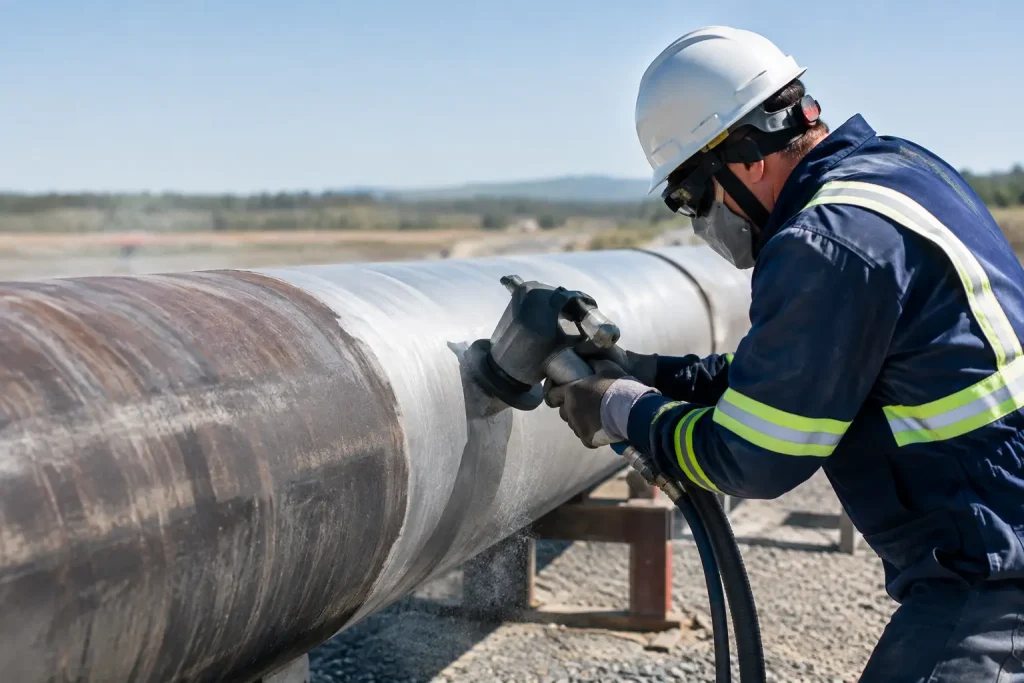
A pipeline surface prep example is most useful when it starts with the decision that matters: what must the surface be ready for next? A line may need localized corrosion removal before coating repair, a clean area for ultrasonic thickness measurement, or preparation around valves and supports where conventional methods are difficult to control. The preparation method should follow that purpose, rather than treating every stained or corroded pipe as the same job.
For asset owners and maintenance teams, laser cleaning can be a practical option where selective treatment, substrate preservation, and access constraints are central to the scope. It is not a substitute for every form of surface preparation. A clear assessment establishes where it fits, what result is realistic, and whether a representative trial should come before wider deployment.
Pipeline Surface Prep Example: Defining the Work Scope
Consider a carbon steel pipeline in a process area with patchy external corrosion beneath aging coating. The integrity team needs reliable readings at selected inspection locations, while the maintenance team also wants to identify areas requiring coating repair. Access is restricted by nearby pipework, cable trays, and operating equipment.
The first question is whether the objective is inspection preparation, coating removal, corrosion removal, or a combination of these. These outcomes can require different cleaning extents and acceptance criteria. For example, an NDT technician may need a defined inspection window with contamination, loose corrosion products, and coating removed sufficiently for the selected technique. A coating repair specification may require a broader prepared area and a particular surface profile that must be verified against the coating system requirements.
Laser cleaning uses controlled energy to ablate contaminants, coatings, oxides, and corrosion products from the surface. The visible change can be useful during assessment: operators and asset representatives can see how the treatment responds across sound substrate, corroded areas, coating edges, welds, and complex geometries. However, visual cleanliness alone is not an acceptance standard. The required result must be agreed against the next process.
Assess the Surface Before Selecting a Method
A practical assessment begins with the pipeline’s material, condition, operating status, and accessibility. Carbon steel, stainless steel, galvanized surfaces, and coated pipework each respond differently to cleaning. Coating type and thickness matter, as does the extent of corrosion, pitting, salt contamination, oil residue, or process deposits.
The team should also establish whether the line can remain in service. Temperature, insulation condition, nearby ignition sources, process hazards, and permit requirements may determine when and how work can proceed. Laser cleaning is a specialist restoration and preparation process, not simply a faster way to clean all exposed pipework.
For an external pipeline, useful assessment information includes the pipe diameter, approximate treatment area, photographs at close and medium range, coating history where available, and the intended follow-on activity. If inspection is planned, the NDT method and the inspection company’s preparation requirements should be confirmed early. If recoating is planned, the coating manufacturer or project specification should define the required surface condition and profile.
Access often determines the real productivity
A straight pipe at ground level is very different from a line above a rack, behind structural steel, or located in a congested processing unit. The cleaning head, operator position, exclusion area, power supply, fume extraction approach, and material collection arrangements all need consideration.
This is where a small representative area can prevent poor assumptions. A trial can show whether the desired result is achievable within the available access window and whether adjacent assets need protection. It can also reveal variations hidden beneath an old coating, including deeper corrosion or repairs that affect the maintenance decision.
Where Laser Cleaning Can Help on Pipelines
Laser cleaning is particularly relevant where the scope calls for controlled, localized removal rather than broad-area blasting. It may be used to prepare inspection windows, clean around welds, remove corrosion products from targeted repair areas, or strip selected coatings where protecting the underlying substrate and nearby components is important.
For NDT preparation, the benefit is often consistency at the test location. Loose material and surface coatings can interfere with inspection access or signal quality. The final condition still depends on the NDT method, the instrument, the technician’s procedure, and the surface geometry. A preparation method should therefore be reviewed with the inspection team, rather than selected in isolation.
For coating repairs, laser cleaning can support careful edge work and treatment around brackets, flanges, valves, and other detailed features. It can help avoid unnecessary removal of sound material outside the repair boundary. Whether it creates the required profile for a specific coating system is a separate question. Laser ablation may clean effectively while a coating specification still calls for another preparation step to achieve its required anchor pattern.
The same principle applies to heavy industrial equipment in refineries, process plants, shipyards, and marine facilities. Localized restoration can be valuable around complex features, but the required preparation standard, access, contamination type, and downstream repair method must guide the scope.
Limitations That Need an Honest Review
Laser cleaning is not automatically the right choice for large, uniform areas where another specified preparation method is better aligned with the required profile, schedule, or project economics. Very heavy scale, deep corrosion, multilayer coatings, and extensive surface damage may require additional mechanical treatment or a different repair strategy.
It also does not correct material loss. If cleaning exposes pitting, thinning, cracking, or failed weld areas, those conditions need integrity assessment and an appropriate engineering response. The cleaning result can make defects easier to evaluate, but it does not remove the need for inspection and repair decisions.
Environmental and worksite controls remain part of the plan. Ablated material and any hazardous coating residues must be managed according to the material present and site requirements. Work in operating facilities may require isolation, permits, controlled access, ventilation, monitoring, and coordination with operations. These are project-specific controls, not assumptions that can be applied identically at every location.
A Representative Trial Creates Better Decisions
For uncertain surfaces, a representative trial is usually more useful than estimating from photographs alone. The trial area should include the actual conditions that will drive the project: intact coating, corroded sections, welds, corners, pipe supports, and any difficult access points. A clean, flat sample panel is rarely enough to predict field performance.
Agree the assessment criteria before the trial starts. These may include the treated appearance, remaining coating at defined boundaries, suitability for an NDT reading, condition of the substrate, required follow-on preparation, and practical access arrangements. The trial should also identify what cannot reasonably be achieved with laser cleaning alone.
BKR Engineering Pte Ltd can assess targeted pipeline, tank, equipment, and restoration applications using laser cleaning and surface preparation methods. For storage tanks or other confined locations, the company’s patent-pending confined-space laser-cleaning technology is designed to support practical access planning without disclosing proprietary engineering details. Its suitability still depends on the tank configuration, product history, access constraints, and site safety requirements.
Information to Prepare for a Project Discussion
A productive project discussion starts with the asset’s purpose and the desired end condition. Provide photographs, dimensions, material details, known coating or contamination information, the operating environment, and any relevant inspection or coating specifications. It is also helpful to state the available shutdown window, access restrictions, and whether the work is intended for a small repair area or a repeated maintenance program.
For heritage stone and commercial facades, the same disciplined approach applies. Laser restoration is most relevant where routine washing has reached its limits and surface deposits obscure original material or architectural detail. A trial helps establish whether treatment can recover the intended appearance while preserving the character of the substrate, extending service life, and avoiding unnecessary replacement.
The most valuable pipeline surface preparation plan is not the one that promises the broadest application. It is the one that defines the required result, tests the difficult conditions early, and gives the maintenance team a sound basis for the next inspection, repair, or restoration decision.