
A gearbox housing ready for inspection should not require a chemical washdown, abrasive media, or days of containment work. For high-value assets, oil grease removal is not simply a housekeeping task. It is the first step toward reliable inspection, sound coating adhesion, accurate repairs, and safer maintenance execution.
Laser cleaning provides a controlled alternative when conventional methods create more disruption than the contamination itself. By directing precisely calibrated laser energy at the contaminated area, technicians can ablate oil, grease, residues, oxides, and selected coatings while preserving the underlying metal or other suitable substrate. The result is a visibly clean surface with far less secondary waste to manage.
Why Oil and Grease Create Maintenance Risk
Oil and grease protect moving components where lubrication is intended. Outside those boundaries, they can hide corrosion, weld defects, cracks, leaks, and surface damage. A contaminated surface may also prevent non-destructive testing, interfere with coating systems, and make it difficult to determine the true condition of an asset.
This matters on piping, valves, pump casings, structural steel, marine equipment, machinery foundations, and fabrication assemblies. In oil and gas, construction, and industrial facilities, a small area of contamination can delay a repair package or compromise inspection readiness. For property and heritage work, aggressive cleaning can create a different risk: permanent damage to delicate metals, stone, or surrounding finishes.
The cleaning method must therefore do more than remove visible residue. It needs to achieve the required level of cleanliness without introducing avoidable damage, waste, or downtime.
Where Conventional Cleaning Falls Short
Solvent wiping can work for light films in accessible locations, but it is labor-intensive and commonly leaves contaminated rags, runoff, fumes, and disposal obligations. It can also spread oil across a larger area if the process is poorly controlled.
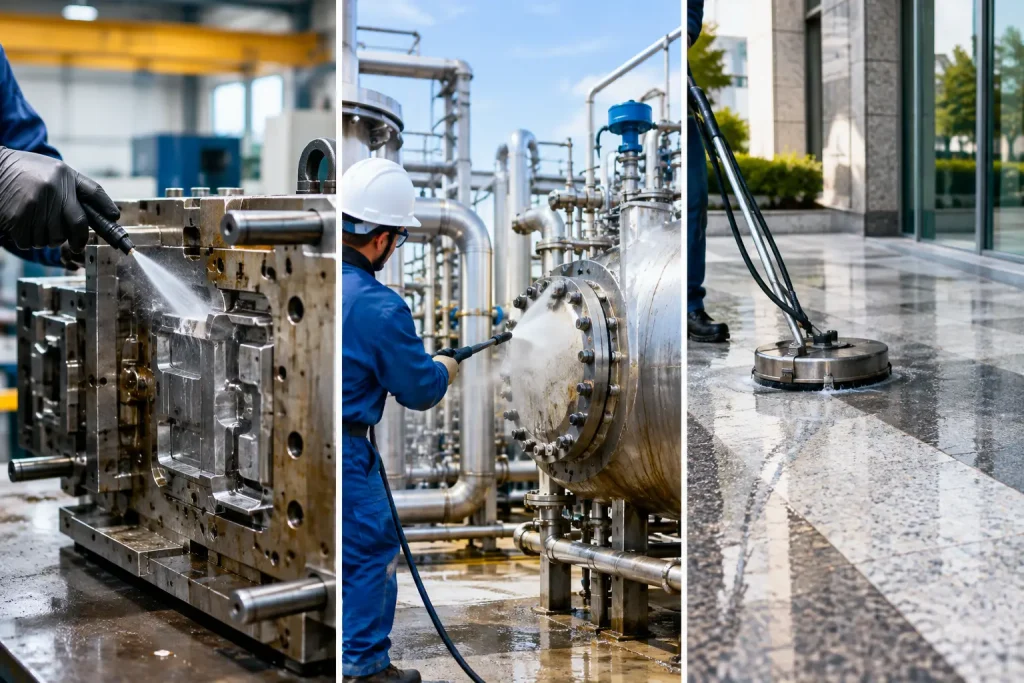
Steam and high-pressure washing may be effective on broad, open surfaces. However, they introduce water, require drainage control, and may be unsuitable around sensitive equipment, electrical systems, or areas where flash corrosion is a concern. Water-based methods can also create significant cleanup work in confined plant environments.
Abrasive blasting removes contamination quickly, but it is not always selective. It can alter surface profiles, erode softer materials, damage edges, and generate large volumes of spent media. The containment, isolation, and cleanup requirements may outweigh its benefits for targeted repairs or in-service equipment.
Chemical degreasers have a place in many maintenance programs, particularly when removing bulk deposits. Their trade-off is the handling of hazardous substances, ventilation requirements, worker exposure considerations, and chemical waste disposal. The best approach depends on the contaminant thickness, the substrate, the access conditions, and the cleanliness specification.
Oil Grease Removal With Controlled Laser Ablation
Laser cleaning uses short, controlled pulses of energy to interact with contaminants at the surface. Oil films, grease, coatings, rust, and other unwanted layers absorb the energy differently from the base material. When the correct parameters are selected, the contaminant is vaporized or released while the substrate remains protected.
This selectivity is the central advantage. A technician can focus on a weld zone, flange face, bearing seat, corroded fastener, or localized leak area without treating the entire component. There is no blasting media to recover and no chemical bath to neutralize.
The visual feedback is valuable in the field. Operators can see the surface condition change as contamination is removed, making it easier to stop at the required cleaning level rather than over-process the asset. For maintenance leaders, this supports more predictable scope control and clearer handover to inspection or coating teams.
What laser cleaning can remove
Laser systems can address light to moderate oil films, grease residues, aged lubricants, carbonized deposits, oxides, rust, paint, and selected surface coatings. They are especially useful where contamination is localized, access is constrained, or the base material must remain intact.
Very thick, wet, or pooled grease may need initial mechanical collection or wiping before laser treatment. Removing bulk material first allows the laser to work efficiently on the remaining bonded film and contamination at the surface. This is not a limitation to overlook during planning. The right process often combines simple preparation with precision laser finishing.
Protecting the Surface Beneath the Contamination
Surface preservation is critical when cleaning machined parts, stainless steel, aluminum, delicate architectural elements, or components with tight dimensional tolerances. Unlike abrasive methods, laser cleaning does not rely on physical impact from grit or media. Properly configured, it can remove the unwanted layer without roughening, gouging, or thinning the underlying material.
That does not mean every substrate should be treated identically. Laser settings must be matched to the material, contamination type, thickness, desired finish, and project objective. A surface prepared for coating may require a different outcome than a component prepared for visual inspection or restoration.
A competent service provider should assess a representative test area before full deployment. This confirms removal performance, verifies substrate response, and establishes an efficient working method. It also gives project stakeholders a clear visual benchmark for acceptance.
Reducing Downtime and Worksite Burden
In maintenance shutdowns, the time required to set up a cleaning method can be as costly as the cleaning itself. Blasting may require enclosures, extensive masking, media handling, and post-job cleanup. Chemical methods may require wash stations, ventilation controls, spill management, and waste segregation.
Laser cleaning is highly targeted and can be mobilized for localized work with a smaller operational footprint. This can reduce the need for broad-area isolation and help crews prepare assets closer to the point of repair. Less cleanup after the job also helps adjacent trades begin inspection, welding, coating, or assembly sooner.
Safety still requires disciplined planning. Depending on the task, controls may include laser-safe work zones, fume extraction, fire prevention measures, suitable personal protective equipment, and coordination with site permit systems. The goal is not to eliminate controls, but to use a process that avoids unnecessary exposure to abrasive dust and chemical residues.
Environmental Benefits That Support Practical Operations
A cleaner process is most useful when it also improves site execution. Laser cleaning produces no spent blasting media and greatly reduces the need for solvents or chemical stripping agents. Contaminants removed from the surface can be captured through appropriate fume extraction and filtration, simplifying housekeeping and waste management.
For organizations with environmental targets, this can reduce the waste stream associated with surface preparation. It also supports cleaner work areas in facilities where chemical spills, wash water, and airborne dust present operational concerns. BKR Engineering applies this green technology with the practical requirements of industrial maintenance in mind: clean the surface precisely, protect the asset, and limit the burden left behind.
Planning an Effective Cleaning Scope
A successful job begins with clear answers to a few operational questions. What is the contaminant? How thick is it? What substrate lies beneath it? Is the surface being prepared for inspection, repair, coating, or restoration? And what access, safety, and shutdown restrictions apply?
Those details determine whether laser cleaning should be the primary method or part of a staged approach. For example, a heavily greased pump may require bulk removal first, followed by laser cleaning around joints, identification marks, and inspection areas. A corroded steel component with an oil film may be cleaned in a sequence that removes the grease before addressing oxidation.
The specification should define the required endpoint rather than merely state that the surface must be clean. Is a visual standard sufficient? Must the area be free of oil for dye penetrant testing? Does a coating manufacturer require a particular surface condition? Clear acceptance criteria prevent rework and keep the project moving.
A Better Starting Point for Inspection and Repair
When contamination is removed with precision, the asset tells a more accurate story. Inspectors can identify defects, maintenance teams can assess repair boundaries, and coating crews can work from a properly prepared surface. That clarity is often more valuable than the cleaning task alone.
For equipment that cannot afford unnecessary damage or extended downtime, oil grease removal should be treated as a controlled surface-preparation decision. Choosing a method that protects the substrate, reduces waste, and fits the worksite can make the next maintenance step faster, safer, and easier to trust.