
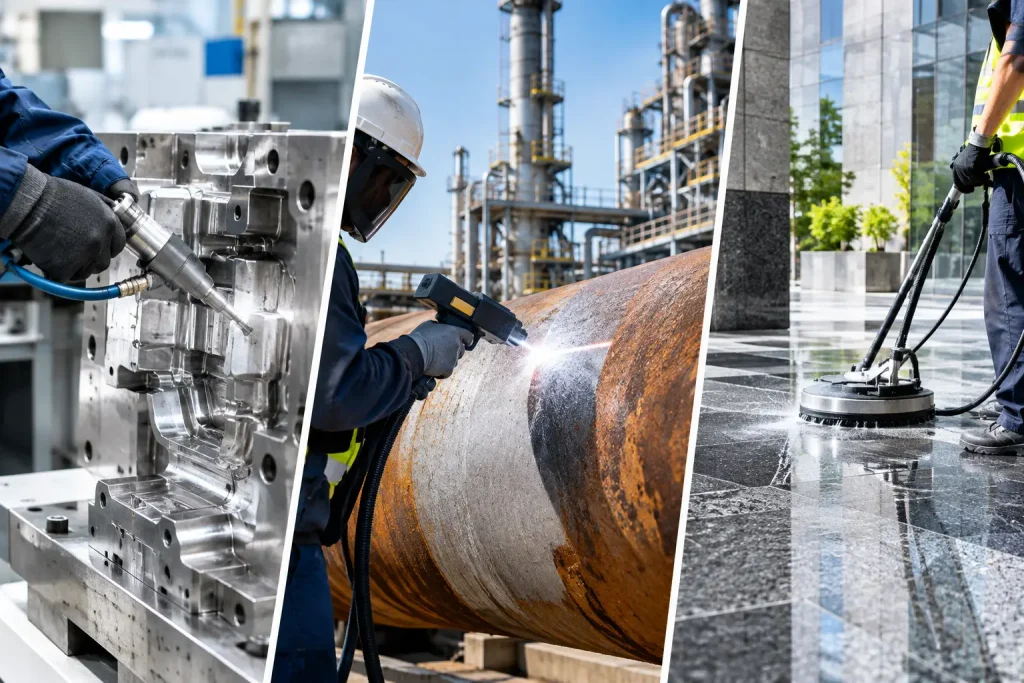
A corroded valve, steel frame, or weld zone rarely needs cleaning for its own sake. The work is usually a prerequisite for inspection, coating, repair, or continued operation. In the needle scaling vs laser cleaning decision, the right method depends on the contaminant, substrate condition, access, environmental controls, and the level of surface precision the next task requires.
Needle scaling remains a familiar field tool because it is portable, mechanically simple, and effective on heavy, loose corrosion. Laser cleaning offers a different approach: controlled laser ablation that removes unwanted surface material selectively, often while preserving the underlying substrate. Neither method is automatically right for every asset. The practical question is whether the cleaning process supports the job that follows without adding avoidable downtime, damage, waste, or rework.
How Needle Scaling Works
A needle scaler uses a bundle of rapidly reciprocating steel needles driven by compressed air or an electric mechanism. The needles impact the surface repeatedly, breaking up loose rust, mill scale, old coatings, and debris. It is a force-based process, so its effectiveness is tied to mechanical impact rather than material selectivity.
For heavy corrosion on structural steel, especially in open areas where surface finish is less critical, needle scaling can be a sensible option. Maintenance crews can deploy the equipment quickly, and the tool can reach irregular profiles, corners, and localized areas that are inconvenient for larger blasting equipment.
The trade-off is that the tool strikes both contamination and the surface below it. On thick steel with extensive scale, that may be acceptable. On thin metal, precision parts, heritage elements, or surfaces requiring a controlled profile, repeated impact can leave marks, create localized deformation, or remove more material than intended. Needle scaling also generates noise, vibration, dust, and loose debris that must be managed around operating equipment and personnel.
How Laser Cleaning Removes Contaminants
Laser cleaning directs controlled pulses of light at a surface. Contaminants such as rust, oxides, paint, oil, grease, and coatings absorb the laser energy differently from the base material. When parameters are properly selected, the unwanted layer is ablated while the substrate remains substantially unaffected.
This selectivity is the central advantage. Rather than striking the surface, laser cleaning can be tuned to remove a defined layer or contaminant. Operators can clean around welds, fasteners, edges, stamped markings, intricate geometry, and sensitive surfaces with a high degree of control.
The process is also visually clear. As the laser passes across a corroded or coated surface, the contrast between the contaminated and cleaned areas is immediately visible. For maintenance leaders and quality teams, that visibility helps verify coverage and assess the condition of the substrate as cleaning progresses. Hidden cracks, pitting, weld defects, and corrosion patterns may become easier to identify before repair or recoating begins.
Laser cleaning does require trained operators, correct process settings, controlled work zones, and appropriate fume extraction. It is not simply a replacement for every hand tool. Its value is strongest where surface protection, cleanliness, containment, and downtime matter as much as raw material removal.
Needle Scaling vs Laser Cleaning: The Key Differences
The most meaningful comparison is not speed alone. A tool may remove corrosion quickly but create cleanup, surface repair, isolation work, or waste-handling requirements that extend the total job duration.
Surface protection and finish
Needle scaling removes contaminants through repeated impact. It can be aggressive and may alter the surface, particularly where the metal is thin, aged, or already degraded. The resulting finish can vary according to operator technique, tool condition, and the hardness of the corrosion layer.
Laser cleaning is designed for controlled, selective removal. It is especially useful when the objective is to expose sound metal, prepare a weld area, remove a localized coating, or clean a component without unnecessarily abrading the base material. The required end condition still matters. Some coating systems require a specific surface profile, and laser cleaning should be evaluated against that coating specification rather than assumed to be a complete substitute for every profiling process.
Worksite impact and waste
Needle scaling creates rust fragments, coating chips, and airborne dust. If old coatings may contain hazardous constituents, containment and disposal requirements can become significant. The tool itself also produces substantial noise and vibration, which can affect adjacent work and worker comfort during longer tasks.
Laser cleaning does not use blasting media, water, or chemical stripping agents. The removed material is typically converted into particulates or fumes that can be captured with suitable extraction and filtration equipment. This reduces secondary waste and can simplify work in facilities where abrasive media, wash water, and chemical residues are difficult to manage.
For enclosed plants, active production areas, and sensitive properties, less cleanup can translate into a more orderly and controlled project. It does not eliminate the need for planning. Laser work still requires safety controls, exclusion zones, and fume management based on the material being removed.
Access, productivity, and downtime
Needle scalers are compact and useful in confined or awkward locations. They are often effective when crews need to remove thick, loose scale from a small area with minimal setup. However, cleaning rate depends heavily on operator effort, and large surfaces can become labor-intensive.
Laser cleaning can be deployed as a portable service and is highly productive for targeted tasks, repeated maintenance points, and areas where avoiding broad containment is valuable. It can reduce time spent on post-cleaning cleanup and preparation, particularly when only a defined section requires treatment. For very large areas of thick corrosion where substrate precision is not a priority, a mechanical method may remain more economical.
The decision should account for the entire work package: access preparation, isolation, cleaning, inspection, waste handling, final cleanup, and return to service. That is where laser cleaning frequently proves its operational value.
Operator safety and asset risk
Both methods require competent operators and task-specific controls. Needle scaling introduces hand-arm vibration, noise exposure, flying debris, and fatigue concerns. These risks can be managed, but they should be included in method statements and work scheduling.
Laser cleaning avoids impact vibration and abrasive rebound, but it introduces laser safety requirements. Controlled access, protective measures, trained personnel, and proper extraction are essential. A professional laser cleaning provider should assess the material, contamination, surrounding environment, and required end state before work begins.
Where Each Method Makes Sense
Needle scaling is often appropriate for rough structural work, heavily rusted steel, field repairs, and situations where a mechanically cleaned surface is acceptable. It can be a dependable choice when the work area is open, cleanup requirements are manageable, and the asset is not sensitive to mechanical impact.
Laser cleaning is particularly well suited to weld preparation, localized coating removal, corrosion removal before inspection, machinery restoration, mold and tooling cleaning, precision fabrication, and heritage restoration. It is also valuable in oil and gas, construction, infrastructure, and property maintenance environments where reducing shutdown scope and protecting the substrate are priorities.
Consider a corroded flange in an operating plant. Needle scaling may remove loose rust, but debris can spread into surrounding equipment and repeated impact can make detailed inspection more difficult. Laser cleaning can target the flange, expose the corrosion condition clearly, and limit contamination around the work area. By contrast, a broad section of severely scaled external steelwork scheduled for full recoating may not require that level of selectivity.
Choosing the Method Before Work Starts
The best choice begins with a site assessment, not a tool preference. Identify the base material, contaminant type and thickness, required cleanliness standard, coating or repair plan, access limits, nearby equipment, and environmental obligations. A small test area can confirm removal rate, substrate response, and the finish available for the next process.
Asset owners should also define what “faster” means for the project. If the measure is only minutes of active cleaning, needle scaling may appear attractive in some cases. If the measure includes containment, cleanup, waste disposal, inspection readiness, and risk of substrate damage, laser cleaning may offer a stronger overall result.
BKR Engineering approaches laser cleaning as a controlled surface-preparation service, not a one-size-fits-all claim. The goal is to remove the unwanted layer efficiently while protecting the material and keeping the worksite practical for the people responsible for the asset.
When the next step depends on clean, intact, clearly visible metal, the cleaning method becomes part of the quality plan. Choose the process that leaves the asset ready for what comes next, not merely the one that removes rust first.