
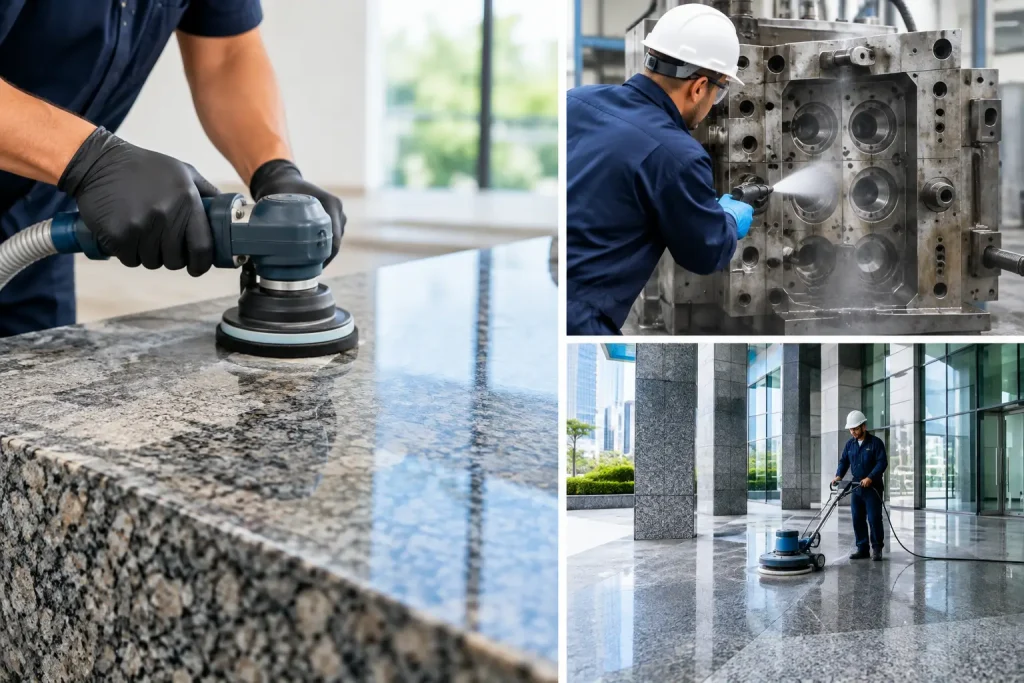
A granite entrance, facade, plinth, or interior feature can look permanently worn long before the stone itself has reached the end of its service life. Granite restoration Singapore projects often begin at this point: conventional cleaning has improved little, replacement is disruptive and costly, and the owner needs to understand whether the original finish can still be recovered.
For commercial and heritage assets, restoration is not simply about making stone look brighter. It is a controlled process of removing unwanted surface contamination while retaining the mineral structure, original tooling marks, joint details, and intended appearance of the granite. Laser cleaning can be a useful option where deposits, discoloration, aged coatings, or localized soiling are obscuring the surface – but only after the stone and contamination have been assessed properly.
When granite needs specialist restoration
Granite is widely selected for its hardness and weather resistance, yet it is not immune to visual deterioration. External stonework can accumulate atmospheric deposits, corrosion staining from adjacent metalwork, biological growth, paint residues, sealers, and embedded dirt. Inside commercial buildings, high-contact areas may develop darkened zones around entrances, counters, columns, and wall panels.
The visible problem does not always sit on the surface. Some discoloration may have entered pores, joints, fissures, or an existing coating. Other marks may be caused by moisture movement, mineral deposits, or metal components behind the stone. These conditions require different responses. Attempting aggressive removal without identifying the cause can alter the finish while leaving the underlying issue unresolved.
Specialist restoration is most relevant when routine cleaning no longer produces an acceptable result, when architectural detail must be retained, or when a replacement program would create avoidable disruption. This is particularly relevant for lobbies, retail and hospitality spaces, civic buildings, commercial facades, memorial features, and heritage elements where matching replacement stone may be difficult.
Granite restoration Singapore: where laser cleaning can help
Laser cleaning uses precisely controlled light energy to interact with contamination on a surface. The response depends on the laser settings, the granite mineral composition, the deposit being removed, surface texture, and the required final appearance. During restoration work, the objective is not indiscriminate removal. It is to establish a treatment approach that reduces unwanted material while protecting the stone as far as practicable.
On suitable granite surfaces, laser cleaning may help remove localized surface deposits, dark accretions, selected coating residues, corrosion-related staining, and contamination trapped around carved or textured features. Its controlled, non-contact nature can be especially useful where mechanical abrasion would be difficult to manage around edges, inscriptions, relief work, or irregular profiles.
The visual effect is also valuable during decision-making. A representative test area can show how the original color and texture may reappear beneath a surface layer. That evidence gives facilities teams, architects, and asset owners a clearer basis for deciding whether a larger restoration scope is justified.
Laser cleaning is not a universal remedy for every stained stone surface. Deeply absorbed staining, chemical etching, cracking, spalling, failed repairs, and discoloration caused by internal moisture or mineral migration may require other conservation or repair measures. In some cases, laser treatment may be appropriate only for a limited part of the scope, alongside localized repairs, joint work, or a revised protection strategy.
Protecting the original granite finish
The key question is not whether granite is generally hard. It is whether the specific surface can tolerate a proposed treatment while maintaining its intended finish. Polished granite, flamed granite, honed stone, bush-hammered finishes, and aged heritage stone all respond differently. A dark, dense granite may also contain mineral variations that are not immediately visible beneath contamination.
For this reason, a restoration plan should start with sample testing rather than assumptions. The test should examine cleaning response, color consistency, texture retention, edge behavior, and any contrast between treated and untreated areas. A treatment that works effectively on a smooth facade panel may not produce the same result on weathered stone near joints or metal fixings.
Containment and access also matter. Restoration in an occupied commercial property may need to be phased around tenant operations, public routes, dust-control arrangements, and work-at-height requirements. For heritage work, the acceptable level of visual change may be narrower, and approval requirements may influence both the method and the treatment extent.
BKR Engineering Pte Ltd approaches laser surface preparation as an engineering-controlled service rather than a general cleaning task. The same discipline used for industrial equipment restoration and pre-inspection preparation is applied to evaluating substrate condition, contamination type, access constraints, and the required finish.
What can limit the result
A credible granite restoration assessment should be clear about uncertainty. Some deposits release cleanly because they remain largely above the stone surface. Others have penetrated the material or reacted chemically with it. Removing the visible layer may improve appearance without fully eliminating a shadow or color variation.
Existing sealers and coatings can complicate the work. They may have weathered unevenly, trapped dirt, or changed color over time. Their removal can reveal differences in the underlying stone that were previously concealed. Likewise, areas repaired with a different granite batch, filler, adhesive, or patch material may respond differently from original stone.
There is also a practical trade-off between cleaning intensity and visual uniformity. Treating only the darkest marks can leave a patchy appearance. Treating a larger area may create better consistency, but it changes the project scope, access requirement, and budget. The right approach depends on the asset’s condition, visual expectations, and whether restoration is intended to be localized or part of a wider renewal program.
Information needed for a useful assessment
A site discussion can move quickly when the owner or facilities team can provide clear photographs, the location and approximate area of the affected granite, and an indication of whether the stone is interior or exterior. Close-up images should show the contamination as well as the surface texture, joints, edges, and nearby materials.
It is also helpful to know the age of the installation, any previous cleaning or coating history, whether staining has returned after earlier treatment, and the operational restrictions around the work area. For facade or elevated locations, access arrangements are a significant part of planning. For heritage elements, available drawings, material records, and conservation requirements can help define the appropriate test process.
Where possible, an on-site review and representative trial provide more reliable guidance than photographs alone. The trial area should include typical contamination and, if relevant, more difficult zones near joints, carvings, drainage paths, or metal interfaces. The result can then be reviewed for appearance, consistency, and suitability before a full work program is agreed.
Restoration as an alternative to premature replacement
Granite replacement is sometimes necessary when stone has suffered structural damage or deterioration beyond practical repair. However, visual contamination alone does not automatically justify removal. Reusing sound original stone can preserve architectural character, reduce disruption to occupied premises, and avoid the matching challenges associated with new material.
The strongest restoration outcomes come from treating the project as a material-preservation decision, not a cosmetic cleaning exercise. Identify what is on the stone, understand why it developed, test a controlled method, and agree the acceptable finish before scaling up. If your granite surface has reached the point where ordinary measures no longer change its appearance, a representative laser-cleaning trial can provide the practical evidence needed to plan the next step.