
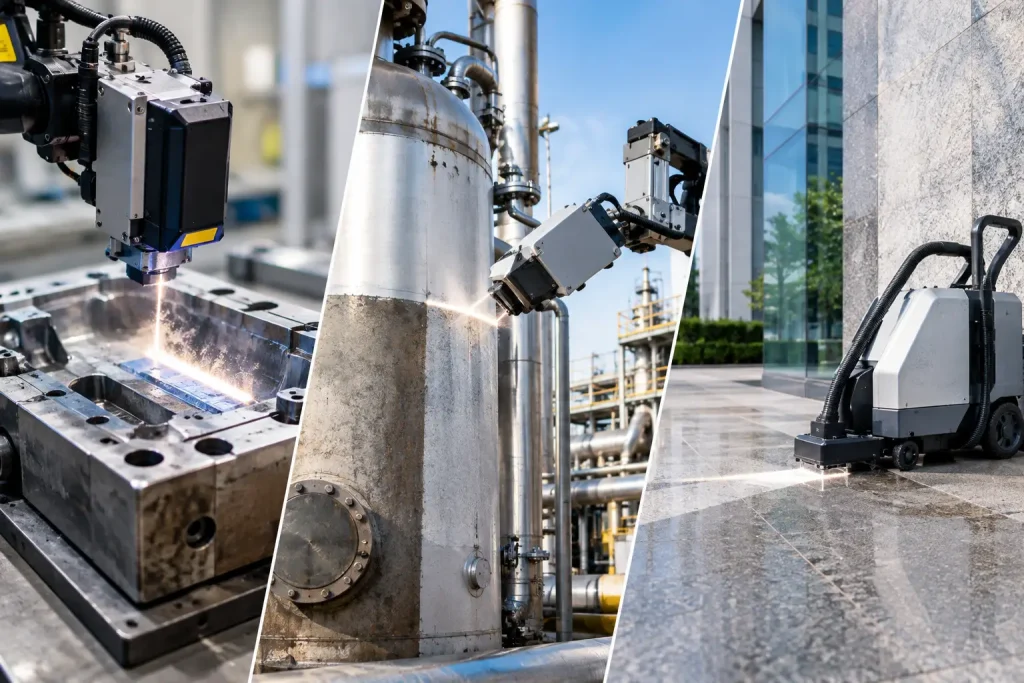
A tank shell, pump casing, weld zone, or heritage façade rarely presents a uniform cleaning problem. Contamination changes across the surface, access can be restricted, and the acceptable finish depends on the next operation. Laser cleaning automation can bring controlled movement and repeatability to these demanding tasks, but it is not simply a matter of placing a laser on a robot and pressing start.
For asset owners and maintenance teams, the practical question is whether automation improves the preparation outcome while fitting the site, substrate, geometry, and work sequence. In the right application, it can support more consistent coverage, reduce repeated manual handling, and make challenging areas more accessible. In the wrong application, a fixed automated approach may add complexity without solving the underlying access or surface-condition issue.
What automation changes in laser cleaning
Laser cleaning removes selected surface layers through controlled laser ablation. Depending on the application, that may include corrosion products, coatings, oils, carbonized deposits, paint residues, or weathered contamination. The objective is not necessarily to make every surface look new. It is to achieve an appropriate condition for inspection, repair, coating, continued service, or conservation.
Automation introduces programmed or guided motion to that process. The laser head may travel along a planned path, maintain a defined stand-off distance, or follow repeated profiles on similar components. It can be used with robotic handling, mechanized travel systems, positioners, or purpose-designed equipment for restricted-access work.
This matters because manual cleaning quality can vary where an operator must work around complex geometry, elevated structures, internal tank features, or repeated equipment items. Controlled motion can help apply an agreed cleaning pattern more consistently. It can also provide a more predictable working method when the same surface condition and component geometry occur repeatedly.
Automation does not remove the need for skilled engineering judgment. Operators still need to assess surface response, adjust parameters where conditions change, protect adjacent materials, and verify that the prepared area meets the requirement of the next trade or inspection team.
Where laser cleaning automation is most useful
The strongest case for automation usually combines repeatability with a difficult access condition or a high need for controlled surface preparation. The following applications often warrant an assessment.
Storage tanks and confined spaces
Storage tank maintenance can involve extensive internal surfaces, restricted access, awkward overhead areas, and preparation requirements before inspection, repair, or recoating. Conventional abrasive methods may create significant secondary material to manage, while manual techniques can be physically demanding and difficult to apply consistently around shell plates, welds, stiffeners, and localized corrosion.
Mechanized laser cleaning can be considered where the access route, tank condition, internal geometry, and work scope support it. BKR Engineering’s patent-pending confined-space laser-cleaning technology is intended to address practical access and deployment challenges in enclosed industrial spaces. Its value is not based on a claim that every tank can be automated. Rather, it can provide an engineered option for projects where controlled deployment, operator positioning, and localized surface preparation need careful planning.
A tank assessment should establish whether cleaning is required across broad areas, along seams and welds, around fittings, or only at identified defects. The answer affects the appropriate travel method, production planning, containment arrangements, and whether automated motion offers an advantage over targeted manual laser work.
Pre-inspection cleaning for NDT
Inspection teams need a surface condition that allows the selected NDT method to perform as intended. Residual corrosion, scale, coatings, oils, or surface deposits can obscure relevant indications or interfere with access to the inspection area. The requirement is therefore specific: prepare the surface sufficiently for the inspection method, without unnecessarily altering adjacent areas or damaging the component.
Laser cleaning automation can be useful when inspection points repeat across similar equipment, pipe supports, structural members, or production assets. A controlled path can help standardize the treatment area and reduce variation between locations. This is particularly relevant where inspection planning calls for defined windows or recurring monitoring locations.
The NDT provider should be involved early. They can confirm the required surface condition, inspection footprint, access needs, and any restrictions related to the method being used. Cleaning and inspection should be planned as one work sequence rather than as separate activities with different assumptions about the required finish.
Heavy industrial equipment restoration
Process plants, refineries, shipyards, and marine facilities contain equipment that is difficult or costly to replace but may require targeted restoration. Examples include valves, pump components, machinery housings, structural elements, heat-affected areas, and fabricated assemblies with corrosion or coating residues.
Automation can be valuable when there are batches of similar components or defined cleaning zones that benefit from repeatable handling. On irregular, heavily degraded, or one-off equipment, a flexible operator-led approach may be more appropriate. The decision depends on the geometry, substrate, contaminant type, required surface condition, and available setup space.
A representative trial is particularly useful in restoration work. It can show how the surface responds, whether deposits release evenly, how edges and recessed areas behave, and whether the proposed method supports the subsequent repair or coating process. The visual effect of laser cleaning can be helpful for confirming progress, but visual appearance alone should not be treated as the acceptance criterion. The required result must relate to the maintenance objective.
Stone and heritage surface restoration
For commercial buildings and heritage assets, routine washing may reach its limit when staining, biological growth residues, pollution deposits, old coatings, or localized discoloration remain embedded in a surface. Replacement can be disruptive and may sacrifice original fabric, profile, and architectural detail.
Laser cleaning can offer a selective restoration option for suitable stone, masonry, metal ornament, and other heritage features. Automation may assist on repeated decorative elements, long accessible elevations, or areas where consistent movement is useful. However, historic surfaces are rarely uniform. Changes in stone composition, previous repairs, weathering, and fragile details require a cautious, trial-based approach.
The objective is to recover the original material where feasible, preserve detail, and extend service life without unnecessary replacement. A small trial area helps establish an acceptable visual result and identify any areas that need a different treatment. Automation should follow that understanding, not replace it.
Limits that should be addressed before specifying automation
Laser cleaning automation is not a universal replacement for manual surface preparation. Highly variable contamination, severe pitting, hidden defects, inaccessible recesses, unstable substrates, and changing geometry can all reduce the value of a programmed approach. Setup time also matters. For a small, isolated repair, configuring automated equipment may not be justified.
The laser process itself must be matched to the substrate and material being removed. Parameters such as pulse characteristics, power, scan pattern, travel speed, and stand-off distance influence the result. Nearby cables, seals, coatings that must remain in place, and heat-sensitive materials may need protection or a different method altogether.
Site conditions also shape feasibility. Teams should consider available access routes, lifting constraints, ventilation, line-of-fire risks, permit requirements, work at height, electrical supply, and coordination with operations. In confined spaces, entry requirements and rescue arrangements remain central to the work plan regardless of the cleaning technology selected.
Information needed for a practical assessment
A useful initial discussion starts with the maintenance objective: inspection preparation, corrosion removal, coating preparation, restoration, or localized repair. Photographs and dimensions help, but they should be supported by details of the substrate, contamination, area size, component geometry, and access conditions.
It is also helpful to know what must happen after cleaning. Will the area undergo NDT, welding, recoating, dimensional inspection, or conservation review? That downstream requirement defines the acceptance standard more effectively than a general request for a “clean” surface.
Where uncertainty remains, a representative trial can be the most efficient next step. It provides evidence on cleaning response, surface appearance, practical access, and the likely role of automation before a larger shutdown or restoration scope is committed.
The best automation decisions begin with the surface and the work objective, not the equipment. A focused project discussion can establish whether controlled laser cleaning is the right route for the asset, the access constraints, and the result your team needs next.