
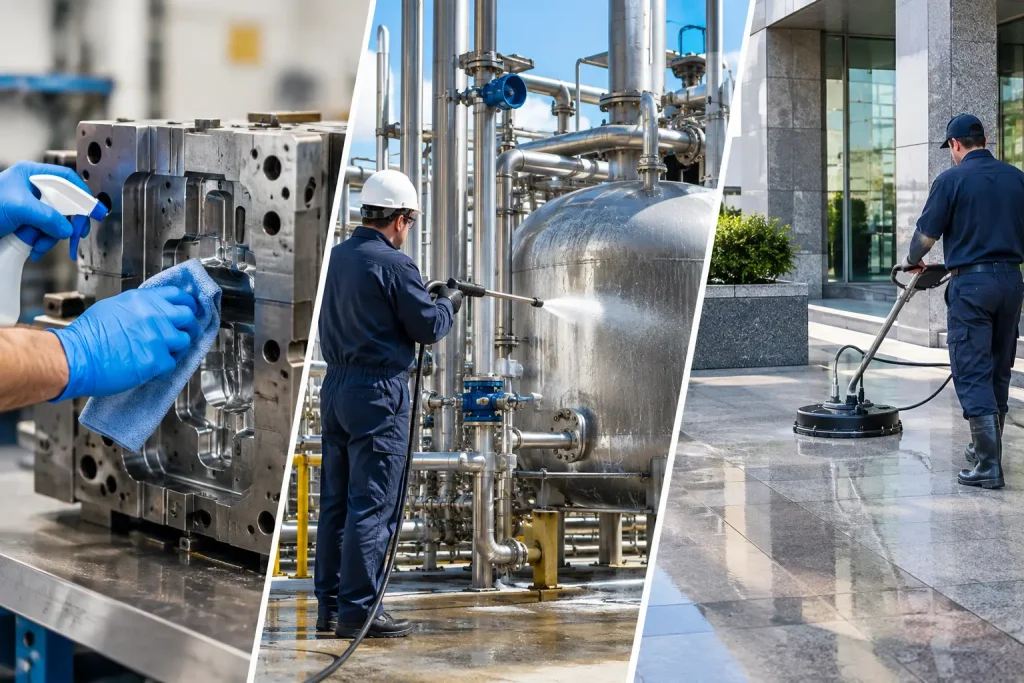
A heat exchanger header is ready for inspection, but years of baked-on oil and grease are masking the surface. A conventional solvent wash may remove the contamination, yet it can also create runoff, vapor exposure, drying delays, and waste-handling work. This is where industrial degreasing alternatives deserve a closer look. The right method is not simply the one that cleans fastest at the start. It is the one that delivers a clean, inspection-ready surface with the least disruption to people, assets, and the wider work area.
For facility owners and maintenance teams, degreasing is often connected to a larger task: corrosion assessment, weld repair, coating application, leak investigation, or restoration. The cleaning method must therefore be judged by what happens after the grease is gone. Surface condition, substrate protection, access requirements, containment needs, and shutdown duration all affect the true cost of the job.
Why Conventional Degreasing Can Become a Project Bottleneck
Chemical degreasers remain common because they are familiar and can be effective on accessible parts with light to moderate contamination. However, their practical limitations become more apparent on high-value assets, complex geometries, or active industrial sites. Solvents can introduce fire, ventilation, and worker-exposure concerns. Water-based products may require rinsing and drying, which creates a corrosion risk on ferrous surfaces if the process is not carefully managed.
The waste stream also matters. Used chemicals, oily rinse water, contaminated wipes, and absorbents must be collected, classified, and disposed of correctly. On a small bench-top job, these requirements may be manageable. On a large maintenance scope, they can add time, labor, and coordination that are not visible in the initial cleaning quote.
Abrasive approaches can remove heavier contamination, but they are not degreasing methods in the selective sense. They may alter the surface profile, drive contaminants into irregular surfaces, or remove sound coating and base material beyond the intended treatment area. When a component needs accurate inspection or controlled preparation, more force is not always better.
Industrial Degreasing Alternatives Compared
The best alternative depends on the contaminant, the underlying material, the required cleanliness level, and the environment where work must take place. A process that suits removable steel parts in a workshop may be impractical for installed pipework, electrical enclosures, heritage metalwork, or production equipment that cannot tolerate moisture.
Aqueous and Bio-Based Cleaners
Water-based alkaline cleaners and bio-based formulations can reduce reliance on aggressive solvents. They are often suitable for general maintenance cleaning where oils are not heavily carbonized and parts can be rinsed thoroughly. Their lower odor and potentially improved handling profile can be attractive for controlled workshop conditions.
The trade-off is process control. Many aqueous systems need heat, dwell time, agitation, rinsing, and drying to perform consistently. For assets that are installed, overhead, or located near sensitive equipment, collecting runoff can be difficult. Residual moisture and cleaner deposits can also interfere with inspection, coating adhesion, or corrosion control if surfaces are not properly dried.
Vapor Degreasing
Vapor degreasing can provide consistent cleaning for certain precision components. It is most useful when parts can be placed inside dedicated equipment and a repeatable, enclosed process is required. The method can reach complex shapes and may leave components dry when correctly configured.
Its limitations are largely operational. The parts must be transportable, equipment capacity must match production needs, and chemical management remains part of the process. It is generally not a field solution for large fixed assets, structural steel, tanks, or installed process equipment.
Dry Ice Cleaning
Dry ice cleaning uses carbon dioxide pellets to dislodge surface contamination. Because the media sublimates, it produces less secondary media waste than traditional blasting. This can make it useful where loose residues need to be removed without introducing water.
However, dry ice cleaning is not equally effective on all grease conditions. Thick, aged, or baked-on oils may require repeated passes, and the removed contamination still needs to be contained and collected. Noise, ventilation, operator access, and the potential for surface cooling also need consideration. It can be a practical option for certain maintenance situations, but it does not offer the same degree of layer-by-layer selectivity as laser ablation.
Mechanical Wiping and Manual Cleaning
Wipes, brushes, pads, and hand-applied cleaners still have a place for minor touch-ups and confined areas. They require little setup and allow technicians to focus on a very small spot. For simple, low-risk tasks, manual cleaning may be the most economical choice.
It becomes labor-intensive quickly. Manual methods can leave fibers, spread oily residues, produce inconsistent results between technicians, and expose workers to repetitive-motion demands or chemicals. They are also difficult to validate across a large surface area when cleanliness is critical before coating, inspection, or bonding.
Laser Cleaning for Controlled Degreasing
Laser cleaning uses precisely controlled laser energy to ablate surface contaminants. When applied correctly, it can remove oil, grease, oxides, paint, rust, and selected coatings while preserving the underlying substrate. Rather than flooding an area with chemical solution or impacting it with abrasive media, the process targets the unwanted layer.
This selective action is particularly valuable when contamination is present on machined surfaces, weld zones, tools, molds, electrical components, structural steel, or heritage metal features. Operators can treat localized areas without preparing an entire enclosure or exposing adjacent surfaces to chemical splash and abrasive rebound. The cleaning effect is also highly visible, giving project teams direct confirmation as contaminated layers are removed.
Laser cleaning does produce extracted particulate and vaporized contaminants, so appropriate fume extraction and site controls remain essential. It is not a substitute for planning. Yet it avoids the liquid chemical waste and spent blasting media associated with many conventional methods, helping simplify cleanup and environmental management.
How to Select the Right Degreasing Method
Before specifying a process, define the job beyond the word “clean.” Is the goal to prepare a surface for coating, reveal corrosion for inspection, remove oil from a weld area, restore a delicate feature, or support a production restart? Each end use has a different tolerance for residues, roughness, heat input, moisture, and access restrictions.
A useful evaluation should consider at least five practical factors:
- Contaminant type and thickness: Fresh lubricants respond differently from hardened grease, carbon deposits, or oil mixed with corrosion products.
- Substrate sensitivity: Aluminum, stainless steel, coated surfaces, machined components, and historic materials may need selective treatment rather than aggressive abrasion.
- Work location: Field work around operating equipment has different containment, drainage, ventilation, and access limits than a controlled workshop.
- Downtime window: Setup, cleaning, drying, cleanup, waste removal, and return-to-service checks should all be included in the schedule.
- Downstream requirement: Inspection, welding, coating, and bonding may require a specific surface condition that not every cleaning method can provide.
The lowest-cost cleaning method per gallon or per hour is not always the lowest-cost maintenance decision. If chemical cleaning requires isolation, rinsing, drying, waste collection, and repeat treatment, its apparent price advantage can disappear. Similarly, a blasting method that damages a surface profile or removes surrounding coating may create repair work that was never part of the original scope.
Where Laser Degreasing Delivers the Strongest Value
Laser cleaning is especially well suited to targeted maintenance where substrate preservation and site efficiency matter. On oil and gas, fabrication, and infrastructure projects, teams often need to expose a surface for inspection without creating a large secondary cleanup operation. Removing grease and oxidation from weld areas can support better visual assessment and preparation before repair work. On machinery and tooling, precise cleaning can help preserve dimensional surfaces and avoid introducing abrasive media into sensitive areas.
It is also useful when water is undesirable. Electrical equipment, enclosed process areas, building interiors, and restoration work can all impose strict limits on liquid cleaning. A dry, controlled method reduces the risk of runoff reaching drains, adjacent assets, or occupied spaces.
There are situations where laser cleaning may not be the primary answer. Very large areas with loose contamination may be better handled by another method, particularly when the required finish is not sensitive and containment is already in place. Access constraints, throughput targets, and contaminant composition should be reviewed before committing to any technology. A site assessment and test patch provide the clearest evidence of cleaning rate, surface outcome, and required controls.
BKR Engineering approaches this decision as a surface-preparation challenge, not simply a cleaning task. By matching controlled laser ablation to the substrate, contaminant, and project objective, maintenance teams can reduce unnecessary removal while keeping focus on safe execution and return to service.
The practical question is not whether every chemical degreaser should be replaced. It is whether the current method leaves your asset cleaner, safer to inspect, and ready for the next operation without creating avoidable downtime or waste. For high-value surfaces and time-sensitive work, that question is often where a better process begins.