
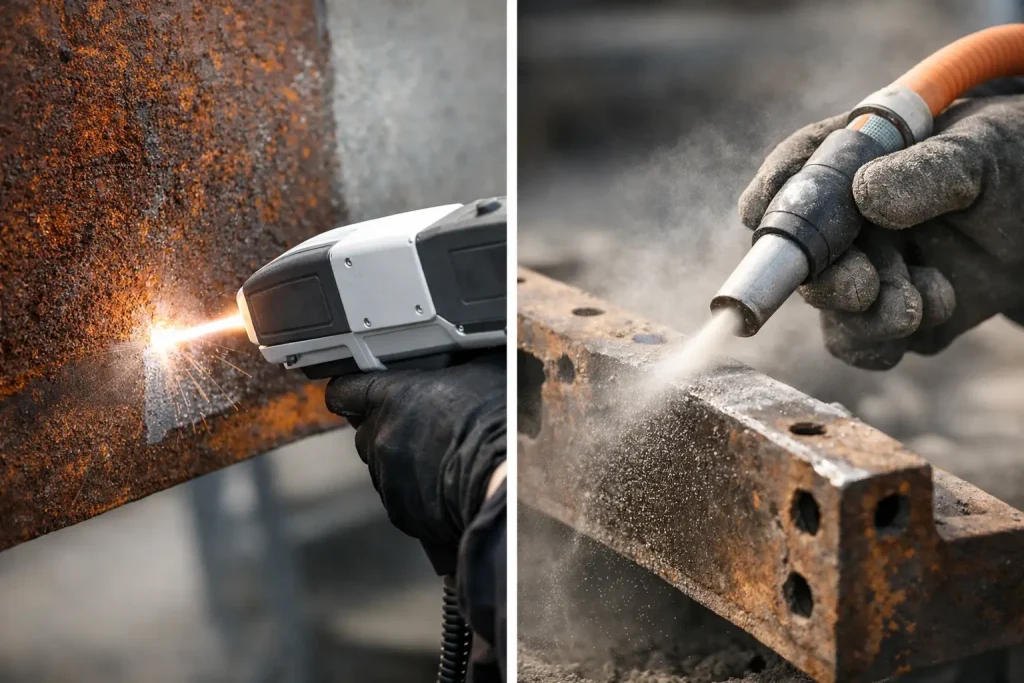
A corroded valve body, aging steel beam, or coated fabrication part may look like a straightforward cleaning job. The method chosen, however, can determine whether the work is completed in a controlled maintenance window or expands into containment, cleanup, disposal, and repair. When deciding between laser cleaning or media blasting, the right answer depends on the contaminant, base material, required finish, work environment, and consequences of getting the surface wrong.
For assets where precision, minimal waste, and substrate protection matter, laser cleaning offers clear advantages. Media blasting remains useful for broad, heavy-duty preparation work. The practical decision is not about choosing the newest technology. It is about matching the process to the job site and the asset.
How the Two Cleaning Methods Work
Laser cleaning uses controlled laser energy to ablate contaminants from a surface. Rust, oxides, paint, coatings, oil, grease, and other unwanted layers absorb the laser energy and are removed while the underlying material is left largely intact when the parameters are properly set. The operator can target a small area, follow a weld line, clean around geometry, or remove a specific layer without treating the entire component.
Media blasting propels an abrasive material, such as garnet, aluminum oxide, steel grit, glass bead, or other selected media, at the work surface. The impact breaks away corrosion and coatings while creating a physical surface profile. It is a familiar method for large steel structures, tanks, vessels, and components that need extensive coating removal or a specified anchor profile before repainting.
Both processes can prepare surfaces effectively. Their operational demands and risks are very different.
Laser Cleaning or Media Blasting: The Key Differences
Substrate protection and selectivity
The strongest case for laser cleaning is selective removal. Abrasive media does not distinguish between the contaminant and the base material in the same way a properly configured laser process can. On thin metal, machined surfaces, molds, precision parts, historic features, and sensitive equipment, blasting can alter dimensions, round edges, embed media, or create an unwanted surface profile.
Laser cleaning gives the operator greater control over how much material is removed and where. This is valuable when cleaning corrosion from a weld zone before inspection, removing coatings from a localized repair area, or restoring a heritage metal element where preserving original surface detail is essential.
That does not mean laser cleaning is always the preferred choice. If the project requires an aggressive, uniform profile across a large steel area for a new protective coating system, abrasive blasting may better meet the coating specification. The required surface standard should drive the choice, not the cleaning method alone.
Waste, containment, and housekeeping
Media blasting produces spent abrasive, removed coating material, and dust. Depending on the coating history and site conditions, that waste may require collection, testing, controlled disposal, and significant housekeeping. Containment can be necessary to protect nearby equipment, occupied areas, drainage systems, and personnel.
Laser cleaning produces no spent blasting media. Removed contaminants are typically captured through localized fume extraction and filtration. This reduces secondary waste and helps simplify work in plants, workshops, commercial properties, and areas where abrasive dust would be difficult to control.
For a maintenance team working near operating equipment, that difference can be substantial. Avoiding blast media migration reduces the risk of contamination entering moving parts, electrical panels, process equipment, or adjacent work areas. It can also reduce the labor required after the cleaning is complete.
Downtime and access
Blasting often requires a larger work envelope. Equipment must be staged, containment may be installed, the area may need to be isolated, and cleanup follows the actual blasting work. These steps are appropriate when the scale and specification justify them, but they can extend the shutdown period.
Laser cleaning equipment can be deployed with a smaller footprint and used for targeted work without a blasting enclosure in many situations. It is particularly effective for spot repairs, inspection preparation, welding preparation, localized coating removal, and maintenance tasks in constrained environments. Less setup can mean faster access to the asset and a shorter interruption to operations.
Access is still job-specific. A large elevated structure with widespread corrosion may favor a conventional blasting setup if productivity over a broad area is the primary concern. Laser cleaning is often most compelling where only the affected area needs treatment or where access and containment are the real project constraints.
Surface finish and preparation requirements
A clean surface is not automatically a coating-ready surface. Coating manufacturers and project specifications may require a defined cleanliness level and surface profile. Media blasting is widely used because it can remove heavy coatings while creating mechanical tooth for subsequent coating adhesion.
Laser cleaning can remove contaminants with exceptional precision, leaving the original surface profile largely unchanged. That is an advantage when the profile must be preserved, but it may not fulfill a specification that calls for a newly generated anchor profile. In those cases, a project may use laser cleaning for localized removal and inspection work, then use another approved process where profile creation is required.
Before selecting either method, confirm the coating system, required surface profile, cleanliness standard, and inspection criteria. This prevents a common and costly mistake: cleaning the component well, but not preparing it to the actual specification.
Where Laser Cleaning Delivers the Greatest Value
Laser cleaning is well suited to work where precision outweighs raw square-footage speed. Common applications include corrosion removal around welds and flanges, pre-weld cleaning, removal of paint or oxides from fabricated parts, mold and tooling maintenance, surface preparation for inspection, and controlled restoration of architectural metalwork or artifacts.
It is also a practical option where chemical stripping would introduce disposal and worker-exposure concerns. Instead of using solvents or acids, the process removes the unwanted surface layer with controlled light energy and captures the resulting particulates. For asset owners focused on environmental performance, this can reduce the waste burden associated with both chemicals and blasting media.
BKR Engineering applies laser ablation as a field-ready service rather than a one-size-fits-all replacement for traditional methods. The objective is to remove what must go while protecting what must remain, whether the work involves industrial equipment, construction assets, or sensitive restoration surfaces.
When Media Blasting Is Still the Better Choice
Media blasting remains a proven choice for extensive coating removal across large, accessible steel surfaces. It is often effective when the job calls for a specific blast profile, the substrate is sufficiently durable, and the site can accommodate containment and waste management.
For example, a large structural steel package being prepared for a full recoating campaign may benefit from blasting because the entire surface needs consistent preparation. The same may be true for components with thick, tightly bonded coatings or heavy scale across a wide area, provided the project team has planned for dust control, media recovery, and disposal.
The decision should also account for the surroundings. Blasting in a fabrication yard differs greatly from blasting beside live plant equipment, inside a commercial building, or near protected finishes. A method that is efficient in an open yard can create unacceptable risk in a confined or sensitive location.
Questions to Ask Before Selecting a Method
Start with the condition of the asset. Is the material thick structural steel, thin sheet metal, stainless steel, aluminum, a machined component, or a heritage element? Then identify the contaminant and its extent. Light oxidation around a weld requires a different approach than multiple layers of aged industrial coating.
Next, clarify what the cleaned surface must achieve. Is the purpose visual restoration, nondestructive testing, welding, localized repair, full recoating, or contamination removal? If a coating specification applies, establish the required profile and cleanliness standard before work begins.
Finally, assess the job environment. Consider nearby operations, ventilation, accessibility, allowable downtime, waste handling requirements, and whether abrasive dust or chemicals can be safely managed. These practical constraints frequently determine the lowest-risk and most cost-effective option.
The Best Method Is the One That Protects the Asset
Comparing laser cleaning and media blasting only by hourly rate can lead to the wrong decision. The real cost includes containment, shutdown duration, waste disposal, rework risk, cleanup, access limitations, and the potential impact on the substrate. A lower-cost cleaning process can become expensive if it damages a precision surface or forces a longer plant outage.
For broad, profile-critical steel preparation, media blasting may be the appropriate solution. For controlled removal near sensitive assets, confined work areas, inspection zones, or restoration surfaces, laser cleaning can reduce disruption while delivering a highly visible, precise result. The most useful next step is a site-specific assessment of the surface, specification, and operating constraints before committing the asset to either process.