
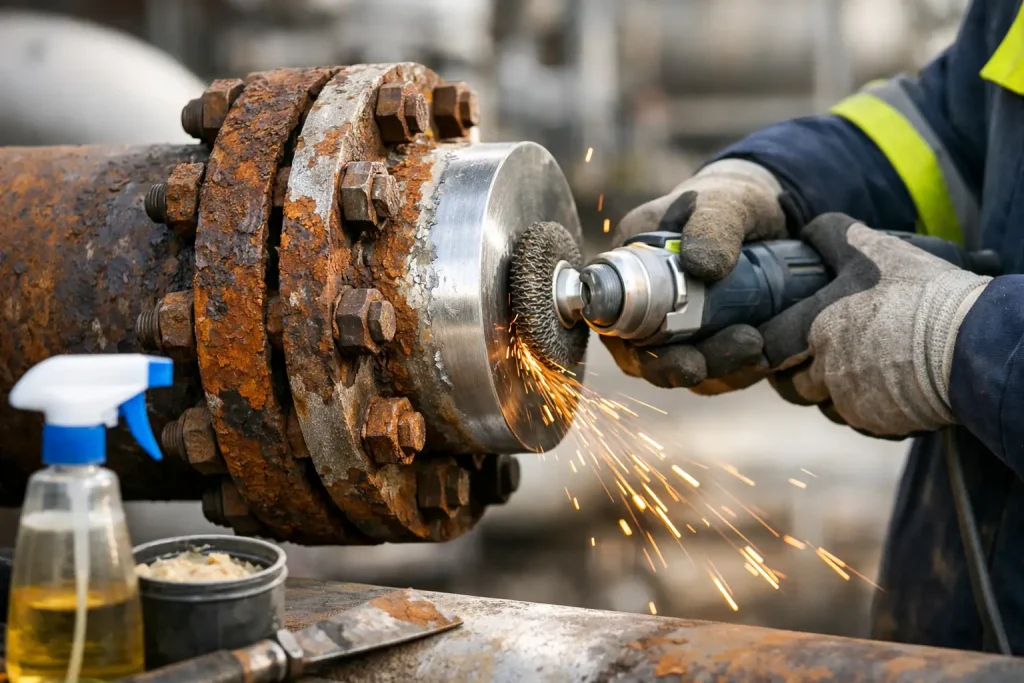
Corrosion rarely waits for a convenient shutdown window. It shows up on piping, structural steel, tanks, flanges, marine components, and heritage metalwork at the exact moment when asset reliability, inspection readiness, and surface condition start affecting cost. That is why the corrosion removal process matters so much – not as a cosmetic task, but as a controlled maintenance decision that can either protect an asset or create new problems.
For plant managers, contractors, and asset integrity teams, the real question is not whether corrosion should be removed. It is how to remove it thoroughly enough to restore function or prepare for coating, without cutting into the base material, spreading contamination, or extending downtime. The right answer depends on the substrate, the corrosion type, the surrounding environment, and what happens after cleaning.
What the corrosion removal process is really meant to achieve
A good corrosion removal process does more than strip visible rust. It restores a surface to a condition suitable for the next step, whether that is inspection, welding, recoating, repair, or continued service. In practice, that means removing oxides, salts, degraded coating residues, and embedded contaminants to a defined standard while preserving the underlying substrate.
That last point is where many projects go wrong. Aggressive cleaning can appear effective because the surface looks bright, but the method may also roughen soft metals, distort thin sections, remove too much parent material, or drive up containment and cleanup requirements. On high-value assets, surface preparation is not just about speed. It is about control.
Common corrosion removal methods and where they fit
The traditional corrosion removal process usually falls into a few categories. Mechanical methods such as wire brushing, grinding, needle scaling, and abrasive blasting are widely used because they are familiar and can be effective on heavy corrosion. They also come with trade-offs. Grinding and needle scaling can be labor-intensive and uneven, while blasting may require significant masking, enclosure setup, media handling, and post-job cleanup.
Chemical cleaning is another option, especially where complex geometry or large affected areas make manual cleaning difficult. The challenge is that chemicals introduce their own handling, disposal, and safety requirements. Residue control also matters. If the surface is not neutralized or cleaned correctly after treatment, the next coating system may be compromised.
Laser cleaning has become a strong alternative where precision, substrate protection, and operational control matter most. Instead of impacting the surface with abrasive media or dissolving corrosion with chemicals, laser ablation removes contaminants selectively. That makes it especially useful for localized corrosion, sensitive substrates, weld areas, inspection preparation, and jobs where surrounding equipment must remain protected.
No method is universally best. Heavy section steel in an open yard may tolerate blasting well. A delicate heritage feature, precision fabrication component, or in-service industrial area often requires a more selective approach.
Key steps in an effective corrosion removal process
Every successful corrosion removal process starts with assessment. Before any tool is selected, the team needs to understand the substrate material, corrosion depth, extent of contamination, access limitations, and the required end condition. Surface cleaning for repainting is different from cleaning for crack detection, and both differ from restoration work on decorative or historical metal surfaces.
The next step is method selection. This should be based on removal quality, substrate sensitivity, environmental controls, and schedule impact. If the job is inside an operating plant, secondary waste and dust generation may matter as much as removal rate. If the asset has tight tolerances, the cleaning method must be precise enough to avoid material loss.
Surface preparation then moves into controlled execution. This is where process discipline counts. Operators need to work consistently across the affected area, monitor the surface response, and avoid overcleaning. With abrasive methods, that means managing pressure, media type, standoff distance, and dwell time. With laser cleaning, it means calibrating the beam and scan pattern to remove corrosion while leaving sound base material intact.
After removal, inspection confirms whether the target condition has been achieved. This may include visual checks, surface profile verification, contamination testing, or preparation for NDT and recoating. Too many maintenance failures are traced back not to coating quality, but to poor surface preparation that was accepted too early.
Finally, the cleaned surface must be protected quickly if it is not returning directly to service. Flash rust, moisture exposure, and airborne contamination can undo good work in a short period, especially in humid or coastal environments.
Why surface selectivity matters more than many teams expect
Corrosion does not always sit neatly on top of a surface. It can mix with coating breakdown, oil residue, chloride contamination, and previous repair materials. That is why blunt-force cleaning methods sometimes create more work downstream. A surface may look clean, yet still retain contaminants that affect coating adhesion or inspection quality.
Selective removal helps solve that problem. When the cleaning process can target corrosion and contamination without aggressively attacking the parent material, the result is more predictable. This is especially valuable for stainless steel, aluminum, molds, tooling, fabricated assemblies, and assets with complex geometry.
Laser cleaning stands out here because it allows a high degree of control over what is removed and what is left behind. In industrial maintenance, that can mean preparing a weld zone, cleaning oxidation from a flange face, removing rust from structural members, or exposing a surface for inspection with minimal disruption to adjacent areas. For restoration work, it can mean removing corrosion from decorative metal or heritage features without the broad abrasion that traditional methods often cause.
Cost is not just about the cleaning method
A narrow cost comparison often misses the bigger picture. The cheapest cleaning method on paper can become the most expensive once containment, cleanup, production delay, waste disposal, and rework are included. This is where decision-makers need to look beyond hourly rates.
For example, abrasive blasting may remove corrosion quickly on large open surfaces, but it can also require enclosure construction, media recovery, dust control, and plant isolation. Chemical cleaning may reduce manual effort, but transport, storage, PPE, and hazardous waste disposal add complexity. Mechanical grinding can appear simple, yet it often slows dramatically on detailed surfaces and can leave inconsistent results.
A more controlled corrosion removal process may carry a different upfront cost, but still lower total project cost by reducing shutdown time, limiting damage risk, and cutting waste handling. That trade-off is often favorable in oil and gas, fabrication, infrastructure maintenance, and occupied commercial environments where schedule certainty matters.
When laser cleaning is the better corrosion removal process
Laser cleaning is not positioned as a replacement for every conventional method. It is most effective where precision and site control are priorities. That includes localized corrosion removal, cleaning around sensitive equipment, preparing surfaces for inspection, treating areas where substrate loss is unacceptable, and working in environments where blasting media or chemical runoff would create operational problems.
It is also a strong fit for projects where visual quality matters. The process produces a clear, controlled cleaning effect, which is useful for asset owners who need confidence in the treated area and for project stakeholders who want to see measurable progress without collateral damage.
For service-led providers like BKR Engineering, the value is not just the equipment. It is the ability to assess the surface correctly, set the right cleaning parameters, and deliver field execution that aligns with maintenance, safety, and environmental requirements. The technology is precise, but results still depend on operator experience and job planning.
Choosing the right process for your asset
The best corrosion removal process is the one that matches the asset, the environment, and the objective after cleaning. If the substrate is thick and the work area is isolated, a conventional method may be practical. If the surface is sensitive, the access is restricted, or the project cannot tolerate dust, waste, or unnecessary material loss, a more selective approach is usually the better call.
A useful way to frame the decision is to ask four questions. What must be removed? What must remain untouched? What site controls are acceptable? What happens immediately after cleaning? Those answers will often narrow the field quickly.
Corrosion removal should never be treated as a basic prep task. On critical assets, it is a reliability decision, a safety decision, and often a cost-control decision as well. The teams that get the best results are usually the ones that treat surface preparation with the same discipline they apply to inspection, repair, and return-to-service planning.
If you are evaluating options, focus less on tradition and more on control. The cleaner the process fit, the better the outcome for the asset and the operation around it.