
A coating failure rarely starts with the coating. It usually starts with what was left behind – rust in the profile, oil in the pores, old paint at the edge, or heat tint around a weld. That is why any industrial surface preparation guide worth using has to begin with the same point: the surface condition determines the result.
For plant managers, fabricators, and asset integrity teams, surface prep is not a cosmetic step. It affects coating adhesion, inspection quality, weld integrity, corrosion control, and project duration. When the surface is cleaned correctly, downstream work moves faster and performs longer. When it is rushed or mismatched to the substrate, rework shows up later as blistering, poor bond strength, contamination findings, or avoidable downtime.
What an industrial surface preparation guide should actually help you decide
The real job of surface preparation is to create a stable, clean, and suitable surface for the next process. That next process might be coating, welding, inspection, bonding, restoration, or precision cleaning. The correct method depends on what must be removed, how much base material can be disturbed, and what happens immediately after cleaning.
This is where many projects go off track. Teams often choose a method based only on speed or familiarity. Abrasive blasting may be effective for heavy corrosion and large open steelwork, but it may also generate dust, media waste, and containment requirements that complicate work in active facilities. Chemical cleaning may dissolve contaminants well, but it can introduce disposal, worker exposure, and residue concerns. Mechanical tools are accessible and common, yet they may struggle with consistency on detailed geometries or risk overworking the surface.
A better approach is to define the required outcome first. Do you need anchor profile for a new coating system? Do you need selective coating removal without harming the base metal? Are you preparing a weld area, exposing a defect for inspection, or cleaning a heritage surface where material loss is unacceptable? The answer changes the method.
Start with the contaminant, not the equipment
Surface preparation becomes much more predictable when you identify the contaminant layer before selecting the tool. Rust, mill scale, paint, oxide films, oil, grease, carbon deposits, chlorides, and process residues all behave differently. Some sit on the surface. Some penetrate irregularities. Some require removal to a visual standard, while others demand tighter control because even small traces can interfere with coating or testing.
Oil and grease are a common example. If they are not addressed early, later cleaning steps can spread contamination rather than remove it. Corrosion products create another challenge. Light flash rust and deeply packed scale do not respond the same way, and treating them as if they do often wastes time.
The substrate matters just as much. Carbon steel can tolerate preparation methods that would be too aggressive for stainless steel, aluminum, stone, or historically significant materials. If the job calls for precision, selective removal, or low-impact cleaning, the preparation method has to match that requirement rather than force the surface to fit the equipment.
Industrial surface preparation guide for common methods
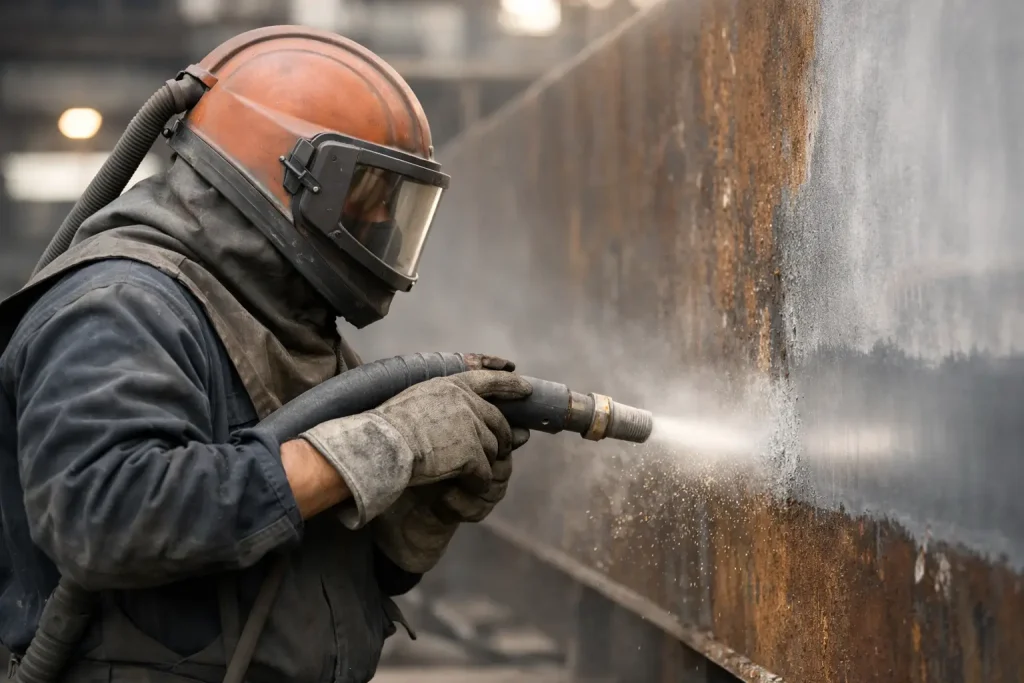
Abrasive blasting remains a well-established choice for heavy-duty preparation, particularly where a coating profile is required on large steel surfaces. It can remove corrosion, old coatings, and scale efficiently, but it also brings practical trade-offs. Containment, cleanup, media handling, visibility issues, and disruption to nearby operations can all affect total project cost more than the blasting itself.
Mechanical surface preparation, such as grinding, sanding, needle scaling, and rotary tools, is useful for localized work and areas where access is limited. It is often practical for spot repairs, weld cleanup, and smaller maintenance scopes. The limitation is consistency. The result can vary by operator, tool condition, and access angle, which matters when strict surface standards or repeatability are required.
Chemical cleaning can be effective where specific contaminants need to be dissolved or loosened, especially in applications involving oils, residues, or oxide layers. The trade-off is that chemical use introduces handling controls, ventilation considerations, rinse management, and waste disposal requirements. It may also be unsuitable where environmental restrictions or sensitive assets are involved.
Laser cleaning has become increasingly relevant where selective removal, substrate protection, and reduced secondary waste are priorities. It uses controlled laser ablation to remove contaminants such as rust, oxides, coatings, paint, oil, and grease with a high degree of precision. For many maintenance and restoration tasks, this means cleaning the unwanted layer while preserving the base material underneath. In active plants, fabrication environments, and sensitive restoration work, that control can reduce setup, minimize disruption, and support faster return to service.
No single method is best in every case. If the requirement is broad-area profile generation for a heavy coating system, blasting may still be the right fit. If the requirement is targeted cleaning around a weld seam, precision inspection prep, or coating removal in an operating facility where dust and waste are a problem, laser cleaning may offer a better operational outcome.
Why surface standards and inspection still matter
Even the best cleaning method fails if the acceptance criteria are vague. Surface preparation should be tied to a measurable target, whether that is cleanliness level, visible contaminant removal, coating edge definition, or readiness for NDT, welding, or recoating.
Visual checks are the starting point, but they are not always enough. Depending on the service environment, teams may also need to verify remaining contamination, surface profile, surface temperature, or time-to-coat window. A clean-looking surface is not automatically a prepared surface.
This is particularly important in corrosion maintenance and coating projects. If salts, oils, or oxidation remain, the coating may fail long before its expected service life. If the substrate is roughened too much or too little, adhesion can also suffer. Good preparation is not just removal. It is control.
When laser cleaning changes the economics of the job
The value of laser cleaning is not limited to the cleaning action itself. In many industrial environments, the real savings come from what the process avoids. There is less need for blasting media logistics, less cleanup, no chemical runoff, and often far less containment than traditional methods require. That can make a major difference in plants where shutdown windows are short or adjacent systems must stay protected.
This is one reason laser cleaning has gained attention in oil and gas, infrastructure maintenance, fabrication, and property restoration. It supports controlled removal with minimal damage to the substrate, which is critical when preparing weld zones, removing localized corrosion, exposing crack indications, or cleaning sensitive stone and metal surfaces.
For decision-makers, the trade-off is straightforward. Laser cleaning may not replace every conventional method across every square foot of production work. But where precision, safety, environmental control, and reduced downtime are high priorities, it often improves the total project equation. That is why specialized providers such as BKR Engineering are increasingly involved early in planning, not just brought in after conventional options create constraints.
How to choose the right preparation method for your site
A practical decision starts with five questions. What exactly must be removed? What substrate must be protected? What standard must the finished surface meet? What site constraints apply around dust, waste, access, and downtime? And what downstream process depends on the result?
Those questions sound basic, but they prevent expensive mismatches. A contractor focused only on removal speed may recommend an aggressive process that creates disposal and containment issues. A team focused only on low upfront cost may end up with more downtime, more rework, or greater risk to the substrate. The right method is the one that meets the surface requirement with the fewest operational penalties.
That is especially true in live industrial environments. If nearby equipment must remain in service, if the work area is hard to isolate, or if environmental controls are strict, preparation needs to be evaluated as part of the wider maintenance plan. Surface prep is not separate from operations. It is part of operations.
The best results come from planning the next step early
Surface preparation works best when it is planned backward from the final objective. If coating follows, prep should match coating requirements and application timing. If inspection follows, the cleaning method should expose defects without masking or damaging them. If restoration follows, the process should remove contamination while preserving the original material.
That is the difference between cleaning a surface and preparing it. Preparation is intentional. It balances removal efficiency, substrate protection, safety, environmental responsibility, and the demands of the next task. When those factors are aligned, the result is not just a cleaner surface. It is a more reliable project, with fewer surprises after the work is supposed to be done.
If you are evaluating a surface prep strategy, the most useful question is not which method is most familiar. It is which method gives you the cleanest path to performance, without creating new problems around waste, damage, or downtime.