
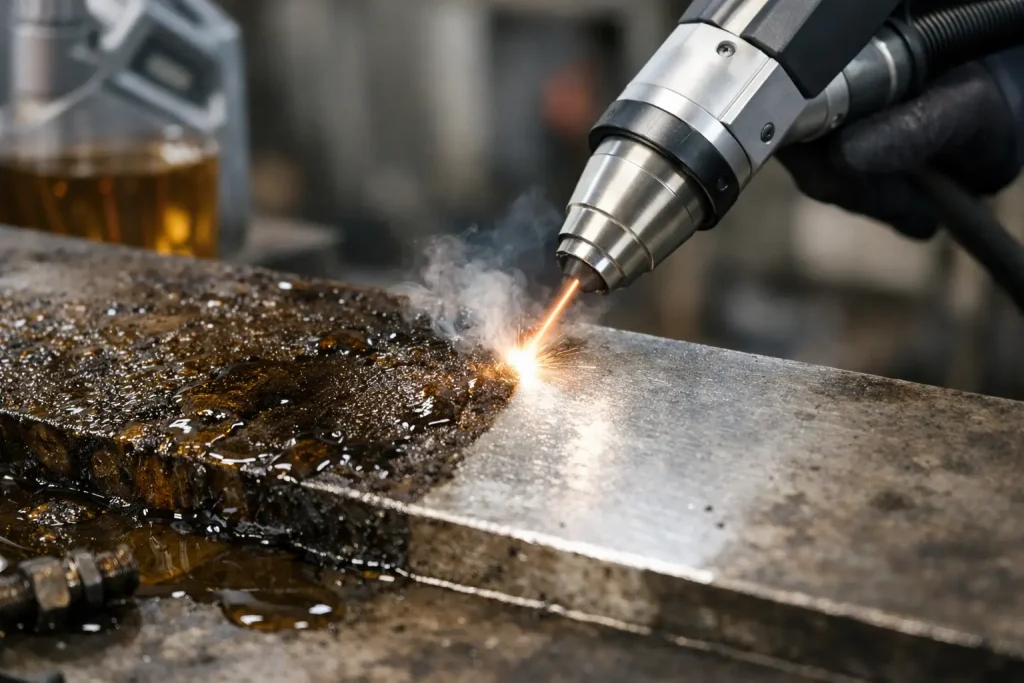
Oil contamination looks simple until it starts interfering with production, inspection, coating adhesion, or weld quality. That is usually when the real question comes up: can laser cleaning remove oil in a practical, repeatable way, or is it better reserved for rust, paint, and oxide removal?
The short answer is yes, laser cleaning can remove oil, but the right answer is more specific. It depends on the type of oil, the thickness of the contamination, the condition of the surface, and what the next process requires. In many industrial settings, laser cleaning is highly effective for thin oil films, greasy residues, carbonized deposits, and mixed contamination layers. For heavy pooled oil or actively wet surfaces, it is often most effective as part of a broader surface preparation strategy rather than the only step.
Can laser cleaning remove oil on its own?
In many cases, yes. Laser cleaning works by directing controlled energy onto the contaminated surface so the unwanted layer absorbs that energy and is broken down, vaporized, or detached from the substrate. When the settings are properly matched to the contamination and base material, oil and grease can be removed without aggressive abrasion and without damaging the underlying metal.
That matters in environments where surface integrity is not negotiable. Maintenance teams working on machined components, weld zones, stainless surfaces, heritage metals, or production equipment cannot afford overcleaning. Chemical cleaning can leave residues. Abrasive methods can alter profile or remove sound material. Laser cleaning gives a narrower, more controlled cleaning window.
Where laser cleaning performs best is with thin to moderate contamination that must be selectively removed. If the oil layer is bonded with dust, oxidation, coating residue, or process deposits, laser cleaning can often deal with the full contamination stack more precisely than conventional methods.
When laser cleaning removes oil well
The most successful oil removal applications usually share one thing: the contamination is on the surface, not deeply absorbed into a porous material. On metal parts, tools, molds, weld joints, flanges, tanks, and fabricated assemblies, laser cleaning can remove oil films and greasy residues efficiently while keeping the substrate intact.
This is especially useful before coating, inspection, NDT, welding, or adhesive bonding. A surface may look clean to the eye and still fail in service because residual oil interferes with adhesion or masks flaws. Laser cleaning helps prepare a more reliable surface while reducing secondary waste.
In industrial service environments, laser cleaning is also valuable when oil contamination appears together with rust, mill scale, oxides, or paint remnants. Instead of switching between multiple cleaning systems, operators can often use laser parameters tailored to remove targeted layers in sequence. That improves control and can reduce shutdown time.
Where the answer becomes it depends
Not all oil contamination behaves the same way. Fresh lubricating oil on a smooth steel plate is very different from thick grease baked onto a hot component over time. Likewise, oil sitting on a flat accessible panel is easier to address than oil trapped in pits, seams, threads, or porous cast surfaces.
This is where project assessment matters. If a component is heavily saturated, laser cleaning may still be the right method, but not necessarily as the first step. Free liquid oil may need to be wiped, drained, or mechanically removed before laser treatment. Once the bulk contamination is gone, laser cleaning can handle the residual film and prepare the surface to specification.
Surface geometry matters too. Laser cleaning is precise, but access and angle affect efficiency. Complex assemblies with recesses or internal spaces may require a combination of methods. For a maintenance leader or plant manager, that is not a drawback. It is simply the practical reality of selecting the right process for the actual condition in the field.
Why laser cleaning is different from solvents and blasting
Traditional degreasing often relies on solvents, alkaline cleaners, or detergents. These can be effective, but they also create handling requirements, disposal issues, ventilation concerns, and the risk of residue left behind. In regulated industrial environments, those factors can drive cost and delay even when the cleaning itself seems straightforward.
Abrasive blasting is another option, but it is usually a poor fit when the goal is only oil removal or when substrate preservation matters. Blasting can spread contamination, generate large waste volumes, and require containment that slows the job. It is also less selective on sensitive surfaces.
Laser cleaning changes that equation by reducing consumables and limiting collateral impact. There is no blasting media to recover, no chemical runoff to manage, and no need to treat every surface as if it can tolerate aggressive contact. For asset owners focused on uptime, safety, and environmental performance, those are operational advantages, not just technical features.
Can laser cleaning remove oil before welding or coating?
Yes, and this is one of the strongest use cases.
Before welding, oil residue can lead to porosity, smoke generation, inconsistent arc behavior, and contamination in the joint area. Laser cleaning can prepare localized weld zones with high precision, removing oil and associated surface films while avoiding unnecessary cleaning outside the target area.
Before coating, even small traces of oil can undermine adhesion. A surface may pass a visual check and still fail later because contamination remains at a microscopic level. Laser cleaning supports better coating performance by removing residues without embedding contaminants into the surface, which can happen with less controlled methods.
For fabrication shops and maintenance teams, this level of control is often the deciding factor. It is not only about making a surface look cleaner. It is about creating a surface that performs predictably in the next process step.
How operators determine if laser cleaning is the right fit
The decision usually comes down to four factors: contamination type, surface material, access, and cleanliness standard.
If the contamination is a thin oil film on metal and the next step demands a clean, residue-free surface, laser cleaning is often a strong fit. If the contamination is heavy grease mixed with particulates, the process may still work very well, but throughput and setup need to be evaluated against the required outcome. If the substrate is sensitive, high-value, or dimensionally critical, laser cleaning becomes even more attractive because of its non-contact, controlled nature.
The cleanliness target matters just as much. If the goal is basic housekeeping, many methods can work. If the goal is preparation for coating, restoration, inspection, or precision manufacturing, the value of controlled laser ablation becomes much clearer.
Experienced service providers will typically assess a sample area first. That allows them to confirm removal rate, substrate response, and finish quality before scaling to the full scope. In practice, this is where confidence is built – not through theory, but through visible results on the actual asset.
Practical expectations for oil removal with laser cleaning
Laser cleaning is not a shortcut that ignores process conditions. It is a precision cleaning method, and precision works best when expectations are aligned with the contamination profile.
For light oil, residue, and greasy films, results can be fast and highly consistent. For thicker contamination, there may be a staging step before laser cleaning begins. For mixed contamination, laser cleaning can offer a major advantage by selectively removing oil, oxides, coatings, or carbonized layers with less risk to the base material.
This is one reason companies in oil and gas, infrastructure maintenance, fabrication, and restoration are adopting the method more seriously. They are not looking for novelty. They are looking for repeatable cleaning performance that reduces waste, protects assets, and supports the next operation without unnecessary downtime.
BKR Engineering has seen that the most successful projects start with the right question. Not simply can laser cleaning remove oil, but what type of oil, on what surface, and to what finish requirement.
That is the practical way to evaluate any cleaning method. If oil removal needs to be precise, substrate-safe, and easier to manage from a safety and waste standpoint, laser cleaning is often a very strong option. The best next step is to judge it by tested results on the actual surface, because that is where good maintenance decisions become reliable ones.