
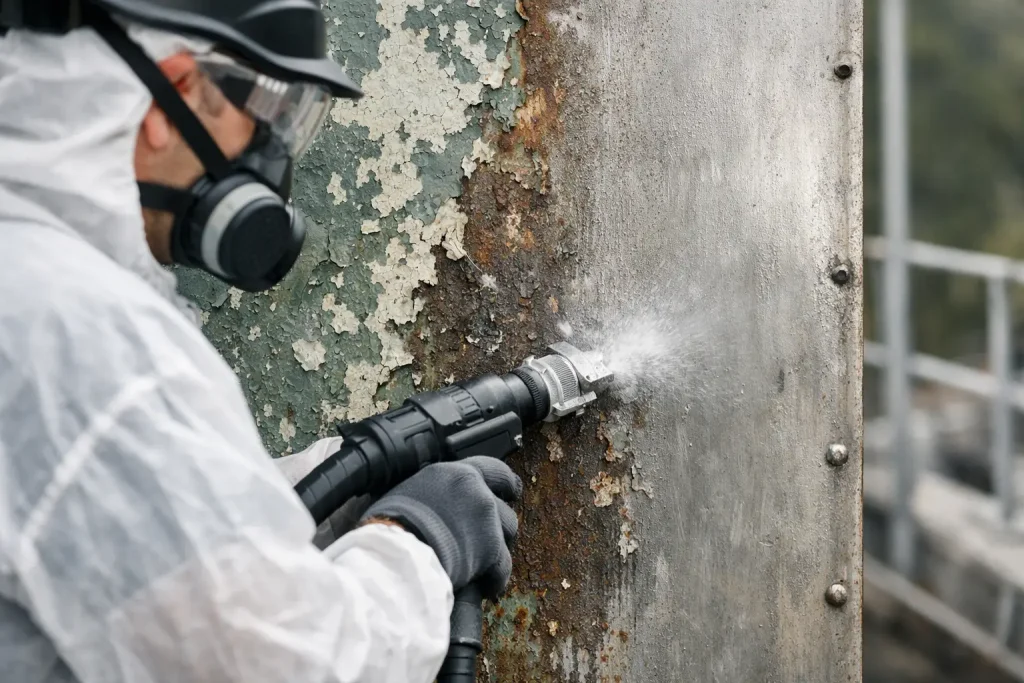
When a shutdown window is tight and the substrate cannot be sacrificed, coating removal without blasting stops being a preference and becomes a project requirement. That is especially true on assets where abrasive media, containment buildout, secondary waste, or surface profile variation can create more problems than the coating itself. In those cases, the question is not simply how to strip a surface. It is how to remove the right layer, leave the right material behind, and keep the job moving safely.
Why coating removal without blasting is gaining ground
Traditional blasting still has a place in industry, particularly where large-area production rates and aggressive profile creation are the main priorities. But many maintenance, restoration, and inspection-preparation jobs are not that simple. Plant equipment often sits near live operations. Sensitive substrates cannot tolerate over-removal. Owners want less mess, less shutdown impact, and fewer waste-handling complications.
That is where non-blasting methods have moved from niche option to practical solution. Instead of using abrasive force to break down the coating, these methods rely on thermal, chemical, or mechanical action with more control over what is removed. The operational benefit is straightforward: better selectivity, cleaner work zones, and less risk of damaging the base material.
For asset owners and contractors, the biggest shift is strategic. Surface preparation is no longer judged only by how fast a coating disappears. It is judged by the total job outcome – substrate protection, containment requirements, labor intensity, downstream inspection quality, and how much disruption the process creates around the work area.
The main options for coating removal without blasting
There is no single best method for every coating system. The right choice depends on the coating type, thickness, adhesion level, substrate sensitivity, access constraints, and what needs to happen after removal.
Laser cleaning
Laser cleaning uses controlled laser energy to ablate coatings and surface contaminants. In practical terms, it can remove paint, oxides, rust, residues, and selected coatings with a high degree of precision while limiting impact on the underlying substrate. That matters on machined parts, heritage surfaces, weld zones, and high-value assets where dimensional integrity or surface condition must be preserved.
It also changes site logistics. Because there is no abrasive media to recover, transport, and dispose of, housekeeping is reduced. Containment requirements may also be simpler than blasting, depending on the application and environment. For many industrial operators, that translates into shorter setup time and less interference with adjacent work.
Laser cleaning is not a magic answer for every square foot of coating on every structure. Productivity depends on the coating chemistry, thickness, bond strength, and target cleanliness standard. On heavily built-up systems across very large open areas, another method may still be more economical. But when precision, selective removal, and reduced waste matter most, laser cleaning is often the stronger option.
Chemical stripping
Chemical removers can be effective on certain paints, adhesives, and layered coating systems, particularly where abrasive action is unsuitable. They can work well on complex shapes and detailed surfaces because the chemistry reaches corners and irregular geometry that tools may miss.
The trade-off is process control. Dwell time, coating compatibility, residue removal, ventilation, and waste handling all need careful management. In industrial settings, chemical use can introduce safety restrictions and disposal obligations that narrow the apparent cost advantage. If the job is inside an operating facility, those constraints tend to become even more important.
Mechanical removal
Mechanical methods include scraping, grinding, needle scaling, and rotary tools. These can be practical for localized coating failure, spot repair, and edge work. They are familiar to most maintenance teams and can be deployed quickly without specialized setup.
The limitation is consistency. Mechanical tools can leave variable surface conditions and may damage softer or more delicate substrates if used aggressively. They also create operator fatigue on larger jobs and can be inefficient where precision matters more than brute force. For selective coating removal, they are often useful as part of a broader process rather than the whole solution.
Dry ice and other specialty methods
Dry ice cleaning can remove some contaminants and coatings while leaving no blasting media behind. It has advantages where residue minimization is important, but effectiveness varies significantly by coating type and bond strength. Other specialty methods exist as well, yet most are best viewed as application-specific tools rather than broad replacements for blasting.
Where laser cleaning stands out
In real project conditions, the value of laser cleaning shows up in the margins that affect schedule, safety, and rework. It is not only about removing a coating. It is about doing so with tight control over the result.
Sensitive or high-value substrates
If the base material is thin, machined, historic, or otherwise vulnerable, blasting may be too aggressive. Laser cleaning allows selective removal with minimal substrate loss, which helps protect dimensional tolerances, original surface character, and weld integrity.
Inspection and maintenance preparation
Sometimes the goal is not full production-scale stripping. It is preparing an area for NDT, corrosion assessment, welding, or recoating. In those situations, fast local access and clean removal often matter more than broad-area throughput. Laser cleaning can be particularly effective when teams need targeted access without expanding the work scope.
Live or constrained environments
In construction, oil and gas, process facilities, and occupied properties, blasting can trigger containment, access, and shutdown complications. A controlled non-abrasive method can reduce disruption around the work zone and simplify project planning. That is one reason coating removal without blasting has become more relevant for owners balancing maintenance needs with ongoing operations.
Sustainability and waste reduction
Abrasive media and chemical residues create handling and disposal obligations that directly affect project cost and environmental exposure. Laser cleaning reduces those burdens by avoiding consumable blasting media and minimizing secondary waste. For companies tracking sustainability targets, that is not a branding point. It is an operational advantage.
What decision-makers should evaluate before choosing a method
The right process starts with the job objective, not the tool. If the requirement is full removal to a specified standard before recoating, the selected method must reliably meet that surface condition. If the aim is localized repair, inspection access, or contamination removal, precision may matter more than maximum area rate.
Coating composition is another critical factor. Epoxies, urethanes, bituminous systems, powder coatings, and multi-layer paint stacks respond differently to heat, abrasion, and chemistry. Thickness also changes the economics. A thin failing coating on stainless steel is a different job from decades of layered coating on structural steel.
Then there is the substrate. Carbon steel, aluminum, copper alloys, stone, concrete, and heritage materials all have different tolerance levels. A method that is acceptable on one surface may be unacceptable on another. This is where practical field experience matters. The removal process should be matched not only to the coating but also to the consequence of substrate damage.
Access, ventilation, shutdown limitations, and waste management should also be priced into the decision from the start. A method that looks cheaper on a rate-per-square-foot basis can become more expensive once containment, cleanup, disposal, and schedule risk are included.
Why service execution matters as much as the technology
Advanced equipment alone does not guarantee a good result. Coating removal quality depends on setup, parameter control, operator judgment, and a clear understanding of the asset condition. The most successful projects begin with a realistic assessment of the coating system, the substrate, and the required finish.
That is especially true with laser cleaning. Its strength is precision, but precision has to be applied correctly. Pulse settings, scan speed, stand-off distance, and work sequencing all influence performance. When those factors are controlled properly, the process can deliver clean, repeatable outcomes with less collateral impact than conventional alternatives.
For owners and contractors, that means the service partner should be able to explain not just what technology is being used, but why it fits the specific job. BKR Engineering has built its work around exactly that approach – controlled laser ablation applied to real maintenance, restoration, and production challenges where downtime, waste, and substrate protection all matter.
Coating removal without blasting is not all-or-nothing
The smartest projects often use hybrid thinking. Laser cleaning may handle selective removal, edge detail, sensitive zones, or inspection areas, while other methods address broader production surfaces where precision is less critical. That kind of process planning usually delivers better overall value than forcing one method to do everything.
For decision-makers, the real advantage is flexibility. You do not need to choose between speed and control in absolute terms. You need the method, or combination of methods, that matches the asset, the coating, and the project constraints.
If a coating has to come off but the substrate, schedule, and surrounding environment still have to be protected, that is where better removal strategy starts – not with more force, but with more control.