
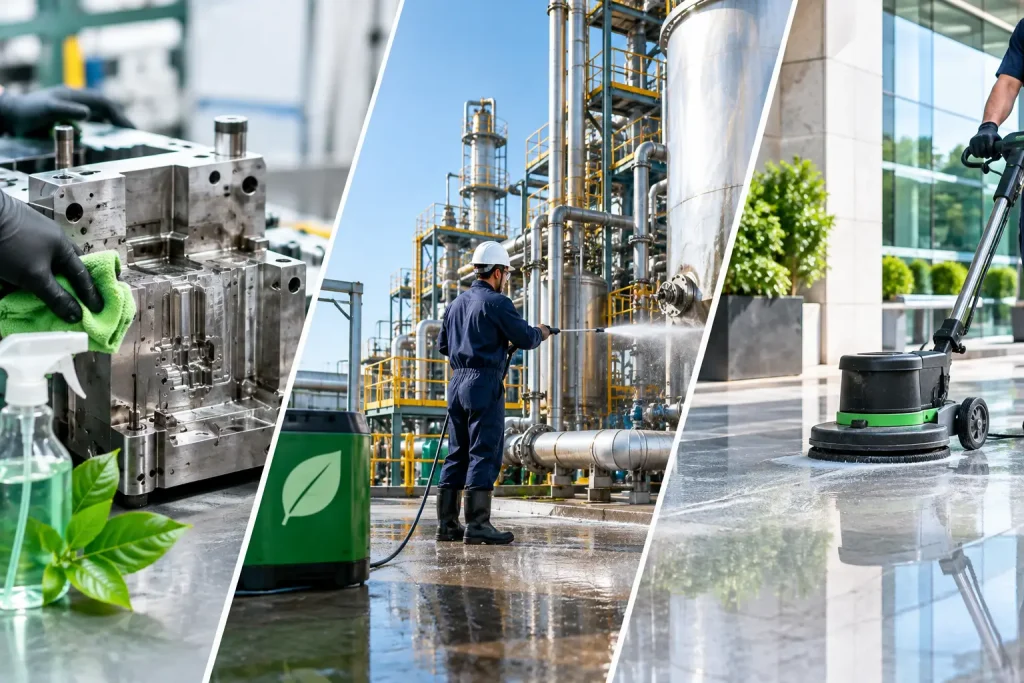
A greasy surface can obscure corrosion, compromise inspection results, and prevent a repair coating from adhering as intended. Eco friendly degreasing is therefore not simply a matter of choosing a milder cleaning product. For industrial and commercial assets, it means selecting a preparation method that removes the relevant contamination, protects the underlying material, and keeps secondary waste manageable.
For maintenance teams, the practical question is not whether a method is labeled green. It is whether it can prepare a specific surface to the condition required for inspection, restoration, repair, or continued service. That decision depends on the contaminant, substrate, access conditions, and acceptance standard.
What Eco Friendly Degreasing Should Achieve
Traditional degreasing often relies on solvents, alkaline chemicals, emulsifiers, rinsing, and absorbent materials. These methods can be appropriate in defined circumstances, but they may create liquid waste, introduce drying time, and require careful control around sensitive equipment or confined areas.
An environmentally considered approach aims to reduce unnecessary chemical use and avoid transferring contamination from the surface into a wash stream. It should also make it easier to collect and characterize the removed residue. That does not mean every application can be completed without chemicals or without waste. Oils, greases, degraded coatings, salts, corrosion products, and process residues each behave differently.
The required finish matters just as much. A surface being cleaned for a visual assessment may need a different result from one being prepared for ultrasonic testing, magnetic particle inspection, coating repair, or heritage restoration. Defining that outcome at the start prevents a cleaning scope from becoming either insufficient or unnecessarily aggressive.
Where Laser Cleaning Can Support Degreasing
Laser cleaning uses controlled energy to remove selected surface contaminants and unwanted layers. In suitable applications, it can lift oil-bound residues, corrosion products, old coatings, carbonaceous deposits, and accumulated grime without the broad application of liquid chemicals. The removed material is typically captured or controlled at the work area rather than being rinsed away.
This makes laser cleaning particularly relevant where localized preparation is needed. Examples include weld areas before NDT, corrosion removal on process equipment, localized preparation inside storage tanks, and restoration of stone or architectural features where preserving detail is a priority.
Laser cleaning is not a universal substitute for every degreasing process. Thick, wet, freely flowing oil or heavy grease may need preliminary containment, mechanical removal, or another controlled treatment before laser work can proceed effectively. Similarly, surfaces contaminated with hazardous process residues require an assessment of exposure controls, waste handling, and site procedures before any cleaning begins.
The value is often in precision. Rather than treating a large area with a general-purpose chemical wash, a team can target the area that requires preparation while retaining surrounding sound material where appropriate. This can be useful when access is restricted, equipment must remain protected, or a defined inspection zone needs to be exposed.
Storage Tanks and Confined Areas
Storage tanks create a difficult combination of restricted access, residue management, ventilation requirements, and inspection deadlines. Cleaning must support the planned activity, whether that is an internal inspection, repair, coating assessment, or corrosion evaluation.
For suitable tank applications, laser surface preparation can reduce reliance on liquid cleaning agents and help avoid introducing additional wash water into the work scope. BKR Engineering’s patent-pending confined-space laser-cleaning technology is designed to support practical access and controlled work in challenging enclosed environments. The appropriate method still depends on tank history, residue type, atmospheric conditions, access arrangements, and the required surface standard.
A pre-job review should establish whether residues are dry, oily, layered, hardened, or potentially hazardous. It should also identify the zones to be cleaned, ventilation and isolation requirements, available entry points, and how removed material will be managed. These details determine whether laser cleaning is an effective part of the preparation plan or whether it should be combined with other methods.
Pre-Inspection Surface Preparation for NDT
NDT is only as reliable as the condition of the inspection area permits. Oil films, oxide, scale, paint remnants, and loose corrosion can mask discontinuities or interfere with contact and coupling. Yet excessive cleaning can also remove context that an inspector needs to understand the condition of the asset.
For pre-inspection cleaning, the goal is controlled exposure rather than cosmetic brightness. Laser cleaning can be considered where teams need to prepare localized areas around welds, nozzles, structural members, pipework, or equipment components without spreading chemicals across the wider asset.
The NDT provider should define the preparation requirement before work begins. Useful inputs include the inspection method, area size, material grade, coating condition, acceptable residual contamination, and whether the surface must remain dry. A representative trial can confirm whether the cleaning result supports the intended inspection process.
Heavy Equipment: Restore What Can Be Retained
In refineries, process plants, shipyards, and marine facilities, equipment often accumulates more than one form of contamination. Grease may sit over corrosion, deposits may be embedded around fasteners and seams, and old coatings may be failing at edges while remaining sound elsewhere. Treating the whole component as a simple degreasing task can lead to unnecessary stripping or replacement decisions.
Laser cleaning can support restoration by removing selected contaminants and corrosion products from defined areas while giving maintenance teams a clearer view of the substrate. This can help establish whether a component is suitable for repair, further surface preparation, recoating, or replacement.
Suitability depends on the geometry and material. Complex assemblies, recessed areas, heat-sensitive components, elastomers, and adjacent cables or instrumentation require careful evaluation. The cleaning plan must account for line-of-sight access, shielding, work permits, and the condition of materials surrounding the target surface.
A visible before-and-after result can be valuable for maintenance decision-making, but appearance alone is not the acceptance criterion. The surface should be assessed against the relevant repair, inspection, or coating requirement.
When Grease Has Reached Architectural Surfaces
Commercial stone and heritage surfaces can retain pollution deposits, oily staining, biological residue, old coatings, and ingrained dirt long after routine washing has reached its limit. The challenge is to recover the intended surface without flattening detail, eroding soft material, or replacing original fabric unnecessarily.
Laser cleaning may be suitable for carefully controlled removal of surface soiling and unwanted layers from selected stone, masonry, metal, or decorative elements. Its localized nature can be helpful where architectural detail, joints, tooling marks, or adjacent finishes must be retained.
The process needs testing. Natural stone varies widely in hardness, porosity, mineral composition, and staining behavior. A method that performs well on one facade element may not be appropriate for another. Small representative trials help determine the achievable result, the appropriate settings, and any limits on treatment.
For facilities managers and conservation teams, the objective is not to make every surface look new. It is to recover legibility, material integrity, and service life where feasible, while avoiding premature replacement.
Information Needed for a Practical Assessment
A useful assessment starts with clear evidence rather than broad labels such as “grease” or “dirt.” Photographs showing both the overall asset and close-up surface condition are helpful. So are details of the base material, previous coatings, likely contaminants, area size, location, access restrictions, and the reason for cleaning.
For industrial assets, include the intended next step: NDT, coating repair, corrosion assessment, mechanical work, or return to service. For tanks and enclosed areas, provide available information on contents, cleaning history, entry conditions, and site safety requirements. For commercial restoration, identify the material, age or heritage sensitivity where known, previous cleaning attempts, and the appearance or condition to be preserved.
A representative trial is often the most reliable way to assess eco friendly degreasing options. It allows the cleaning response, residue control, substrate condition, and achievable finish to be reviewed before a larger scope is committed.
The best cleaning decision is usually the one that solves the preparation problem without creating a larger disposal, access, or material-loss problem elsewhere. If a surface is preventing inspection, repair, or restoration, a focused project discussion can establish whether laser cleaning is the right next step.