
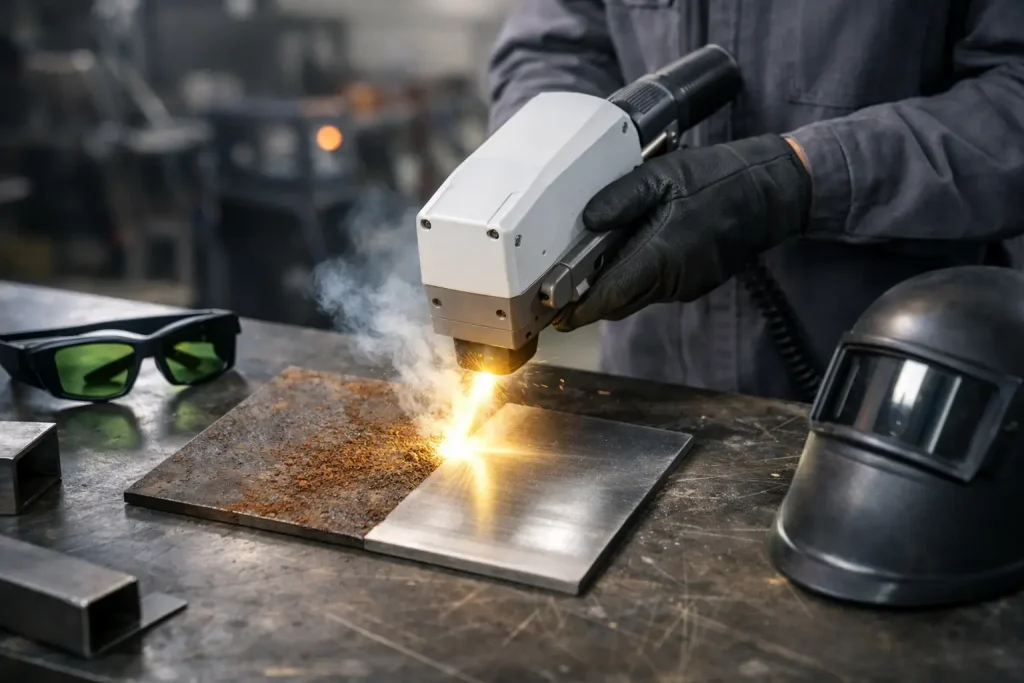
A fabricator can lose hours before a weld is even struck. Rust on plate, mill scale at the seam, oil on formed parts, or coating residue on reused components can slow production, create rework, and compromise quality. That is where laser cleaning for fabrication stands out – it gives shops and project teams a precise way to prepare surfaces without grinding away good material or creating the mess of blasting and chemicals.
For fabrication environments, surface condition is not a small detail. It affects weld integrity, coating adhesion, inspection readiness, fit-up quality, and overall throughput. When the cleaning method is too aggressive, the base metal pays the price. When it is too slow or inconsistent, schedules slip. Laser cleaning offers a different approach: controlled removal of contaminants, oxides, coatings, and residues while preserving the substrate underneath.
Why laser cleaning for fabrication is gaining ground
Most fabrication teams already know the limits of conventional cleaning. Abrasive blasting can be effective, but it often demands containment, cleanup, media handling, and added safety controls. Mechanical methods such as grinding and wire brushing are familiar, yet they can be labor-intensive and inconsistent from one operator to the next. Chemical cleaning may remove specific contaminants well, but it introduces disposal concerns, exposure risks, and additional process steps.
Laser cleaning addresses those pain points by using focused laser energy to ablate unwanted material from the surface. The process is selective. That matters in fabrication, where the goal is usually not to remove metal – it is to remove what should not be there. Rust, oxides, paint, grease, and residue can be targeted with a high degree of control, reducing the chance of substrate damage on critical parts.
This is one reason the method has become increasingly relevant for fabrication support, especially where quality requirements are high, access is difficult, or downtime is expensive. The benefit is not only a cleaner surface. It is a more predictable preparation process.
Where fabrication shops see the biggest value
The most obvious use case is weld preparation. Oxides, scale, and contamination near the joint can interfere with weld quality and lead to porosity, lack of fusion, or unstable arc behavior. Laser cleaning can prepare the seam area with precision, giving welders a more consistent starting point.
It is also useful after welding. Heat tint, oxidation, and localized discoloration may need to be removed for inspection, passivation steps, or final appearance. In these cases, a selective process is valuable because operators often need to clean the affected zone without disturbing adjacent surfaces.
Fabrication teams also use laser cleaning before coating. Paint systems depend heavily on surface cleanliness and profile conditions. While laser cleaning is not a one-size-fits-all replacement for every coating prep specification, it can be highly effective for removing rust, old coatings, and contaminants in targeted areas where blasting is impractical or excessive.
Another strong fit is rework and salvage. Components that have been stored outdoors, lightly corroded in transit, or contaminated during handling do not always need full abrasive treatment. Laser cleaning can restore these parts for fabrication or assembly while minimizing material loss.
Common fabrication applications
In practice, laser cleaning is often applied to structural steel, pipe spools, tanks, frames, stainless assemblies, machined components, and tooling. It is especially useful when the cleaning scope is localized, the substrate must be protected, or the work area cannot easily accommodate blasting operations.
For contractors and project managers, that flexibility can make a real difference on active sites. A targeted process with less secondary waste can simplify coordination around adjacent trades and reduce disruption to ongoing work.
What laser cleaning changes operationally
The technical result matters, but the operational impact is usually what gets attention from plant managers and fabrication leaders.
First, there is less secondary waste. Abrasive media, chemical residue, and contaminated cleanup materials create handling and disposal burdens. Laser cleaning largely avoids those issues. In environments where housekeeping, environmental control, and waste management affect project cost, this is a meaningful advantage.
Second, setup can be simpler. Fabrication teams do not always have the time or space to build enclosures, isolate blasting zones, or manage extensive cleanup before the next work step begins. Laser cleaning often reduces that overhead, which helps compress project timelines.
Third, the process is easier on the substrate. That is especially important for high-value assemblies, machined surfaces, thin materials, and parts with tight tolerances. A cleaning method that removes contamination without excessive abrasion supports better dimensional control and less avoidable rework.
Finally, it can improve safety conditions compared with chemical cleaning or heavy abrasive methods. Every worksite has its own risk profile, but reducing airborne media, hazardous chemicals, and manual grinding exposure is often a step in the right direction.
It is precise, but precision is not the same as speed in every case
This is where a realistic evaluation matters. Laser cleaning is not automatically the best answer for every fabrication job.
If the requirement is to clean a very large surface area quickly and the substrate can tolerate aggressive treatment, conventional blasting may still be more economical. If a specification calls for a certain anchor profile across broad coated surfaces, the selected prep method must match that requirement. Laser cleaning is highly effective, but application fit should drive the decision.
The best results tend to come when precision, selectivity, substrate protection, or reduced waste are priorities. For example, cleaning weld seams, removing localized corrosion, stripping coatings from defined areas, or preparing sensitive surfaces for inspection are all cases where laser cleaning often has a strong advantage.
The right question is not whether laser cleaning replaces every legacy method. It is where it improves quality, lowers total process friction, and reduces downstream risk.
How to evaluate laser cleaning for fabrication work
A sound evaluation starts with the substrate and the contaminant. Carbon steel, stainless steel, aluminum, and mixed assemblies all respond differently depending on the material condition, geometry, and required finish. The type of contamination also matters. Loose rust, adherent oxides, oil residue, paint, and layered industrial buildup each behave differently under laser ablation.
Next, look at the end requirement. Is the goal weld prep, coating removal, inspection access, cosmetic restoration, or contamination control before assembly? The acceptable cleanliness level, the amount of material to remove, and the tolerance for heat input or surface change all shape the right process window.
Production context matters as well. A fabrication shop may prioritize throughput and repeatability, while a field project may care more about access, mobility, and minimal disruption. In both cases, the cleaning method should support the broader workflow, not create a bottleneck.
This is where an experienced service partner adds value. Laser cleaning is highly controllable, but that control depends on using the right parameters for the job. Power settings, scan behavior, stand-off distance, and handling technique all influence the result. A specialist with field experience can assess whether the method fits the application and then execute it consistently.
Why experience matters as much as the technology
In fabrication, cleaning is tied directly to quality outcomes. If surface preparation is uneven, everything after it becomes harder – welding, coating, inspection, and final acceptance. That is why the service model matters just as much as the equipment.
A dependable partner does more than bring a laser system to site. They help define the cleaning scope, identify the required finish, account for substrate sensitivity, and align the work with production timing. In sectors such as construction and oil and gas, that practical understanding is essential because site constraints are rarely simple.
As Singapore’s first laser cleaning service company, BKR Engineering has built its approach around that kind of execution. The value is not only in controlled laser ablation itself, but in applying it where it solves real fabrication problems without adding unnecessary complexity.
A smarter option for the right fabrication tasks
Laser cleaning for fabrication is not about replacing every traditional prep method on principle. It is about using a more precise and cleaner process where precision, substrate protection, and operational efficiency matter most. For weld prep, coating removal, corrosion treatment, rework, and inspection access, it can remove a surprising amount of friction from the job.
For fabricators and asset teams under pressure to improve quality while controlling downtime and waste, that balance is hard to ignore. The strongest results usually come from matching the method to the task, then executing it with care. When that happens, surface preparation stops being a recurring problem and starts supporting the pace and quality the rest of the project demands.