
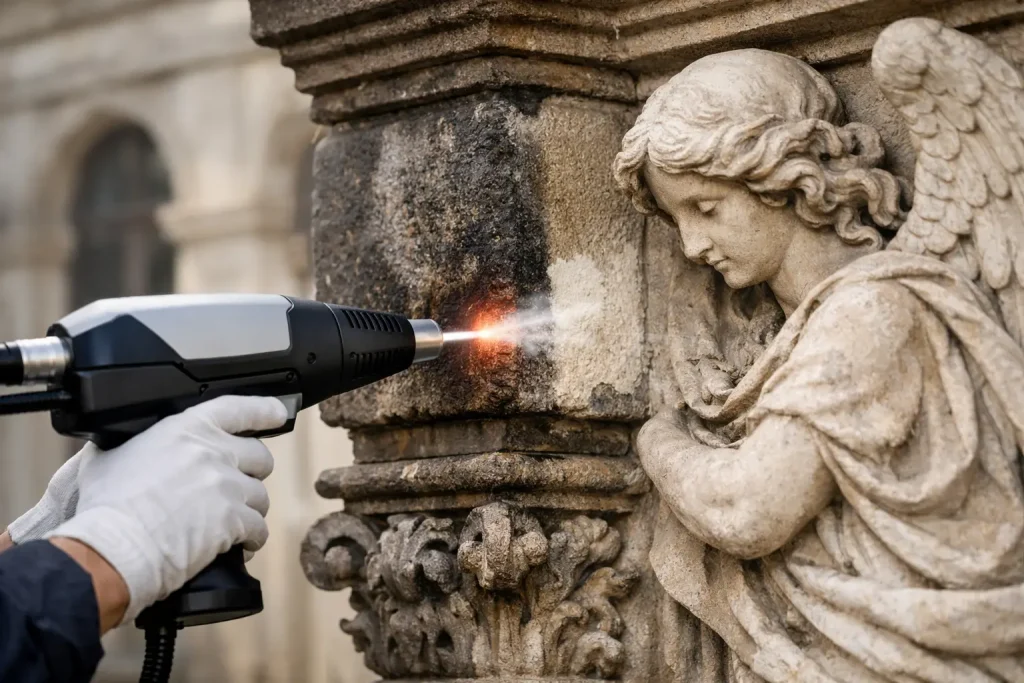
A carved stone façade, a cast-iron gate, or a painted timber detail can lose decades of character under soot, corrosion, failed coatings, and urban grime. The challenge with laser cleaning for heritage restoration is not simply making a surface look better. It is removing contamination with enough control to preserve what makes the asset historically significant in the first place.
That is where project teams need more than a cleaning method. They need a process that respects substrate condition, surface fragility, access limitations, and conservation intent. In heritage work, aggressive cleaning can do more harm than the contamination itself. The right approach is selective, measurable, and tailored to the material in front of you.
Why laser cleaning fits heritage restoration
Laser cleaning uses controlled laser energy to ablate unwanted surface layers such as soot, corrosion, aged coatings, biological residue, and environmental deposits. Because the process can be finely adjusted, it gives restoration teams a level of selectivity that is difficult to achieve with abrasive blasting or chemical stripping.
For heritage assets, that selectivity matters. Historic stone, brick, bronze, copper, wrought iron, and timber often have uneven aging, previous repairs, and delicate surface features. Decorative profiles, inscriptions, tooling marks, and original finishes can be easily compromised if the cleaning method is too aggressive. Laser cleaning allows operators to target contaminants while minimizing impact on the underlying substrate.
This does not mean it is the automatic answer for every restoration project. Heritage materials vary widely, and contamination layers can behave differently from one surface to another. Still, when substrate preservation is the priority, laser cleaning is often one of the most controlled options available.
What laser cleaning for heritage restoration can remove
The value of laser cleaning is easiest to understand when the contamination is visually distinct from the base material. On many heritage projects, that includes black crusts on stone, rust on metalwork, flaking paint on architectural features, and carbon staining from fire or pollution.
On metal elements, laser cleaning can remove corrosion, oxides, and failed coatings without the profile damage associated with mechanical abrasion. This is especially useful on gates, railings, structural connections, plaques, and ornamental ironwork where preserving edges and details is critical.
On masonry and stone, the process can help reduce surface deposits and localized staining with a high degree of control. However, stone cleaning always requires careful testing. Not every deposit should be fully removed, and not every stone type responds the same way. Porosity, mineral composition, prior treatments, and weathering all affect the right laser settings and cleaning strategy.
Painted heritage surfaces are another area where precision matters. In some cases, laser cleaning can remove later overpaint or deteriorated coatings while preserving stable underlying material. In others, traditional hand methods or hybrid approaches may still be more appropriate. The correct answer depends on the stratigraphy of the coating system and the conservation objective.
Where traditional methods fall short
Abrasive blasting is effective in heavy industrial cleaning, but heritage substrates often cannot tolerate that level of mechanical impact. Soft stone can lose surface character. Ornamental metal can lose crisp definition. Timber can be gouged or roughened. Once original material is removed, it cannot be put back.
Chemical cleaning has its own limits. Residues must be managed carefully, runoff can create environmental and compliance concerns, and the chemistry may react unpredictably with aged or porous materials. On occupied sites or public-facing heritage properties, chemical handling and containment can also complicate logistics.
Manual methods remain essential in restoration, but they can be slow and inconsistent on larger areas or difficult geometries. When project teams need controlled cleaning with less secondary waste and a lower risk of substrate erosion, laser cleaning becomes a practical alternative.
Precision is the real advantage
The strongest case for laser cleaning in heritage work is precision. Operators can adjust energy levels, pulse characteristics, scan width, and working distance based on the material and contaminant layer. That level of control supports gradual cleaning rather than forced removal.
For owners and consultants, this translates into better decision-making on site. Small test patches can establish the acceptable cleaning level before full-scale work begins. Results can be reviewed visually and adjusted in real time. If one section of a façade has a different weathering pattern or repair history, the method can be adapted rather than applied uniformly across the whole asset.
That flexibility is important because heritage restoration is rarely uniform. A single building elevation may include areas of dense pollution staining, sheltered sections with biological growth, repaired mortar, exposed metal anchors, and original carved features. A one-speed cleaning method often creates unnecessary risk. Laser cleaning supports a more selective workflow.
Operational benefits beyond conservation
Preservation is the first concern, but operational factors matter too. Heritage projects are often carried out in active public spaces, mixed-use buildings, or live facilities where access, containment, and downtime affect cost as much as cleaning speed.
Laser cleaning produces far less secondary waste than blasting or chemical stripping. There is no abrasive media to collect and dispose of, and no chemical sludge to manage. That can simplify site controls, especially in urban environments or enclosed interior restoration zones.
The method also supports cleaner work areas and reduced setup in locations where large containment systems are impractical. For contractors and asset owners, that can mean smoother coordination with other trades and less disruption to building occupants or surrounding operations.
In settings where inspection or recoating follows cleaning, precision also improves downstream quality. Removing contamination without scarring the base material gives conservators, painters, and repair teams a better surface to assess and treat.
The role of testing and method selection
Successful laser cleaning for heritage restoration starts with testing, not assumptions. Before any full application, representative sample areas should be evaluated to confirm how the substrate responds, what contaminants can be removed, and what finish is considered acceptable.
This is where technical experience matters. A blackened bronze plaque, a sandstone cornice, and a painted timber shutter may all sit on the same property, but they should not be approached the same way. Pulse settings, stand-off distance, cleaning speed, and pass count may all change from one element to another.
It is also important to define the restoration goal clearly. Some projects aim to expose original material. Others aim to stabilize the surface while retaining evidence of age. Overcleaning can reduce historical authenticity just as easily as undercleaning can limit performance. The best results come from aligning the cleaning method with conservation priorities from the start.
When laser cleaning is the right choice – and when it is not
Laser cleaning is well suited to projects where substrate protection, selective removal, and reduced waste are high priorities. It performs especially well on detailed metalwork, corrosion removal, localized coating removal, and controlled cleaning of sensitive architectural features.
That said, it is not a universal replacement for every heritage cleaning method. Large uniform areas with heavy deposits may still require a hybrid approach. Some porous or friable materials may respond better to lower-energy manual techniques. In multi-layer decorative systems, laboratory analysis and conservation input may be needed before any removal method is selected.
The most reliable project outcomes come from treating laser cleaning as a specialist process, not a generic shortcut. Used correctly, it can improve both conservation quality and site efficiency. Used without material understanding, it can miss the restoration objective.
For owners, consultants, and contractors managing heritage assets, that is the real decision point. The question is not whether the surface can be cleaned. It is whether it can be cleaned with enough control to protect the asset’s historical value while still meeting project demands for safety, schedule, and environmental responsibility.
That is why experienced service partners matter. Companies with field knowledge in precision surface preparation understand how to balance technical settings, substrate behavior, and project constraints. In specialist applications, including heritage work, BKR Engineering brings that practical discipline to laser cleaning so restoration teams can move forward with confidence.
Heritage restoration is rarely about making old surfaces look new. It is about removing what does not belong while keeping what still matters.