
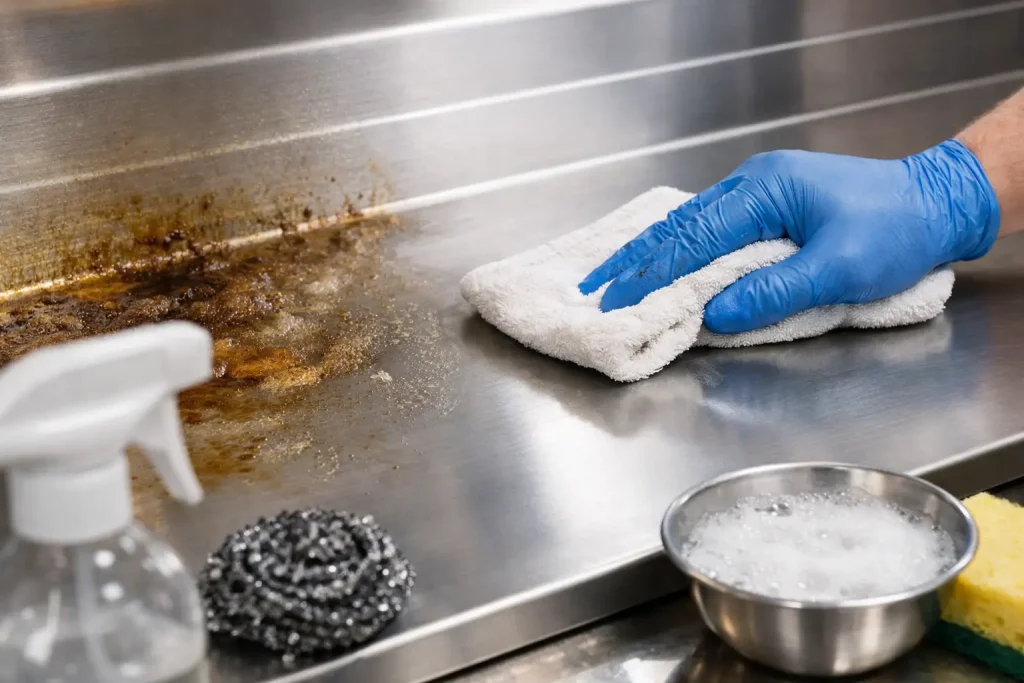
Grease on metal rarely stays a surface-level problem for long. In plants, workshops, buildings, and restoration sites, it blocks inspection, interferes with coatings, traps debris, and can turn a simple maintenance task into a larger reliability issue. If you need to remove grease from metal surface areas effectively, the right method depends on what the metal is, what comes next, and how much disruption your operation can tolerate.
A lightly contaminated stainless panel does not call for the same approach as an oil-soaked pump housing, structural steel near live equipment, or a heritage metal feature that cannot tolerate abrasion. That is where many cleaning decisions go wrong. The goal is not simply to make the surface look clean. It is to remove contamination without creating new damage, new waste streams, or unnecessary downtime.
Why grease removal matters more than it looks
Grease is often treated as a housekeeping issue, but in most operating environments it affects performance and decision-making. It can conceal corrosion, hide cracks, interfere with weld prep, and reduce coating adhesion. On parts scheduled for NDT, painting, refurbishment, or restoration, even a thin greasy film can compromise the next step.
This is especially relevant in oil and gas, fabrication, infrastructure maintenance, and property restoration. Teams are not just cleaning for appearance. They are preparing a surface for inspection, repair, coating, or preservation. If residue remains, the job is not finished, even if the metal looks acceptable from a distance.
The best way to remove grease from metal surface areas depends on context
There is no single best method for every asset. The right choice depends on four practical questions: how heavy the contamination is, how sensitive the substrate is, whether the work is done in place or off-line, and what follows after cleaning.
For example, solvent wiping may be adequate for light grease on accessible components before assembly. Alkaline washing can work for batch cleaning in controlled environments. Abrasive methods may remove contamination quickly, but they also change the surface profile and can spread debris. In many industrial settings, that trade-off is too expensive.
When the underlying metal must be protected, surrounding areas must remain clean, or shutdown windows are tight, more controlled cleaning methods become important.
Common grease removal methods and their trade-offs
Solvent cleaning
Solvents are widely used because they cut grease quickly and are familiar to maintenance teams. For small areas or localized contamination, they can be practical. The limitation is residue management, worker exposure, flammability, and the need to collect and dispose of contaminated materials properly.
Solvents also tend to move grease around unless the wiping process is controlled. On textured or uneven surfaces, they may not fully clean pits, edges, and tight geometries.
Detergent or alkaline cleaning
Water-based detergents and alkaline cleaners are often used where environmental controls are stronger and parts can be rinsed and dried properly. They can be effective for general degreasing, especially in workshop settings.
The challenge is that rinsing, wastewater handling, and drying are not minor details. In field conditions, they can create a larger operational burden than expected. Flash rusting and moisture retention also need to be considered, particularly on carbon steel.
Abrasive cleaning
Abrasive blasting and mechanical scrubbing can remove stubborn contamination, but they do so by physically affecting the surface. That can be acceptable for some heavy-duty applications, yet it is not ideal where dimensional control, finish, or substrate preservation matter.
Abrasives also generate secondary waste and often require containment. In active facilities, setup time and cleanup can outweigh the cleaning speed itself.
Laser cleaning
Laser cleaning offers a different approach. Instead of blasting the surface or saturating it with chemicals, it uses controlled laser energy to remove contaminants selectively from the metal surface. For grease, oil films, oxides, and coatings, this can provide precise cleaning with minimal impact on the base material when the process is set correctly.
That matters in environments where substrate protection, housekeeping, and downtime are closely managed. Laser cleaning can be especially useful when you need a clean, inspection-ready, or coating-ready surface without the mess and disposal demands associated with many conventional methods.
When laser cleaning makes the most sense
If the surface must stay intact, laser cleaning deserves serious consideration. This includes machined parts, stainless steel, aluminum, welded assemblies, molds, tooling, and architectural metal elements where aggressive methods would leave visible or functional damage.
It is also well suited to areas where conventional cleaning creates access or containment problems. In operating plants and construction environments, extensive enclosure setup can delay work more than the contamination itself. A cleaner process with less secondary waste can improve both productivity and site safety.
Another advantage is selectivity. Not every job requires full-scale stripping. Sometimes the requirement is to remove grease from a specific band before inspection, a weld line before joining, or a localized patch before coating repair. Precision matters because overcleaning also has a cost.
How to assess a greasy metal surface before choosing a method
Before any cleaning starts, the surface should be evaluated with the end use in mind. The key questions are straightforward.
What metal are you dealing with – carbon steel, stainless, aluminum, copper alloy, or a plated surface? Is the grease light, baked-on, mixed with dirt, or combined with corrosion and old coatings? Is the part going back into service as-is, or is it being prepared for painting, welding, bonding, or inspection?
These questions determine whether a fast wipe-down is enough or whether you need controlled contaminant removal. They also influence risk. A method that is acceptable on structural steel may be completely wrong for a precision component or a heritage artifact.
Remove grease from metal surface without creating new problems
Many cleaning processes solve one issue and create two more. Chemical methods can leave waste and require ventilation. Abrasive methods can roughen the substrate or spread contamination. Excessive moisture can complicate drying and corrosion control. Even manual wiping can become inconsistent across large assets.
A better standard is to judge the method by the full job outcome. Did it remove the grease thoroughly? Did it preserve the substrate? Did it reduce downstream rework? Did it fit within site safety and shutdown constraints? Those are the metrics that matter to plant managers, engineers, and asset teams.
This is why controlled cleaning technologies are gaining traction across maintenance and restoration work. They align cleaning quality with operational demands instead of treating degreasing as an isolated task.
Where precision grease removal delivers the most value
In production support, clean metal surfaces reduce variability before welding, bonding, and coating. In maintenance, grease removal exposes the true condition of the asset so corrosion mapping and inspection can proceed accurately. In restoration, it protects delicate substrates while removing years of contamination.
The value is not only technical. Better cleaning choices can shorten outage windows, reduce waste handling, and improve worksite conditions. For organizations under pressure to meet safety and sustainability targets without extending project timelines, that matters.
For that reason, service-led laser cleaning is increasingly used where conventional degreasing is either too disruptive or too blunt. Companies such as BKR Engineering apply this approach in real operating environments, where precision and speed need to work together rather than compete.
A practical way to choose the right cleaning approach
If the job is small, low-risk, and easily isolated, a conventional degreasing method may be perfectly reasonable. If the surface is critical, contamination is complex, or downtime is expensive, the decision deserves a closer technical review.
Look at the substrate, the contamination type, the surrounding environment, and the required finish after cleaning. If preserving the metal is just as important as removing the grease, a non-abrasive and tightly controlled method will usually provide better long-term value than the cheapest immediate option.
Clean metal surfaces support reliable inspection, sound repairs, and longer asset life. The smartest grease removal method is the one that gets the surface ready for what comes next, without adding cost, damage, or delay.