
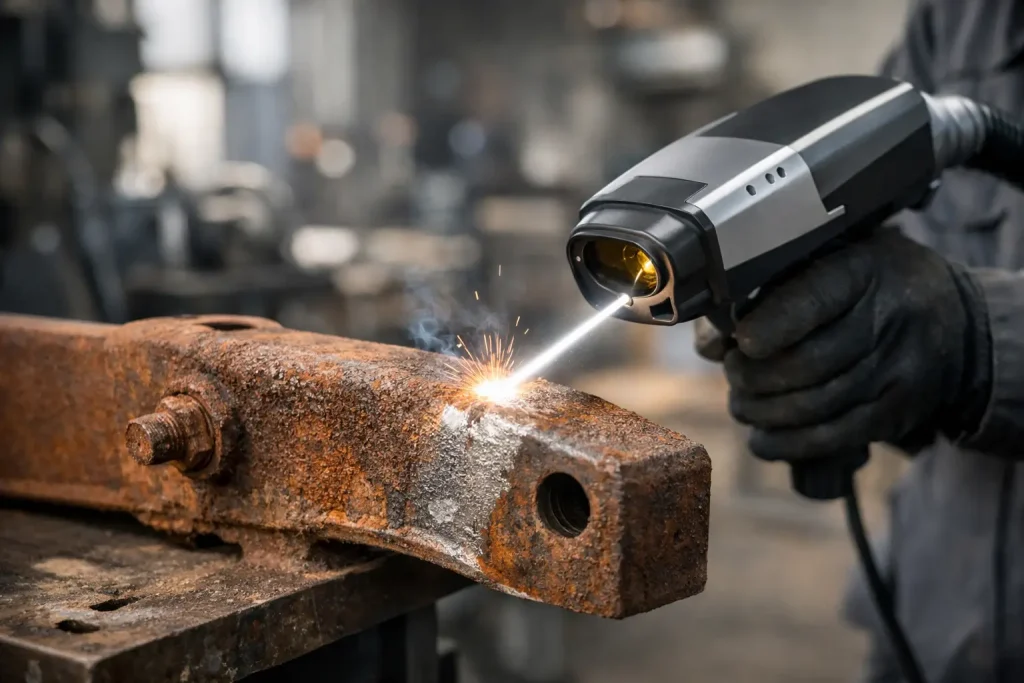
A corroded flange, a rusted steel beam, or oxidation around a weld seam can turn into a larger maintenance problem fast. The right laser rust removal service does more than improve appearance – it removes corrosion with control, protects the base material, and helps teams move into inspection, coating, or repair work without the mess and disruption of blasting or chemical cleaning.
For plant managers, contractors, and asset integrity teams, that difference matters. Surface preparation is rarely an isolated task. It affects shutdown duration, containment requirements, waste handling, worker exposure, and the quality of whatever comes next, whether that is NDT, repainting, fabrication, or restoration.
What a laser rust removal service actually does
Laser rust removal uses controlled laser ablation to remove corrosion, oxides, and other contaminants from a surface. The laser energy is absorbed by the unwanted layer and breaks it away from the substrate. When the process is set correctly, the underlying metal remains intact.
That level of selectivity is what makes the service attractive in high-value environments. Instead of attacking the entire surface aggressively, the cleaning process can target rust and contamination with a much lighter touch. On delicate substrates, machined parts, heritage elements, and precision components, that control is often the deciding factor.
This is also why laser cleaning is not just another version of abrasive blasting. Blasting is effective in many settings, but it is inherently aggressive, creates secondary waste, and often requires significant setup and containment. Chemical cleaning has its own place, but disposal, exposure risk, and residue management can add complexity. A laser-based process changes that equation.
Where laser rust removal makes the most sense
A laser rust removal service is especially useful when substrate protection is a priority. That includes structural steel with localized corrosion, equipment surfaces that need inspection prep, weld areas where precision matters, and components that cannot tolerate profile damage or media embedment.
In oil and gas, fabrication, marine-adjacent assets, and infrastructure maintenance, rust removal is often tied to uptime. If a method reduces cleanup, avoids blasting media, and limits the need for chemical handling, it can simplify the job well beyond the cleaning step itself. That can mean less interference with nearby operations and fewer site controls compared with more intrusive methods.
It also fits restoration work well. On heritage metalwork, decorative surfaces, and older assets with mixed conditions, the ability to remove corrosion selectively is valuable. The goal is not just to make the surface look clean. The goal is to preserve what should remain while removing what should not.
Why many operators are moving away from conventional methods
The case for laser cleaning usually comes down to operational trade-offs, not hype. Most maintenance teams already know blasting and chemical systems work. The question is whether those methods are still the best fit for the specific asset, environment, and project constraints.
A laser rust removal service reduces secondary waste because there is no abrasive media to collect and dispose of. It can also reduce setup requirements because blasting enclosures and large containment arrangements may not be necessary to the same extent, depending on the site and application. For facilities under pressure to improve housekeeping, safety, and environmental performance, that is a practical benefit.
There is also the issue of substrate damage. Abrasive methods can alter surface profile, remove base material, or affect adjacent areas if not carefully managed. Chemical methods may leave residues or require more post-cleaning controls. Laser cleaning offers a more precise path when the surface condition needs to be corrected without creating a new problem.
That said, precision is not the same as universality. Laser cleaning is highly effective, but the right answer still depends on coating thickness, contamination type, geometry, access, and production demands.
Laser rust removal service for industrial maintenance
In industrial settings, corrosion removal is rarely about cosmetics. It is about keeping assets serviceable, preparing surfaces for coating systems, and making inspections more reliable. Rust, oxide, grease, and old coatings can hide defects or interfere with downstream work.
A laser rust removal service supports maintenance programs by cleaning targeted areas without excessive disruption to surrounding equipment. On a shutdown or turnaround, that can help teams focus on the exact treatment zone instead of over-processing the wider area. On live or partially active sites, the cleaner work environment can also be easier to manage.
For weld preparation and post-weld cleanup, laser cleaning offers a controlled way to remove oxidation and surface contamination. For inspection preparation, it can expose the true surface condition with less risk of masking or distorting the base material. Those are meaningful advantages when decisions depend on what the cleaned surface actually reveals.
What affects performance on site
Not every rust removal job should be approached the same way. Surface condition matters. Light surface oxidation behaves differently from heavy scale. Flat plate is different from pitted steel, curved assemblies, or tight corners. Access constraints, mobilization limits, and required cleanliness standards also affect how the work should be planned.
This is why an experienced service provider starts with the application, not just the machine. Power level, scan settings, working distance, and process speed all need to match the substrate and contamination. The best results come from a controlled process, tested against the actual asset condition.
Project expectations matter too. If the goal is localized rust removal before repainting, laser cleaning may be ideal. If the asset has thick multilayer coatings over broad open areas, another method or a hybrid approach may make more commercial sense. Good technical advice includes saying when laser is the right fit and when it is not.
Safety, waste, and environmental impact
Maintenance decisions are increasingly shaped by EHS requirements, not just cleaning speed. A laser rust removal service can help reduce worker exposure to blasting media and chemical agents, while also cutting down waste streams associated with conventional surface prep.
That does not mean the process is casual or unregulated. Laser systems require proper controls, trained operators, and application-specific safety procedures. But from a project planning standpoint, many clients value the fact that they can avoid handling large volumes of spent media or hazardous chemical residue.
For companies with sustainability targets, this is more than a compliance issue. Waste reduction, lower cleanup burden, and more selective treatment can support better environmental performance without compromising cleaning quality. In sectors where documentation and client reporting matter, those gains are increasingly relevant.
Choosing the right laser rust removal service partner
The technology matters, but field execution matters more. A capable partner should understand corrosion, coatings, substrate sensitivity, and the realities of working around active operations, shutdown schedules, and permit controls. They should be able to explain what level of cleaning is achievable, how productivity will be managed, and where the process offers the strongest return.
Look for a provider that treats laser cleaning as a service solution rather than a gadget demonstration. That means evaluating the asset, confirming suitability, defining the cleaning objective, and aligning the work with downstream requirements such as coating adhesion, inspection readiness, or restoration standards.
This is where experience in industrial and construction environments makes a real difference. BKR Engineering approaches laser cleaning as a practical surface preparation service, built around precision, safety, and reduced disruption for asset owners and operators who cannot afford unnecessary damage or downtime.
When laser is the better decision
Laser cleaning tends to be the better decision when the value of control outweighs the appeal of brute force. If the substrate must be protected, if waste handling is a problem, if setup constraints are tight, or if the cleaned surface needs to support inspection or finishing work, the method becomes very compelling.
It is also a strong choice when clients want a cleaner process overall. Less mess on site, less secondary waste, and targeted removal can simplify execution in ways that are easy to underestimate at the planning stage. Often, the labor and disruption around the cleaning method matter just as much as the cleaning itself.
Rust removal is never just about taking corrosion off metal. It is about preparing an asset for what comes next, with as little compromise as possible. The best service is the one that gets the surface where it needs to be while protecting time, material, and the long-term value of the asset.